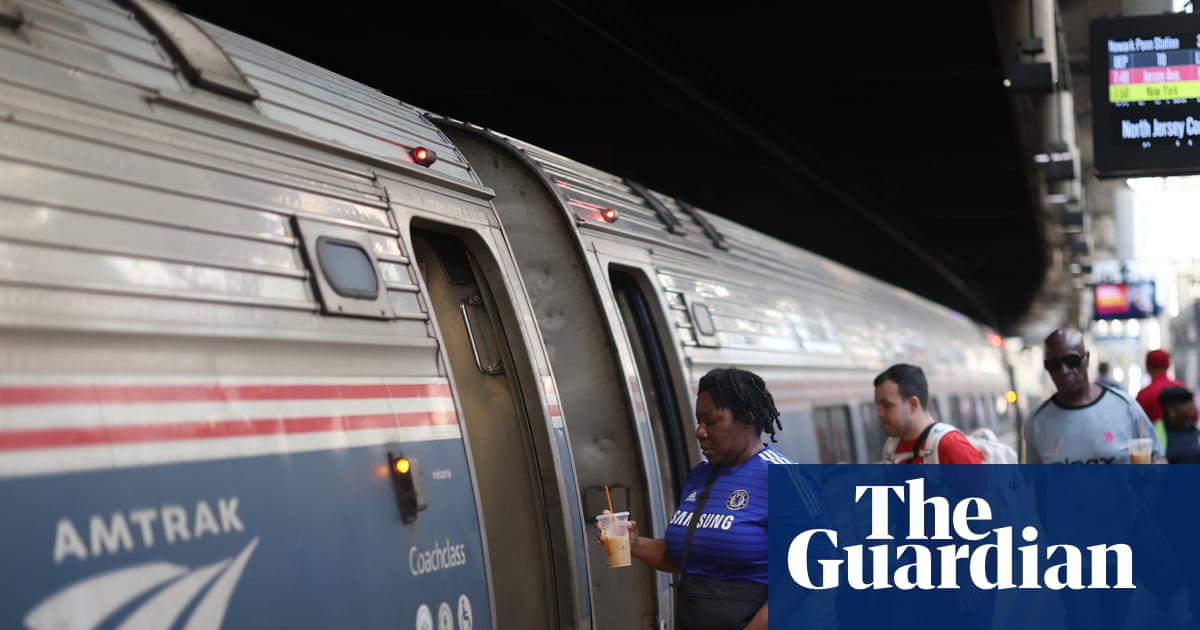
Sebastian Caillat didn’t know how fascinating the dental industry could be until he sat next to a dentist on an Amtrak ride from college in New York City to his childhood home in Washington DC in 2023. They spent the ride discussing the dentist’s efforts to self-fund his own practice. Caillat was surprised to learn the extraordinary cost of dental technology equipment – but also how interesting a conversation about dental technology equipment could be.
In Caillat’s view, that conversation represented the magic of Amtrak trains, a mode of transport that he says encourages social interaction. He also saw this dynamic play out last summer, when he rode from New York City to Philadelphia for a Club World Cup match between Palmeiras and Botafogo. Fans of the Brazilian clubs engulfed a train that traveled through New York City and New Jersey, an area home to more than 70,000 Brazilians.
“It was a really, really fun experience,” Caillat said. “Fans doing full chants on the Amtrak, banners waving, and flags. It got to the point where there was green powder dust floating around in the cabins.” He added that fans were respectful of other passengers, explaining to them why their train had become a giant futebol-fueled party.
For this summer’s World Cup, the 22-year-old soccer consultant is eyeing matches along Amtrak’s Northeast Corridor, which stretches from Washington DC to Boston, that he expects to recapture that spirit. He is looking forward to the match on 19 June in Philadelphia between Brazil and Haiti, who have qualified for the World Cup for the first time in 52 years. New York and New Jersey are home to more than 250,000 Haitians.
“Oh man, that is going to be an unbelievable public transportation experience,” Caillat said.
The world’s largest sporting event could bring as many as 10 million people to the US. It’s an enormous stage for a country not known for its passenger rail. While some of the 11 American host cities are better suited for train travel than others, Amtrak figures to play a big role in getting people from one city to another.
The World Cup, which begins 11 June and runs until 19 July, comes at a time when the national passenger rail carrier’s popularity is surging. Amtrak has broken ridership records two years in a row, reaching 34.5 million passengers last year – a 5% increase on the previous year’s mark.
But the system remains creaky. The company uses freight-owned rail lines in many parts of the country, rendering it unable to modernize and expand lines, or even run trains on its preferred schedule. It faces the potential of significant budget cuts under the Trump Administration. Meanwhile, the Northeast Corridor, where it does own the track, is near maximum capacity.
The World Cup is a huge test for the system’s capacity and reliability. Whether Amtrak passes will say a lot about the state of rail in the US.
The Northeast Corridor
Most of Amtrak’s ridership comes on the Northeast Corridor. The region saw 15 million riders in 2025 and operates around 150 trains per day. With 21 matches between Boston, New York/New Jersey, and Philadelphia, the 457mi stretch of rail will be a popular, convenient option for matches. Even a fan in Washington DC, which is not hosting any World Cup matches, could use the train to get to Philadelphia in about two hours or New York in about three hours.
The Cascades route connects Pacific Northwest cities, including two trains per day from Seattle to Canadian host city Vancouver. Seattle Stadium is well-situated for rail travelers, sitting less than a 10-minute walk from King Street Station. According to W Kyle Anderson, the company’s World Cup co-lead, Amtrak is seeing increased bookings out of Seattle and Vancouver around World Cup gamedays. Someone in Portland, which is not a World Cup host city, could reach Seattle in three hours by train.
“This is our opportunity to show why the Northeast Corridor, in particular, or the Cascades in the Pacific Northwest, are known for being America’s best railroad corridors,” he said.
Amtrak has been working to get its operation ready. Anderson said Amtrak has spent $30m fixing up tracks, catenary wires, and other infrastructure on the Northeast Corridor – one of the only sections of rail owned by Amtrak – for the World Cup. It also opened its first track on the Portal North Bridge in New Jersey this spring, replacing a 116-year-old bridge.
Even as the Northeast Corridor operates near capacity of over 2,000 trains per day on some portion of the line, Amtrak is finding ways to squeeze every ounce of productivity out of its tracks. It introduced new trains last year on Acela, its faster service in the northeast, that can hold about 27% more passengers, plans to add coach cars to some Northeast Regional trains this summer, and ensured construction work won’t impact operations on gamedays. It has also reconfigured seating on Northeast Regional trains, which allowed for increased train frequency.
The scale and cost of transport have been significant issue in the runup to this World Cup. NJ Transit plans to sell 40,000 round-trip tickets from New York to MetLife Stadium per match. At $98 – a decrease from their original $150 – the NJ Transit matchday tickets are more expensive than some matchday Amtrak roundtrip trains from DC to New York at time of writing.
Amtrak’s dynamic ticket pricing has been a point of contention among riders. However, rail travel is often the more affordable option compared with air travel and driving. As gas prices increase due to the war in Iran, Amtrak and Brightline, a privately-operated rail route in Florida, have seen ridership increase. As of early May, fans could take Amtrak from DC to New York same-day roundtrip on 19 July to see the World Cup final for $160 ($177 for a flight).
Brightline can transport fans from Orlando, which is not a World Cup host city, to Miami in less than four hours, making it time competitive with driving. Ticket costs are around $260 ($287 for a flight) from Orlando to Aventura Station near Miami Stadium for same-day round trip tickets for the third-place game on 18 July. While similarly priced to flights, the trains are pricier than a high-speed train from Shanghai to Beijing, which typically costs about $80 and covers more than 800mi in around four hours and 30 minutes.
Anderson said Amtrak’s ticket pricing structure, which is based on demand, won’t change for the World Cup.
“We’ve really been treating it like Thanksgiving,” Anderson said. “Thanksgiving is Amtrak’s busiest time of the year. We move so many people from that Monday before Thanksgiving all the way through Sunday afterwards.” While trains don’t typically sell out during Thanksgiving, Amtrak is still encouraging customers to book trips as early as possible for the World Cup.
Adie Tomer, senior fellow at Brookings Metro, said there will be some natural balancing. While Amtrak hasn’t recommended regular travelers in the northeast pursue alternative options – NJ Transit did when announcing its World Cup plans – they may end up avoiding the train during the event. Tomer added that this is a unique World Cup.
“With how big the country is compared to most host countries, this is going to be nothing like traveling for other major global soccer events,” he said. “People keep making this comparison to the Olympics. I would throw all those out. That’s ridiculous. That’s a one-city thing.”
Tomer added that travelers make rational decisions based on time and money, and rail in the US – a country that has prioritized investments in air and car travel – can’t always compete.
Beyond the northeast
Indeed, as service in the northeast has advanced, it has lagged in much of the rest of the country. Multiple Amtrak routes have been cancelled since the US last hosted the World Cup in 1994. Dallas and Houston – two cities separated by 250mi and set to host a combined 15 matches – had a direct Amtrak route that took six hours in 1994. That route was cancelled in 1995. It now takes about 23 hours to get between the cities by train. On the west coast, a ride from Los Angeles to Seattle is doable, said Sean Jeans-Gail, the vice-president of government affairs at the Rail Passengers Association. At 34 hours, though, he says it is an “acquired taste”.
Anderson said Amtrak has “applied an aggressive fleet preparedness approach leading up to Summer 2026”, including train set health assessments, additional inspections and preventative maintenance. However, given the age of the equipment, failure is always a concern, according to John Robert Smith, who served as chair of Amtrak’s board of directors from 2001 to 2003.
“It just saddens me to think of the impact passenger rail could have, if this country had invested in passenger rail the way it should have over the years,” Smith said.
Smith, now a senior policy advisor at Transportation for America, said the service could perform much better with upgraded fleets and equipment.
“Amtrak is doing all that it can do at this time to prepare itself to be an option for our guests to use for the World Cup,” he said. “Their ability to respond is constrained by the total lack of additional equipment that you would normally put into service to increase your ridership and revenue” during an event like the World Cup.
Jeans-Gail said Congress consistently gives Amtrak less than it requests. For example, it received $2.4bn in fiscal year 2023 when it requested $3.3bn. The agency has faced additional headwinds under the Trump administration, with a recent report showing the White House’s proposed 2027 budget would slash passenger rail funding by 82%.
In Jeans-Gail’s view, the USDOT and Amtrak could have accelerated certain projects in time for the World Cup. For example, new Siemens-made Airo trains with greater capacity won’t roll out in the Pacific Northwest until after the tournament.
Kansas City is looking for a temporary fix. The Missouri Department of Transportation, Amtrak and Union Pacific, which owns the railroad, are adding cars to two trains in both directions during the World Cup. Deborah Fischer Stout, executive director of the Northern Flyer Alliance, a group advocating for passenger rail on the I-35 corridor, would like to see state departments of transportation go a step further and run trains from Kansas City to Dallas during the World Cup.
“I don’t see what’s holding them back other than vision,” she said.
On the west coast, California has been investing in passenger rail, including added service to the Pacific Surfliner in southern California. However, it takes roughly nine hours to get between LA and San Jose on Amtrak, despite the state’s decades-long effort to build a high-speed rail line that would connect the San Francisco Bay Area and LA in less than three hours.
Meanwhile America’s peers, such as the Britain, France, Germany and Spain, have far superior systems, with all having recently hosted large-scale sporting events, or are due to soon. A person could take a three-hour train from Barcelona to Madrid – roughly the same distance as San Francisco to LA –– for around $100 on average. “Peer countries tended to better maintain their network and fund operators than the US did throughout the middle to end of the 20th century,” Tomer said. He added that private freight companies own most of the rail in the US and prioritize freight over passenger rail traffic. “It’s typically the reverse in other countries,” he said.
But it’s not all bleak. The 2021 Bipartisan Infrastructure Law invested $66bn in passenger rail and is beginning to have an impact. Amtrak fully electrifying the Northeast Corridor in 2000 has largely been a success. Brightline launched a higher speed train from Miami to Orlando in 2023, and aims to complete its LA-to-Las Vegas bullet train by 2029. Amtrak’s Mardi Gras line connecting New Orleans and Mobile, Alabama, smashed ridership expectations. States such as Minnesota, Virginia and North Carolina are breaking records too.
The fan experience
All of this means that the experience using rail for this summer’s World Cup will come down to which country you support. Danny Navarro parses World Cup transportation options for followers of his TravelFutbolFan social media accounts. After attending the 2022 World Cup in Qatar where matches were at most 45 miles apart, he wondered how a continental tournament might play out.
“I had a suspicion that fans were going to have trouble navigating the space,” he said.
Navarro lives in DC and supports Colombia. He was “begging” for the team to land in Group I, which would have meant matches in the Northeast Corridor.
“It would have been fantastic on the Amtrak,” he said. “I would have been your No 1 proponent after Joe Biden.” The former president is famously a prolific Amtrak user, taking it from DC to his home state of Delaware.
Instead, Colombia are in Group K with matches in Miami and Mexico. Nonetheless, Navarro is advising fans supporting teams playing in the northeast to use Amtrak. France play in Boston, New York and Philadelphia. While it’s not the Train à Grande Vitesse that zips riders from Paris to Marseille in less than four hours, Amtrak will likely be the most convenient travel option for Les Bleus. It could be the most entertaining travel option, too.
“I highly anticipate the French fanbase to basically paint those trains blue,” Navarro said.