A recent report from the Commonwealth Fund ranked Arkansas dead last in health system performance for Hispanic residents.
The Natural State was given a third percentile score for Hispanic groups’ healthcare quality, 50th among the District of Columbia and states with available data — well below neighboring Louisiana and Missouri, who both finished above the national median.
Hispanic Arkansans also ranked 49th for healthcare access (behind Georgia), another of the three categories in which overall rankings were determined.
“When this report these major disparities for Latino families in Arkansas, what it shows is the health system is not working for everybody,” said Camille Richoux, health policy director for Arkansas Advocates for Children and Families. “That has consequences for children’s health, their readiness for school, the financial stability of their family and their long-term well-being.”
The report’s authors used standardized scores for 24 indicators, broken down further by state and race or ethnic group. Those indicators were separated into three categories — outcomes, care access and “quality and use of health care service” — and combined within categories to give summary rankings.
Among the most worrying health indicators in the report is data on insurance rates — 35% of Hispanic Arkansas adults between 19 and 64 were uninsured (compared to 23% nationally), along with 14% of children 18 or younger, above the 10% U.S. average.
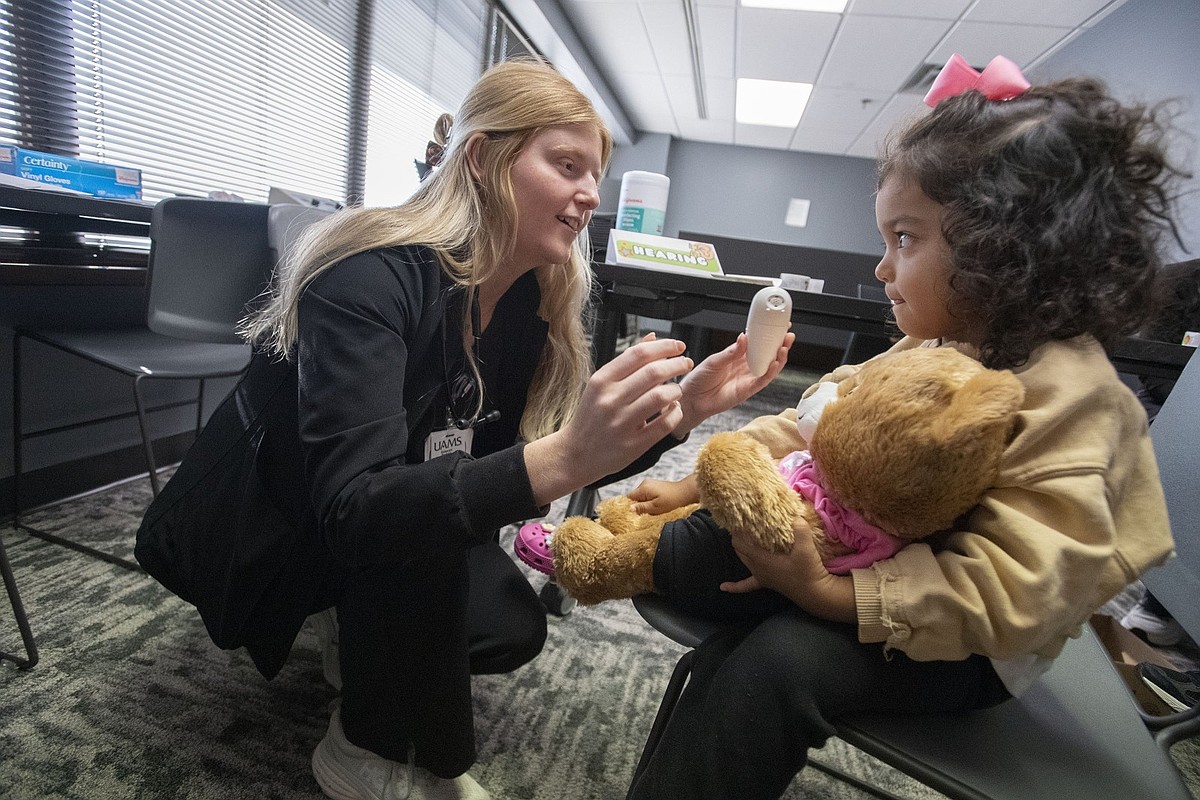
According to the report, Hispanic children in Arkansas were struggling in areas where other ethnic groups performed close to or better than the national average. Less than 58% of Hispanic children in the state between 19 and 35 months had all recommended vaccines, below the approximately two-thirds national average.
By comparison, the vaccination rate for Black children between 19 and 35 months in Arkansas was listed at 80%, 13 percentage points above the rate for Black Americans and better than every state except North Carolina and Ohio.
The state’s 71% early childhood vaccination rate for white children was close to the national average.
Several measures for older Arkansans were also below national standards. Only 58% of Hispanic women in Arkansas between ages 50 and 74 have received mammograms in the past two years, the report said, compared to 76% across the country. In addition, 34% of adults between ages 45 and 75 had a recent colon cancer screening, a statistic that rose to 51% across the U.S.
Mireya Reith, founding executive director of Arkansas United, said Hispanic people in all states may deal with language issues or other systemic barriers to participation in the healthcare system.
Those in Arkansas often deal with additional hurdles, such as a lack of safety net programs for immigrants or fewer bilingual health specialists.
“Even at the time of (COVID-19) and beyond, we really haven’t gotten past, for many of our Hispanic community, a kind of awareness or culture of getting general health tests and supports,” Reith said. “There’s a pretty deep awareness that there’s challenges.”
Reith said similarly low rankings in Oklahoma and Mississippi were unsurprising, as many access-related health issues in the region can’t be solved by crossing state lines. About 40% of the Arkansas immigrant community lives in areas with fewer than 8,000 people, she noted, another confounding factor.
According to Reith, there’s also concerns about engaging with institutions within Arkansas Hispanic communities, especially those who are first-generation immigrants, because “there’s news coming out every single day that they don’t know if it relates to them or not.”
The hesitancy extends to some residents with citizenship or green cards, she added — not only on their own behalf, but also because they may be living with a family member or partner without the same legal status.
Despite challenges in the access and quality sections, Hispanic people in Arkansas were ranked sixth in health outcomes, a seemingly paradoxical result that Michael Niño, an associate professor at the University of Arkansas, Fayetteville’s department of sociology and criminology, called the “Hispanic health advantage.”
The same patterns often show up on a national scale, Niño said, with researchers having tried to determine the mechanisms for “some time.”
“We do know there are generational differences, where folks born outside of the United States and moved to the U.S. have healthier profiles than children of immigrants on the whole,” he said. “And then children of immigrants generally have better health profiles than folks who were born in the U.S. to U.S.-born parents.”
Niño explained the higher outcomes could also be related to behavioral health, such as physical activity or eating less-processed foods, as well as the “salmon bias effect” — the idea that “immigrants may emigrate (back) when they develop poor health,” according to a 2022 article in the European Journal of Public Health.
The professor also said the ways in which Hispanic Arkansans interact with care systems in the state depends on where they live. Citing data from the Arkansas Health Survey, a tool which he worked on, Niño claimed the large proportion of Hispanic people in Springdale, living near areas experiencing economic and social growth, were engaging with healthcare differently than those living in southern, agriculture-focused regions.
Recently, Arkansas has seen much of its internal migration from Texas and California, strongholds with large Hispanic contingents, Niño said. When those people move to new areas, he suggested, the infrastructure might not be there yet.
The Commonwealth Fund report’s authors offer a number of suggestions for reducing racial health disparities across the United States.
Noting that predominantly Hispanic and Black communities often lack primary care providers and high-quality facilities compared to white areas, the report suggests bolstering pipelines into physician and health roles across racial backgrounds, updating licensing standards to allow practice in multiple states and offering financial incentives, such as raised reimbursement rates or loan repayment, to providers in underserved areas.
The authors also stressed the need to address “health-related social needs,” such as housing, transportation and public benefits — childcare subsidies and the federal Supplemental Nutrition Assistance Program, for example.
Reith said creating medical pipelines and financial incentives could be particularly effective.
“I think we have an opportunity to (involve) that in how we approach our workforce strategies here in Arkansas,” she said.