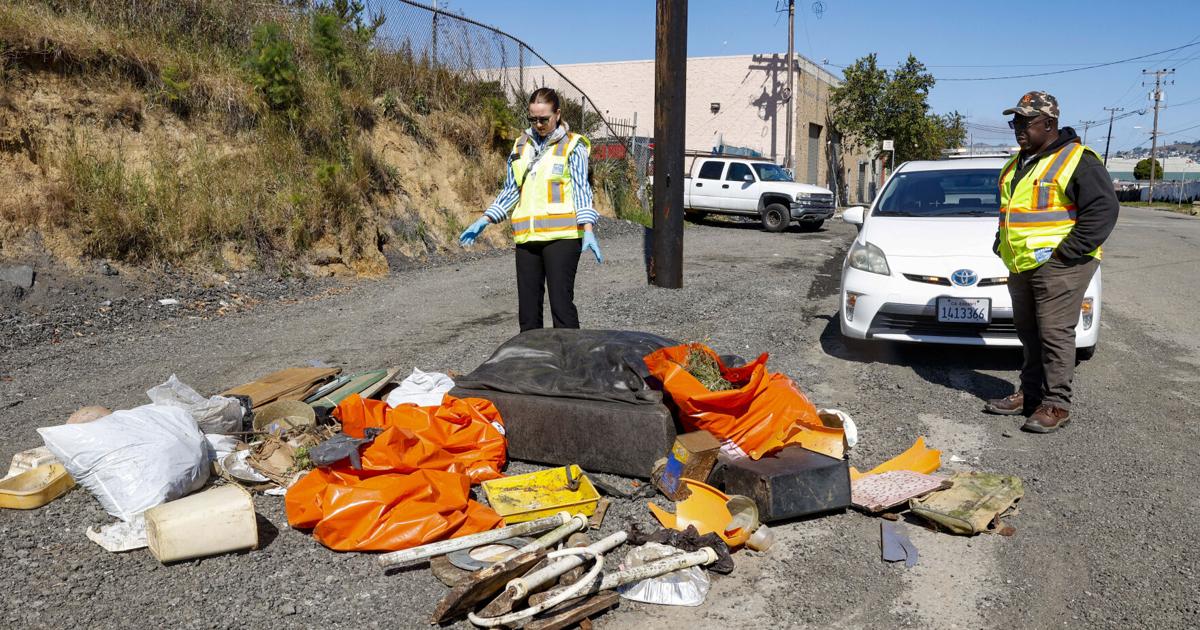
Mary Revelli said she planted flowers to beautify a wedge of land on a corner of the 900 block of Palou Avenue in San Francisco’s Bayview-Hunters Point, where she runs her custom metal-fabrication studio, One Off Furniture
But she said she’s largely abandoned the effort because the site is so affected by illegal dumping.
“We had to stop the garden because there’s so much trash,” Revelli said. “We cleaned it out many, many times, and every time we get it cleaned out, a new bunch of trash, plastics and stuff goes in there.”
San Francisco Public Works — which teamed with city refuse contractor Recology to pick up an average of more than 5,000 pounds per day of illegally dumped garbage in the Bayview last year — wants that pattern to change.
The agency is seeking approval from the Board of Supervisors for expanded use of surveillance technologies such as license-plate readers, video cameras and drones to deter people from using areas such as the largely industrial one where Revelli has done business for the last 20 years — a neighborhood that also contains many homes — as garbage receptacles.
“We want violators who dump garbage in San Francisco, or violators who come to San Francisco to dump their garbage on our streets, to know that with this technology we will catch you, we will find you, and we will publicly shame you — with safeguards, of course,” said Esther Lee, the agency’s government-affairs liaison, during a Board of Supervisors committee hearing Thursday.
The committee sent the matter to the full board with a recommendation for approval.
Public Works is seeking approval for its plans in accordance with The City’s surveillance policies. Access to data would be restricted to specific employees, and raw data would be retained for a maximum of 30 days, Lee said.
“We intend to utilize this technology to catch violators in the act and cite them for their illegal activities,” Lee said.
Fines typically start at $250 and can run as high as $1,000 per incident, though department officials might seek to increase that amount.
As part of its policy request, Public Works is asking for authority to use surveillance data for “publication, education and promotion,” Lee said, “because we do plan to put this on our website and on social media.”
Lee said part of the motivation for publicizing the department’s efforts was an attempt to warn off out-of-town opportunists.
“We plan to shame these people coming into San Francisco and dumping their trash onto our streets,” Lee said.
Illegal dumping is not at all unique to San Francisco, and governments far and wide are looking for innovative ways to prevent it, said Rachel Gordon, the agency’s director of policy and communications. Crews from Public Works and Recology work jointly and separately collecting millions of pounds of abandoned trash each year.
Public Works has previously used license-plate readers on a pilot basis, but it stopped doing so because alone they were insufficient, Gordon said. The department determined that it needs to combine license-plate cameras with video cameras in order to connect people doing illegal dumping with vehicles, she said.
Public Works also already uses drones for some purposes, such as surveying construction sites. The devices could be used to locate illegal dump sites in addition to enforcement, Gordon said.
Shannon Sweeney, a Public Works outreach coordinator, said she currently relies on private security cameras for video evidence, and through her department she can get license-plate information from the state Department of Motor Vehicles.
One of three Public Works “trash detectives,” Sweeney seeks tips from people before she puts on latex gloves to comb through trash piles looking for clues. She photographs items such as letters and bills bearing names and labels with company logos, to identify potential illegal dumping culprits, often via the Internet.
Sweeney said she sometimes works in tandem with a team of cleanup workers that proactively scours much of the southeastern part of The City five days per week, cleaning illegal dump sites.
“Our staff gets frustrated having to go back to the same corner constantly — and as soon as they pick up a bag, there’s another bag added,” Sweeney said.
At the same time, she said, it’s important to clear sidewalks that disabled pedestrians might use.
Sometimes the offenders are from nearby residences. Sweeney lets unaware people know that businesses and residences are required to have garbage service.
Sweeney said that one day, she was writing a citation for a home when a woman connected to the residence approached and said she thought it was okay to leave garbage outside for The City to collect.
On another occasion, a resident responded to Sweeney’s knock at the door by signing her sons up for The City’s Adopt-A-Street program.






“I just don’t think they always realize the impact they’re having by leaving trash out,” Sweeney said.
Sweeney said that typically, she’ll give increasingly stern warnings for the first couple of violations, but she’ll often issue fines for third offenses. If a suspected offender can prove they hired a commercial waste hauler, Sweeney will send the citation to the hauler. Serious cases are referred to the City Attorney’s Office for further action.
The department recently sent a $750 fine and a $1,000 fine to JAHnetics — a San Francisco-based marijuana cultivation, manufacturing and retail delivery business — after Sweeney found plants and dirt dumped in the Bayview on several occasions, Sweeney said.
Ramses Alvarez, a Public Works community engagement manager, said that the owner denied responsibility at first, but admitted guilt once confronted with the evidence collected. That case was referred to the city attorney.
“He said, ‘I’m sorry; it’s just very expensive to dump in San Francisco. I’m trying to make this business work,’” Alvarez said. “With all due respect, that’s not an excuse.”
A man who answered the phone number listed for JAHnetics but wouldn’t give his name said sometimes people “deceive,” taking money for hauling material but dumping it in the streets instead.
“It’s all done correctly at this point,” he said. “All of those lessons have been learned. I’ve already suffered enough from all of that.”
He said he now contracts for waste service from Recology, which he said was expensive.
“If they would allow San Franciscans to just go dump stuff for free, it would eliminate illegal dumping,” he said. “It’s not that people want to litter. It’s that they don’t want to pay.”
In fiscal 2024-25, Public Works logged nearly 500 illegal dumping citations with fines totaling almost $117,000, according to agency data. It has counted 434 citations with fines of more than $116,000 since July 1, 2025.
Sweeney said she thinks The City fielding its own cameras and license plate readers together “would be such a big game changer, because a lot of it happens after work hours.”
Gordon said that Public Works has conducted undercover stings, but such operations can be time-consuming and sometimes fruitless. But at one point in the past year, plainclothes personnel spotted people in Chinatown putting trash bags in the street from businesses and single-room-occupancy hotel residences, she said.
“There are a lot of different tools that we’re trying to use, but at the end of the day, it’s people not doing the right thing,” she said. “It’s behavior. All of it stems from behavior.”
On Palou Avenue, Revelli said the problem of dumping is multifaceted, in part because of homelessness and people living in recreational vehicles.
Sweeney said she has been ramping up her efforts to coordinate with multiple other city agencies in an attempt to effect lasting changes, whether it be by helping people get housed or removing abandoned vehicles.
A recurrent problem for Revelli is that people collect copper wires and burn the plastic casings off in order to sell the metal within, a process that sends toxic smoke wafting into her business.
She said a man was doing just that near her studio recently next to a large mound of garbage that a city front loader subsequently scooped up. The detritus strewn around a stripped automobile frame was surrounded by multiple trucks, vans, recreational vehicles and rubbish piles.
Revelli said that abandoned waste triggers other cascading problems.
“The illegal dumping leads to illegal burning leads to rodents and toxins leaching into the waterway,” she said. “When you get one person dumping, then everybody else thinks that that’s the spot to dump.”
Revelli said she suspects that a business that cleans out apartments has been frequenting her corner because the materials regularly deposited there have included large items, such as mattresses, desks and filing cabinets.
“We’ve been trying to be very diligent about keeping it clean, doing everything we can,” Revelli said, estimating that she calls The City almost every other day. “But it’s just such a waste of The City’s resources.”
Alvarez said there are a lot of “hurdles in San Francisco to make a program like this come to fruition, mostly because San Francisco is a city that really values our civil liberties.”
“We truly are just looking for bad actors,” he said. “We just want to keep the streets clean.”