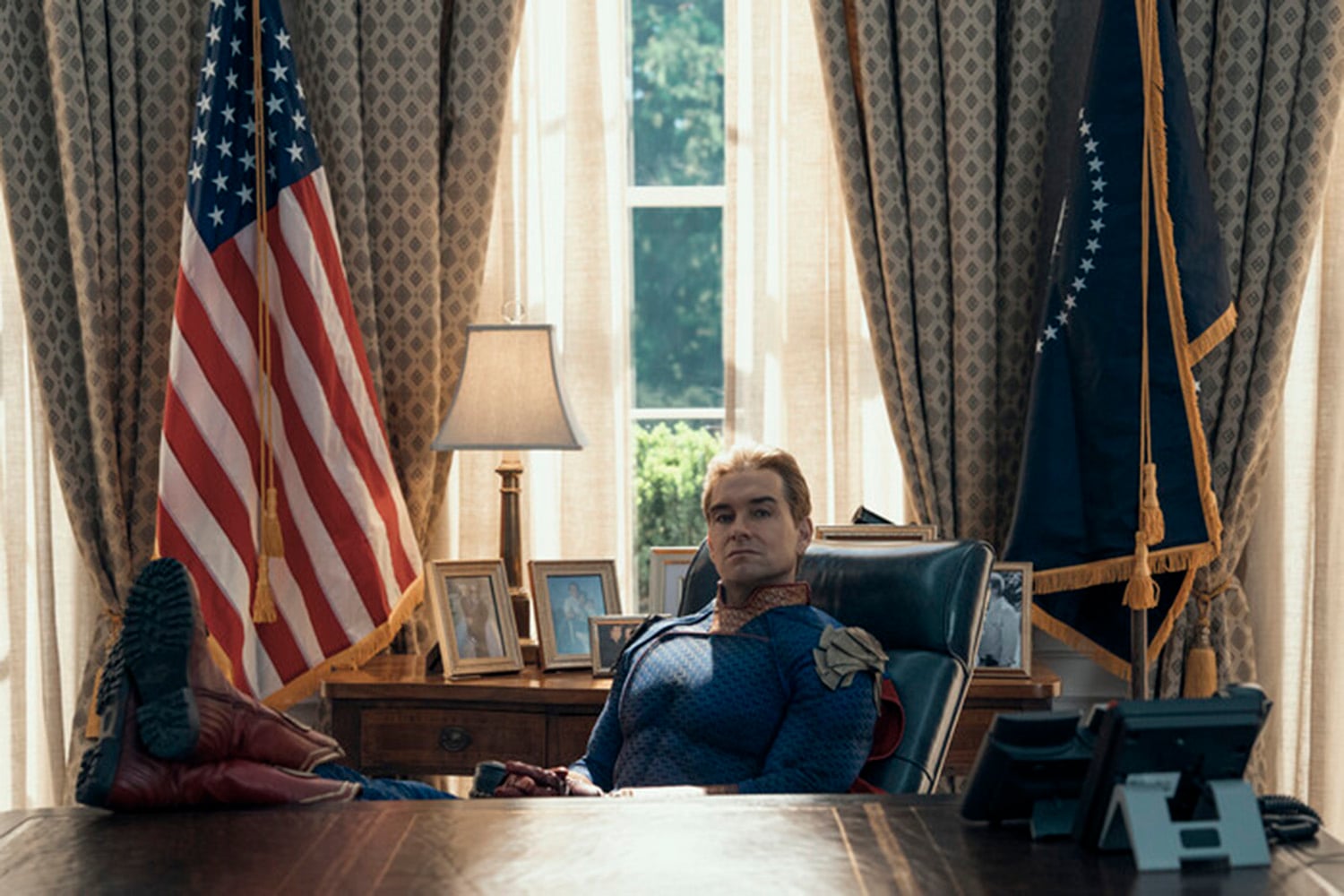
The Boys came a long way in the five seasons between its 2019 debut and the final episode on May 20. Set in a fictional world where the United States’ greatest superheroes are also its biggest celebrities, the Amazon Prime show more or less started out as a parody of the cultural and commercial machinery of the Marvel Cinematic Universe, with Vought International—an entertainment-slash-pharmaceutical conglomerate that creates, brands, and markets its superpowered employees—standing in for the Walt Disney Company. Over time, though, the scriptwriters for The Boys set their sight on U.S. politics, with Vought’s most popular and powerful hero, Homelander (played by Antony Starr), becoming a foil for Donald Trump. It’s safe to say that many viewers tuned in to Thursday’s finale not only to see what would happen to the chauvinistic, self-obsessed Homelander, but also to learn what fate could have in store for them.
Homelander is not the first villain in recent media to take after Trump. The same, for example, has been said of the failed-businessman-turned-space-colonizer portrayed by Mark Ruffalo in Bong Joon-ho’s Mickey 17. Homelander is, however, one of the most on-the-nose. Whereas Bong claimed that any similarities were purely accidental, The Boys showrunner Eric Kripke confirmed that, to him, Homelander has “always been a Trump analogue.” Even before the show started addressing Trumpism directly in its second season—where a superhero with ties to Nazi Germany convinces Homelander to ditch political correctness and use his patriotic image to become a far-right figurehead—it was already exploring the media ecosystem that helped bring Trumpism into existence.
The Boys came a long way in the five seasons between its 2019 debut and the final episode on May 20. Set in a fictional world where the United States’ greatest superheroes are also its biggest celebrities, the Amazon Prime show more or less started out as a parody of the cultural and commercial machinery of the Marvel Cinematic Universe, with Vought International—an entertainment-slash-pharmaceutical conglomerate that creates, brands, and markets its superpowered employees—standing in for the Walt Disney Company. Over time, though, the scriptwriters for The Boys set their sight on U.S. politics, with Vought’s most popular and powerful hero, Homelander (played by Antony Starr), becoming a foil for Donald Trump. It’s safe to say that many viewers tuned in to Thursday’s finale not only to see what would happen to the chauvinistic, self-obsessed Homelander, but also to learn what fate could have in store for them.
Homelander is not the first villain in recent media to take after Trump. The same, for example, has been said of the failed-businessman-turned-space-colonizer portrayed by Mark Ruffalo in Bong Joon-ho’s Mickey 17. Homelander is, however, one of the most on-the-nose. Whereas Bong claimed that any similarities were purely accidental, The Boys showrunner Eric Kripke confirmed that, to him, Homelander has “always been a Trump analogue.” Even before the show started addressing Trumpism directly in its second season—where a superhero with ties to Nazi Germany convinces Homelander to ditch political correctness and use his patriotic image to become a far-right figurehead—it was already exploring the media ecosystem that helped bring Trumpism into existence.
The similarities between Homelander and Trump range from their personality and appearance to their flexible morals and beliefs. Both are tall, blond, and wear padded suits to make themselves seem more imposing than they really are. Both, as Tom Nichols of The Atlantic put it, “share a childlike need for adoration and are quick to anger when contradicted.” Both, in their own way, are capable of bringing about massive destruction and frequently threaten to do so.
Both appropriate nationalist symbolism—Homelander wears the U.S. flag as a cape—and present themselves as living embodiments of the American Dream. Both entered politics when they were already well-known media personalities, cultivated a climate of fear and uncertainty in their inner circles, and (at least arguably in Trump’s case) deliberately exploited domestic and international crises to expand their emergency powers. Homelander has also feigned support for causes with passionate, violent followings (like white supremacy), pretending to be on their side when, in truth, he respects no one but himself.

People wait in line for theater tickets as a digital billboard advertises U.S. presidential candidate Donald Trump in New York City on Sept. 15, 2016.Drew Angerer/Getty Images
For his part, Trump has reinforced comparisons with Homelander by incorporating superheroes into his political messaging and imagination. He has retweeted people who described him as “the hero America needs,” considered (though ultimately abandoned) the idea of wearing a Superman shirt after recovering from COVID, and marketed a “Digital Trading Card” that depicted him wearing a superhero-style T-shirt and shooting laser beams from his eyes in front of Trump Tower.
By casting himself as a superhero, and thereby framing his opponents as supervillains, Trump weaponizes a number of assumptions inherent to superhero media. Many famous vigilantes—from Batman and Superman to Iron Man and Captain America—represent general heroism as much as they do U.S. greatness, making them natural vehicles for campaigns of conservative rejuvenation. More importantly, superheroes—particularly white, male ones—possess what political theorist Menaka Philips calls the “privilege of violence,” legitimizing extrajudicial force in the eyes of the public and distinguishing right from wrong as they see fit.
As superheroes, Homelander and Trump are able to position themselves politically as alternative sources of justice: unmediated, reliable answers to ineffective governments bogged down by corruption and bureaucratic red tape. Homelander, who rebrands his heroine rival Starlight (Erin Moriarty) as a villain and terrorist, does this as early as the show’s first season, when Vought is trying to integrate its superheroes into the U.S. military. After failing to rescue the passengers of a hijacked airplane, Homelander falsely blames the crash on the government’s refusal to include him in the chain of command. His accusation echoes Trump’s campaign promise to end the Russia-Ukraine war on his first day in office—a promise he later claimed to have made “in jest.”
For most of its run, The Boys was trying to catch up to reality. At the end of the show’s third season, for instance, Homelander loses his cool and uses his laser-beam eyes (one of his many powers, which also include flight, superstrength, and X-ray vision) to murder a protester at a political rally in Manhattan. In a nod to Trump’s claim that he could shoot someone “in the middle of Fifth Avenue” in New York and not lose any votes, Homelander chuckles maniacally when—to his genuine surprise—his supporters cheer uproariously.

Starr in season 5 of The Boys.Jasper Savage/Amazon MGM Studios
By the show’s final season, The Boys was outpacing reality. Written a year before Trump returned to the presidency, the season sees a psychologically struggling Homelander—who previously seized control of both Vought and the White House, and set up internment camps for his political opponents—develop a god complex. An episode in which the character founds a church that worships his divinity aired just a few days after Trump posted an AI-generated image of himself resembling Jesus Christ. An episode revealing a giant, golden statue of Homelander aired the same day that a gold-leaf statue of Trump (the “Don Colossus”) was erected at the golf course of the Trump National Doral resort in Florida.
The Boys correctly predicted that there is a limit to a leader’s self-aggrandizement—and that even those who rise to power by breaking with long-established social norms are capable of going too far in the eyes of their followers. In the show, Homelander’s public relations team attempts to make his self-proclaimed divinity more palatable to the public by referring to him as a prophet. When Homelander insists on being recognized as God and executing anyone whom his psychic underlings identify as non-believers, he starts on a path that ultimately turns everyone against him.
Trump, too, has faced backlash for associating himself too closely with Christ. His post drew criticism from former allies like Marjorie Taylor Greene and Tucker Carlson, who accused Trump of “making fun of Christianity,” as well as hitherto loyal supporters like Daily Wire reporter Megan Basham and conservative podcaster Riley Gaines. A Washington Post-ABC News-Ipsos poll found that 87% of Americans had a “negative view” of the April post, while another survey released in early May reported that Trump’s disapproval rating had reached an all-time high.
In apparent response to the backlash, Trump deleted the post—a rarity for him—and framed the controversy as a misunderstanding, claiming that in spite of the religious imagery he had intended to portray himself not as Christ but a doctor. “Honor is not worship” and “giving honor where honor is due is biblical,” televangelist Mark Burns, who spoke at the unveiling of “Don Colossus,” wrote on social media. Several days later, Trump posted another AI-generated image, this one showing him and Christ embracing.
Accompanied by social media posts drawing parallels with The Boys, the controversy left an aftertaste that has yet to fade away. Accusations of idolatry, along with suspicions of insider trading on foreknowledge of Iran War decisions and disapproval of the administration’s failure to fully disclose the Epstein files, taint the president’s image as an anti-elitist champion of ordinary citizens and traditional values. Like Homelander, Trump’s own ego could eventually make him a target of the very frustration and resentment that he himself helped cultivate.

A man dressed as “Super Trump” arrives at a campaign rally in Richmond, Virginia, on March 2, 2024. Win McNamee/Getty Images
The numerous similarities between Trump and Homelander should not distract from an important difference. While Homelander is portrayed as a textbook narcissist, the late Robert Jay Lifton, a psychiatrist and writer, characterized Trump as a solipsist, someone whose self-regard leaves no room whatsoever for the consideration of other people and their feelings.
Whereas Homelander is desperate for external validation, Trump welcomes attention of any kind—positive or negative. Whereas Homelander secretly doubts his greatness and acts out because of this insecurity, Trump appears completely convinced of his. Homelander’s public persona is a carefully curated, cookie-cutter image, while Trump rose to popularity in large part because he appeared to present himself as is: unfiltered, uncouth, and utterly unlike other politicians. Homelander spends the entire show hiding his real, pathetic self from the outside world, and his ultimate failure to do so solidifies his downfall. Trump, by contrast, has nothing to reveal that hasn’t been revealed already. In superhero terms, they don’t share the same kryptonite.
For those looking for political lessons, the finale of The Boys brings good news and bad news. The good news is that, as scholar Sarah Wagstaffe mentions in her own analysis of the show, even the most powerful individuals are not as strong as we think. Despite taking over Vought and subjecting his former bosses to his personal whims, Homelander cannot change the capitalist logic on which the corporation and the country operate; even as he seeks to establish himself as an actual god, Vought is still doing surveys and focus tests, just as it did when it was making blockbusters and selling merchandise.
Trump, too, is encountering the limits of what his second administration can achieve, not least overseas. His inability to end his war against Iran and reopen the Strait of Hormuz is pushing the United States towards stagflation. Iranian officials and internet users have given Trump a taste of his own AI memes, and the backlash against U.S. interventions and their resultant economic hardship is driving a wedge between European far-right parties and the White House. Meanwhile, this month’s summit in Beijing accomplished little except increasing the likelihood of a Chinese takeover of Taiwan. Trump, far from exercising complete control, remains at the mercy of many influential players.
The bad news is that defeating Homelander will not destroy the world he created. Earlier in the final season, Vought’s former CEO, Stan Edgar, delivered a monologue reminiscent of one in the 1976 film Network, a classic and prescient satire about money and the media. In his monologue, Edgar essentially argues that Homelander’s megalomania is still just a symptom of capitalism, not its antithesis or apotheosis. The system will survive, just as it always has. And sure enough, after Homelander’s death, Edgar—reinstated as Vought’s interim CEO, just like Bob Iger returned to Disney after COVID—appears on TV, promising shareholders that the company’s “greatest, most profitable days” are still ahead.
Many conservative viewers have long since turned on The Boys. Whereas it seemed that the show used to make fun of both sides, in their eyes it now exclusively targets the right. While it’s true that Homelander’s Trumpian qualities did not take center stage until further along in the story—and earlier seasons mostly railed against popular right-wing bêtes noires like corporate virtue-signaling—the show did not suddenly change targets. Before The Boys set its sight on Homelander personally, it was critiquing the system that produced him, and which controls him far more than he controls it.