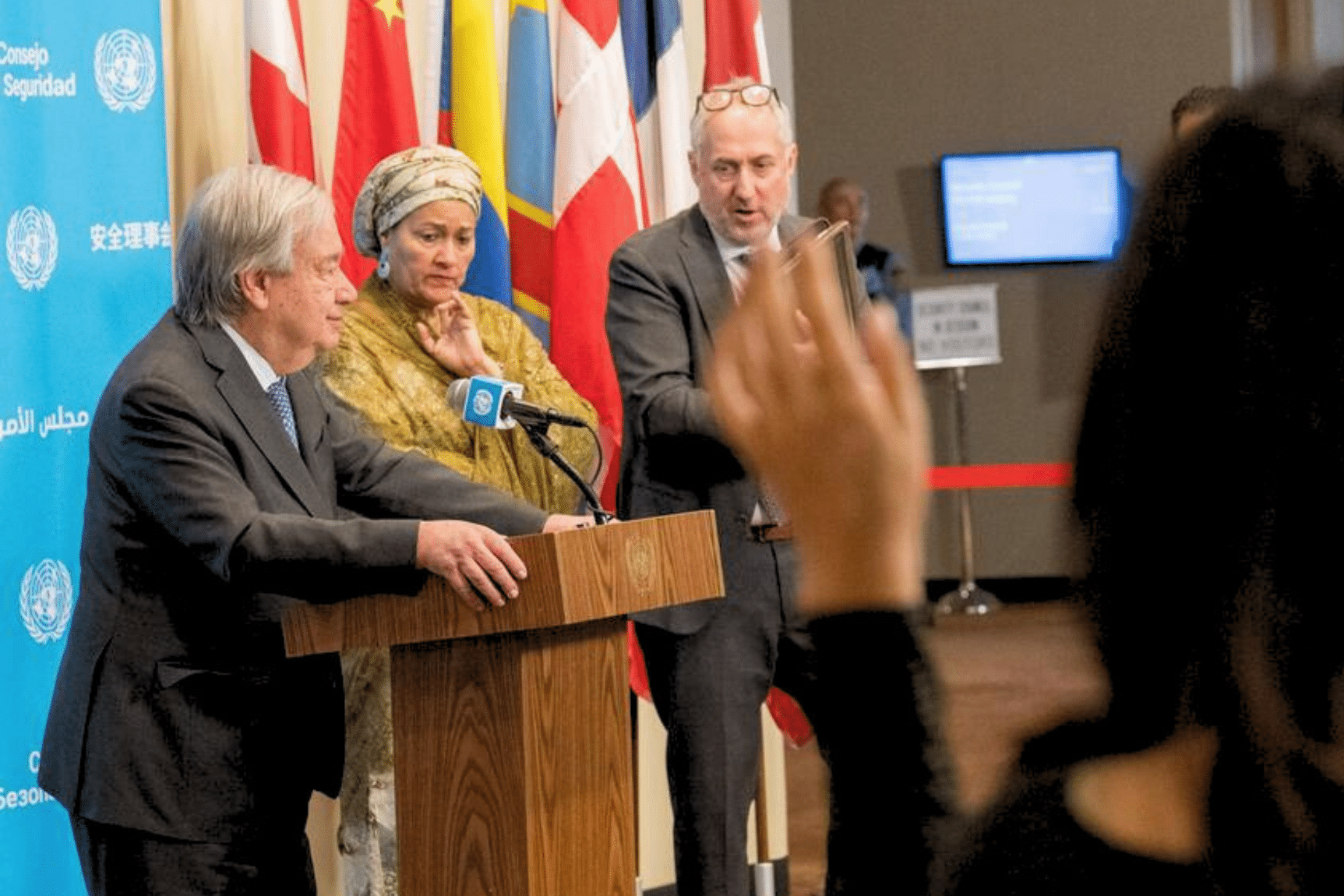
The United Nations is preparing to choose its next Secretary-General — the diplomat who will become the public face of the world’s largest and premier international organization and one of the few people tasked with navigating nearly every major global crisis at once.
If that sounds like a bureaucratic exercise with little to do with everyday Americans, consider this. Conflicts abroad can disrupt shipping routes and drive-up prices at the gas pump. Disease outbreaks can expose weaknesses in global health coordination. Economic shocks and trade disputes can quickly affect supply chains, jobs and markets at home.
That’s why the race to lead the UN matters more than many Americans realize.
While agency heads often grab headlines, the Secretary-General is the connective tissue of the organization — part CEO, part crisis manager, part diplomat, part “secular pope” — responsible for keeping the global operation in sync and delivering for eight billion people.
Yet for a role with that much weight, much of the selection process remains surprisingly unwritten. As UN Foundation expert Bojan Francuz puts it, “What actually governs the process of selecting a Secretary-General lives mostly in practice — not in a single rulebook.”
One Rule and a Lot of Precedent
The UN Charter offers just one clear instruction. Article 97 states: “The Secretary-General shall be appointed by the General Assembly upon the recommendation of the Security Council.”
Everything else has evolved through precedent over decades.
The process became somewhat more transparent beginning in 2015 during the selection of current Secretary-General, António Guterres. Public candidate forums were introduced, vision statements became standard and campaigners around the world mobilized to bring global attention to the process.
In 2025, the UN General Assembly adopted Resolution A/RES/79/327, which further formalized parts of the process and expanded expectations around the nomination process of candidates, transparency and engagement with the UN Member States. The resolution also reaffirmed the Secretary-General’s responsibility across the UN’s three core pillars: peace and security, human rights and development.
Still, much about the race remains informal.
Step One: Nominations Open
The process officially begins roughly a year before the end of an incumbent Secretary-General’s term, with a joint letter from the presidents of the General Assembly and Security Council inviting nominations. With Guterres’ term ending in January 2027, the current race kicked off in October 2025.
Candidates cannot declare themselves — a requirement that was introduced after several unofficial and symbolic candidacies drew public attention — but must be formally nominated by at least one UN Member State. Countries may nominate foreign nationals, but each government can back only one candidate.
Over time, several unwritten expectations have also emerged.
The position has historically rotated among regional groups, though not through a rigid formula.
There is also mounting pressure among civil society for the UN to appoint its first female Secretary-General after nearly eight decades of a male at the helm.
Diplomatic relationships matter enormously. Early support from influential governments can determine whether a candidacy gains momentum or quietly fades away.
“It’s not about who declares first,” Francuz says. “It’s about who can build enough trust early on to be considered viable — or who operates in stealth mode as a skilled operator long enough before declaring their candidacy and presenting themselves as a compromise candidate among great powers.”
Candidates are now also expected to submit public vision statements, disclose campaign financing and participate in open dialogues hosted by the General Assembly. A dedicated UN webpage also tracks each nominee’s background and financial disclosures.
Step Two: Public Engagement
One of the most notable changes is the introduction of public dialogues. Candidates appear before the General Assembly to answer questions from Member States and civil society — sometimes for hours at a time.
The forums function as something of a diplomatic job interview.
“This level of transparency helps diplomats and the public have a better sense of who the candidates are as leaders,” Francuz explains, “not just their approach to the role and vision for the organization.”
Civil society organizations have also increasingly organized parallel events and public conversations around the world, pushing candidates to engage with issues ranging from women in the role to UN reform.
Step Three: Security Council Review
After the public phase, attention shifts to the UN Security Council — the 15-member body responsible for recommending a final candidate.
Five countries hold especially enormous power: the United States, the United Kingdom, France, Russia and China. As permanent members of the Council, each holds veto power.
The Council conducts a series of informal straw polls in which members indicate whether they encourage, discourage or have no opinion on candidates. A veto from any permanent member can end a campaign immediately.
“This system is designed to produce a leader who can operate in a complicated world and under intense pressure while managing conflicting priorities,” Francuz says. “Consensus candidate who emerges at times can be unexpected.”
Because negotiations happen largely behind closed doors, surprises are common. Candidates who appear dominant early can suddenly collapse. Others can emerge late with quiet backing from powerful governments.
“You could wake up late in the year and suddenly a candidate appears out of nowhere and rises to the top,” Francuz notes. The phases of the process are not always linear, and Francuz adds “Increasingly, I believe this is very likely this year.”
Step Four: General Assembly Appointment
Once the Security Council agrees a candidate, all 193 UN Member States vote to appoint the Secretary-General.
“The General Assembly’s role is important,” Francuz says. “It reinforces that this is a leader for the entire membership — not just the major powers.” He added, “increasingly countries in the General Assembly are keen for their voices to matter, not simply serve as a rubber stamp for the Security Council.”
The process concludes with the swearing-in of the Secretary-General-designate in the final quarter before the term begins — a transition period now explicitly recognized in the 2025 resolution.
The Secretary-General’s Team
Just as important as the Secretary-General is the team they build around them. Deputy secretaries-general, senior advisors and political appointees play an outsized role in how effectively an agenda is implemented, and which coalitions inside the UN system gain influence. Leadership at the UN is deeply tied to the network of diplomats, regional blocs and political alliances surrounding the office.
Why it Matters
Most Americans won’t follow the race for UN Secretary-General the way they follow, say, a U.S. presidential campaign. But they’ll still catch glimpses of it — headlines about China or Russia maneuvering for influence or debates inside the Security Council.
And while the process can feel distant, the stakes are anything but. The next Secretary-General will help shape how the world responds to wars, pandemics, migration, climate disasters and economic shocks — crises that directly affect Americans and around eight billion people globally.
The Secretary-General is one of the few global figures expected to be above and think beyond any single one of them — and yet for all of them.
“There isn’t a world leader who can take a step back — who’s not advancing a specific national interest — and connect local realities to global systems like the Secretary-General,” Francuz says. “That is why the position matters.”
The U.S. holds enormous influence over who fills that role. In a world of darkness and uncertainty… where do we look for moral clarity and ultimately … hope?” Francuz asks.
“That’s the place for the next leader of the UN to fill.”