Sign up for Executive Dysfunction, a newsletter that highlights one under-the-radar story each week about how Trump is changing the law—or how the law is pushing back. You’ll also receive updates on the latest from Slate’s Jurisprudence team.
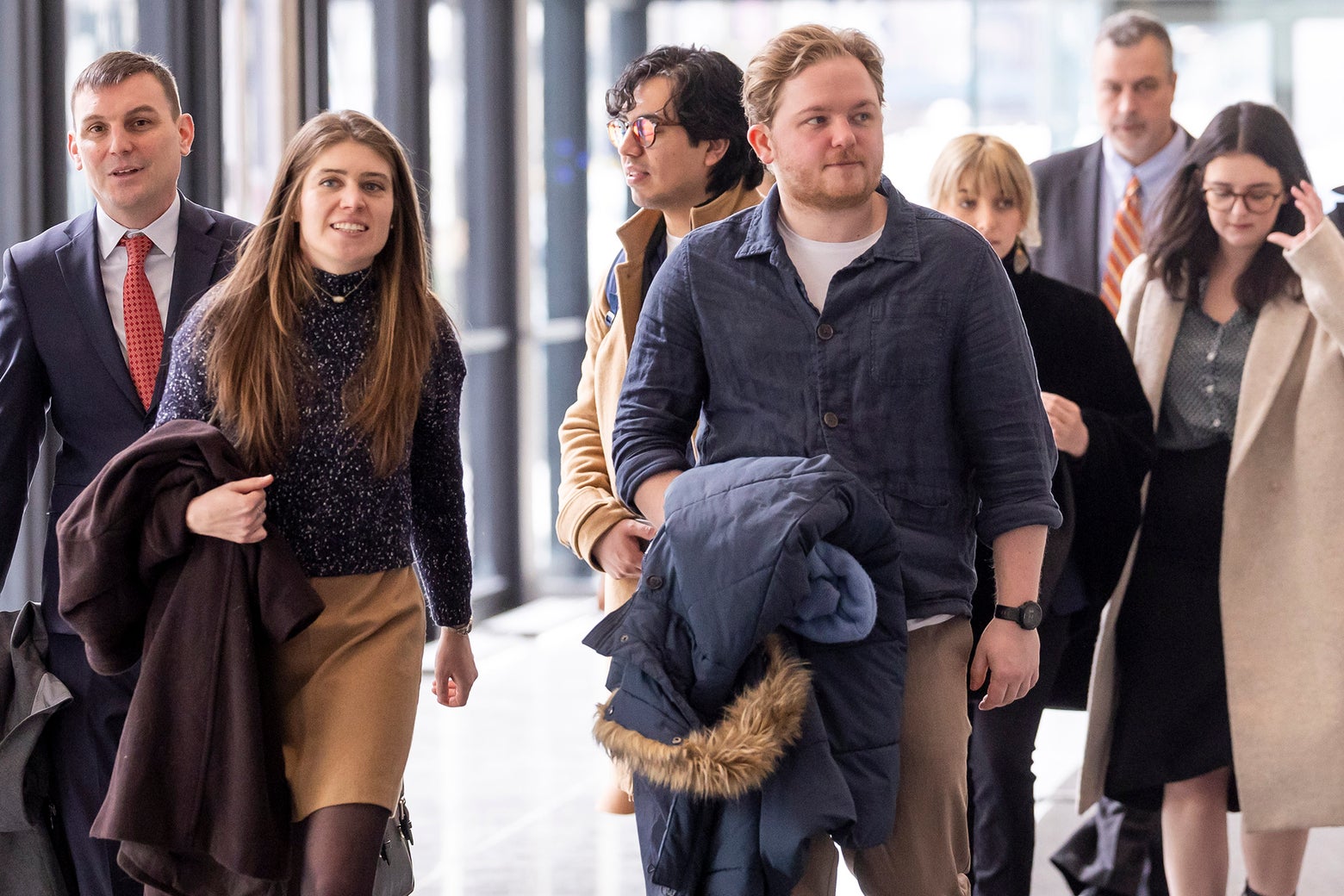
A federal court threw out all charges against the Broadview Six—a group of protesters accused of obstructing a Chicago ICE facility—during a heated hearing on Thursday at which Justice Department officials apologized for egregious misconduct in securing the indictments. U.S. District Judge April Perry excoriated prosecutors for using illegal tactics to get the criminal charges past a skeptical grand jury, dressing down U.S. Attorney Andrew Boutros and his colleagues for their “incredibly shock[ing]” malfeasance. The Broadview Six will now walk free, and may even apply for President Donald Trump’s fund for victims of government “weaponization.”
On this week’s Slate Plus bonus episode of Amicus, co-hosts Dahlia Lithwick and Mark Joseph Stern discussed the prosecution’s sudden collapse, Perry’s remarkable condemnation of Trump’s Justice Department, and the surprising implications of the case for the weaponization slush fund. A preview of their conversation, below, has been edited for length and clarity.
Dahlia Lithwick: Even by the low, low standards of the DOJ these days, this was quite a bomb. Judge Perry told the U.S. attorney: “I have never seen the types of prosecutorial behavior before a grand jury that I saw in those transcripts.” And she added: “I think there is also a potential here, separate and apart from the merits of this case and how this case ends up proceeding, on sanctions for prosecutorial misconduct and for potential ethical violations, including lack of candor to the court.” Walk us through what happened here.
Mark Joseph Stern: Prosecutors had tried to conceal these grand jury transcripts from the court, and now we can see why. Here’s what we discovered: First, prosecutors did something called “vouching,” assuring grand jurors that they are trustworthy and would never bring an unjust case, so the charges must be sound. That is fundamentally unfair and never allowed. Second, it turns out that the grand jury originally refused to indict the Broadview Six, and instead came back with what’s called a “no true bill.” So prosecutors then allegedly removed the grand jurors who had refused to vote for an indictment, then went back to the remaining grand jurors and asked them to indict, which they did. That is obviously a violation of the Fifth Amendment.
Third, prosecutors allegedly had communications with grand jurors outside of the grand jury proceedings. We don’t have clarity on exactly what was said, but based on Judge Perry’s reaction, I strongly suspect they lobbied grand jurors to indict. That is, of course, totally improper and unacceptable. In light of these violations, the U.S. attorney moved to drop all the charges, and Judge Perry dismissed the case with prejudice, meaning it can’t be brought again. She also said that this Justice Department had lost “the presumption of regularity” because the long-standing “trust” in prosecutors’ candor to the court “has been broken.” So we have yet another judge saying she can no longer trust Trump’s DOJ to tell the truth or pursue justice.
This case really concretizes something that’s hard to pin down, which is the unbelievable power that the Justice Department has to ruin lives. We have this almost innate sense of: Well, if they indict someone, that person probably did something pretty bad. They don’t go around indicting innocent protesters who did nothing, right? And this is a really useful corrective to the notion that every single time there’s smoke, there’s fire. Because that was trumped up smoke with no fire.
We should also note that a federal prosecution like this absolutely ruins your life, even if you ultimately walk free. The Broadview Six ran up huge legal fees. They spent months thinking they might be sent to federal prison for years for exercising their First Amendment rights. So as great as this outcome is for them, I fear the Trump administration accomplished much of what it wanted to do through the lies and deceit and misconduct. Even though the Fifth Amendment ultimately kicked in and did its job, the government ruined lives in the process.
I think this is really important—the degree to which this prosecution is designed to chill First Amendment rights. This was designed to force every single person who is thinking of going to go out and protest to say, “Wow, they have this immense power. They brought these trumped up charges then they lied about it. They could get anyone for anything.” And unless there are real consequences, what’s to stop this from happening again? But one of the interesting back and forths in the transcript is that at the same time the U.S. attorney is abjectly apologizing, he’s still saying he wished he could’ve brought this to trial and that the defendants’ behavior was “unacceptable in a civilized society.”
That led Judge Perry to retort: “You are significantly undercutting your mea culpa here by standing behind the charges and continuing to vilify these particular defendants.” Thank goodness she was assigned this case; she worked in this very U.S. attorney’s office for years, so she understands what a fall from grace this is. She was willing to hold prosecutors’ feet to the fire and to review transcripts that they didn’t want to turn over. But this is why the Trump administration is forum-shopping to keep its cases out of courtrooms like hers—like taking a Rhode Island case to Texas, where it can hand-pick the MAGA judge it prefers.
Now that all charges have been dismissed, a lawyer for the Broadview Six has indicated that they might apply for compensation from Trump’s $1.8 billion slush fund for anyone who feels the Justice Department has been “weaponized” against them. This is funny, but it’s also actually making a serious point.
It does make the obvious point that the people facing actual weaponization of the Justice Department are Donald Trump’s perceived enemies: protesters, Democratic politicians, people exercising their First Amendment rights to oppose this regime. But I also think it could be tactically smart. There’s been a lot of discussion about who would have standing to challenge this fund; who could go into federal court with a legitimate, personal claim and give a judge the opportunity to assess its illegality? And I think someone who applies for a payout from this fund with a colorable case of weaponization, but gets denied, may well have standing. They can say, “If this fund is legal, I deserve my payout.”
That gives the courts a chance to weigh in on the legality of the entire fund. They don’t have to limit their review to whether or not the individual deserves a payout. They can examine whether the fund itself is lawful as a predicate to deciding whether the individual should get relief. I don’t know if that’s the tactic that the Broadview Six and their lawyers have in mind. But these are exactly the kind of people who would have the strongest claim of standing to challenge the whole scheme.