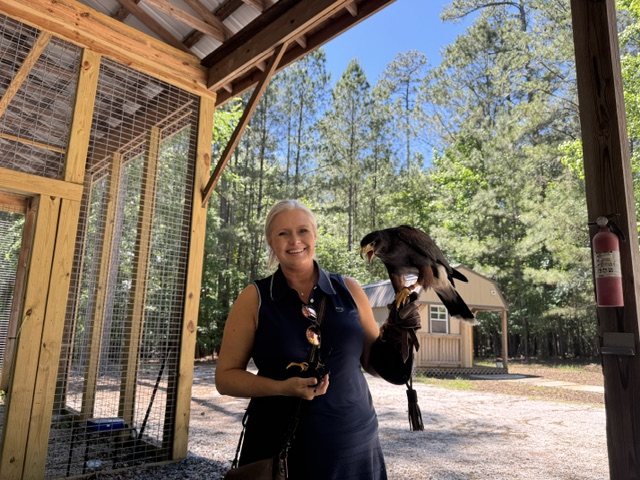
Falconry has been around for roughly 4,000 years. Early cultures in Central Asia relied on birds of prey to help hunt for food.
By the 10th century in Europe, falconry was also seen as a sign of rank and prestige. Kings were at the top, servants at the bottom. Nobles would bring falcons to gatherings, turning a useful skill into a show of status.

At its heart, falconry is still what it has always been. It is the ancient art of training birds of prey to hunt. It is more than a sport; it is a way of life.
Things changed a lot when firearms became common in the 18th century. Falconry did not vanish, but it became much less common. Today, there are only about 4,000 licensed falconers in the United States. Last week, I spent a day with one of them.
I did not know much about the sport. I had learned a bit from C.J. Box’s Joe Pickett novels, where falconry is shown with a sense of rugged nobility. Honestly, Box gets it right.

I also learned a bit from pop culture, especially Wes Anderson’s The Royal Tenenbaums, where a hawk has a memorable part. As you might expect from Wes Anderson, even the bird had a strange behind-the-scenes story.
In the movie, a hawk plays a role. Strangely, the hawk was actually kidnapped during filming.
The crew had to find a replacement, which changed the story a bit. If you have not seen his movies, The Royal Tenenbaums is a good place to start. After that, try The Life Aquatic with Steve Zissou.
In Florida, falconry is regulated by the Florida Fish and Wildlife Conservation Commission. The state has roughly 150 licensed falconers.
My experience, though, happened just up the road in Georgia, near Lake Oconee, through Reynolds Outfitters in partnership with the Ritz-Carlton Reynolds and Sandy Creek Sporting Grounds.

Our guide was Master Falconer Linda Spence.

One of the first things I learned is that falconry is not only about falcons. Falconers also work with hawks, eagles, and owls.
We began with a hawk. While we were walking, Ruger suddenly took off after seeing a deer. Linda told us the hawk could do real damage with its talons. Seeing that kind of power up close was both intimidating and fascinating.
When a small snack was offered, Ruger came back and joined us again. Standing still while a hawk circles above you really makes you appreciate how precise and powerful these birds are.
Next, we met the owl. It looked like it could win a fight with something from Jurassic Park. We also spent time with an eagle, and seeing one up close was just as majestic as you would expect, given how the birds bond with people. Linda answered carefully. These birds do not bond the way pets do. She used the word ‘trust.’ Sometimes, she said, it is more like ‘tolerate.’ It is a working partnership based on routine, patience, and food.
It takes years to become a master falconer. Apprentices first train under a master. Then they become general falconers before finally reaching master level after gaining experience and the right licenses.

I asked Linda if technology had changed falconry. Her answer was simple: not much. Other than a digital scale, falconry is still very hands-on. Training, timing, trust, and repetition remain the most important factors.

I learned a lot that day. Birds do not drink water the way I thought. They do not bond with people in the usual way. They store food before swallowing it. And it turns out, they do not really have a smell. I do not usually look for learning experiences on vacation, but this one was an easy 10 out of 10. If you are in the area, Linda and her team are worth visiting.
Her dedication to falconry is inspiring. It seems right to end with a line from Wes Anderson’s Rushmore: ‘I guess you’ve just gotta find something you love to do and then do it for the rest of your life.’ Linda seems to have done just that.