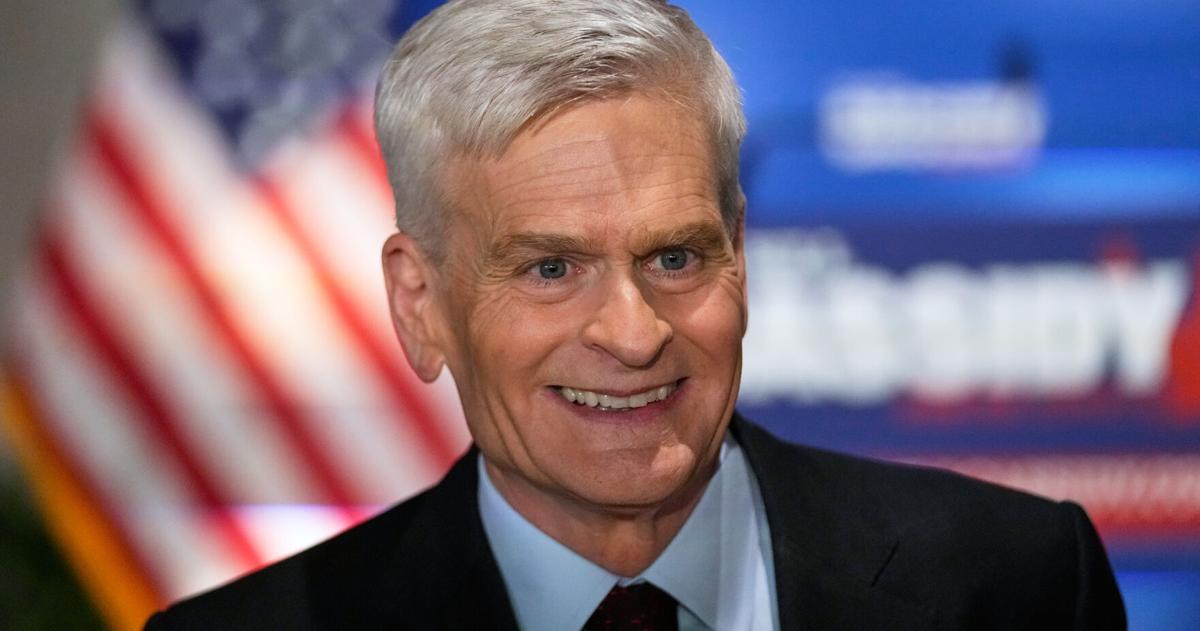
WASHINGTON — U.S. Sen. Bill Cassidy isn’t sure when or even if he’ll go back to practicing medicine after January 2027, when he leaves the Senate.
“I really don’t quite yet know what I’m going to do. I’ve got some speaking opportunities,” Cassidy told local reporters over the phone at a news conference. “I just met with my staff. I’ve been really focused on the next seven months. What do we have teed up that we can do that’s going to help my state and my country?”
Cassidy was defeated in a closed Republican primary on May 16. But, for the next seven months, he remains chair of the powerful Senate Committee on Health, Education, Labor, and Pensions.
Cassidy already has been working on legislative ideas to lower the cost of healthcare and health insurance.
“I’d really like to accomplish that,” he said.
He’s got another measure to punish China for not enforcing environmental laws that he wants to see concluded. He’s working with LSU on ways to rebuild Louisiana’s fast-eroding coastline.
He’ll probably have to hand off lowering the cost of flood insurance to his successor.
Cassidy has long been on point in Senate efforts to fix Social Security. The Social Security Old-Age and Survivors Insurance trust fund is expected to run out of money in 2032, at which point benefits for the elderly will be reduced by about 25%.
“We’ve been talking about it through the years, and I got seven more months to get it done,” Cassidy said.
But one thing is clear about how Cassidy will serve out the rest of his term: President Donald Trump can’t count on him to keep quiet.
Pushed out of Congress by Trump
Cassidy beat incumbent Sen. Mary Landrieu in 2014. When he ran for reelection in 2020, Cassidy polled 1.2 million votes.
He received only 99,496 in this year’s Republican Party primary. He came in third and out of runoff contention.
U.S. Rep. Julia Letlow, a Baton Rouge Republican who Trump endorsed, and state Treasurer John Fleming, R-Minden, face each other in a June 27 runoff to determine which Republican will face off in the November general election against either Jamie Davis, a farmer from Ferriday, or Gary Crockett, a businessman from New Orleans, who are competing in the Democratic runoff.
Cassidy’s third Senate race was not a charm because of lingering anger over his supporting Trump’s conviction in the 2021 impeachment trial on charges that the president incited his supporters to storm the Capitol and disrupt the official certification that Democrat Joe Biden won the 2020 presidential election.
The Louisiana Republican Party censured Cassidy. Gov. Jeff Landry and the Louisiana Legislature changed the state’s open primary system, in which all candidates competed regardless of party, to a closed primary where only voters registered for a specific party or no-party voters can participate in the primary election.
Right before early voting began in the GOP primary, Trump wrote on Truth Social: “Hopefully all of the Great Republican People of Louisiana, which I won, BIG, three times, will be voting Bill Cassidy OUT OF OFFICE in the upcoming Republican Primary!”
It wasn’t the first time Trump castigated Cassidy.
In April 2024, Trump posted a two-page entry that read, in part: “One of the worst Senators in the United States Senate is, without question, Bill Cassidy, A TOTAL FLAKE, Republican though he may be.”
Cassidy didn’t respond to Trump’s humiliations, but kept his head down and worked to get back into the president’s good graces.
He is largely responsible for ensuring vaccine skeptic Robert F. Kennedy Jr. was confirmed as secretary of the U.S. Department of Health and Human Services — the agency that oversees vaccines. He was a deciding vote to confirm Pete Hegseth as secretary for the Department of Defense.
Cassidy was in the Oval Office when Trump signed into law the HALT Fentanyl Act, which closed loopholes makers were using to avoid prosecution, and the SUPPORT for Patients and Communities Reauthorization Act, which provides first responders with naloxone, the medication to treat overdoses.
He drafted the section of the tax cuts law that eliminated tip taxes on tips for some barbers and hairdressers, as well as a set-aside for families who want to send their children to private parochial schools.
After Cassidy lost the primary election, Trump gloated on Truth Social: “His disloyalty to the man who got him elected is now a part of legend, and it’s nice to see that his political career is OVER!”
A problem for Trump?
The caution that sits on the shoulder of most politicians left Cassidy’s after election night results were tallied.
In his concession speech, Cassidy didn’t mention Trump by name, but was hardly circumspect about who he meant.
“When you participate in democracy, sometimes it doesn’t turn out the way you want it to,” the senator said. “But you don’t pout, you don’t whine, you don’t claim the election was stolen.”
Upon returning to Capitol Hill, Cassidy stopped speaking cautiously.
He said he was at peace with his impeachment vote against Trump.
“That may have cost me my seat, but who cares? I had the privilege of voting to uphold the Constitution. Isn’t that a great thing?” Cassidy said. “When I die, if that’s put in my obituary, ‘He voted to uphold the Constitution,’ I’ll figure that that’s going to be a better obituary.”
He criticized Trump’s effort to shoehorn into a narrow bill on funding immigration enforcement $1.776 billion to compensate conservatives who felt targeted by the Justice Department under Biden.
“We are a nation of laws; you can’t just make up things,” Cassidy said.
He also blasted a plan to spend $1 billion to build a ballroom at the White House.
“This is a spit-in-the-eye insult to all my taxpayers in Louisiana, to spend a billion on a ballroom when we should be doing something about the high price of gas, groceries and healthcare,” he said.
Both amendments were pulled from the funding bill Thursday.
Cassidy joined a handful of Republicans and all but one Democrat in a procedural move to eventually call a floor vote on a resolution to end the military action in Iran.
On Wednesday, Cassidy wrote on X that “Americans are exhausted by a culture that treats every disagreement as betrayal.”
“Our constitutional system was designed around debate, persuasion, and compromise,” Cassidy continued.
Senate Majority Leader John Thune, R-S.D., said Monday: “Bill Cassidy is a very principled conservative, very independent thinker and probably knew the challenges he was up against in that race.”
Thune also noted that, as chair of the Senate Health Committee, Cassidy could still be “a real force for change and a factor in trying to get some things done” during the remaining seven months of this Senate’s term.
“Cassidy’s departure will subtract most of the Senate membership interested in responding to the approaching crisis of Social Security funding,” Washington Post columnist George Will wrote. “He will be replaced by a Republican whose identity does not matter: He or she will win because voters are pleased to assume he or she will be a cipher, vigorously subservient to Trump.”