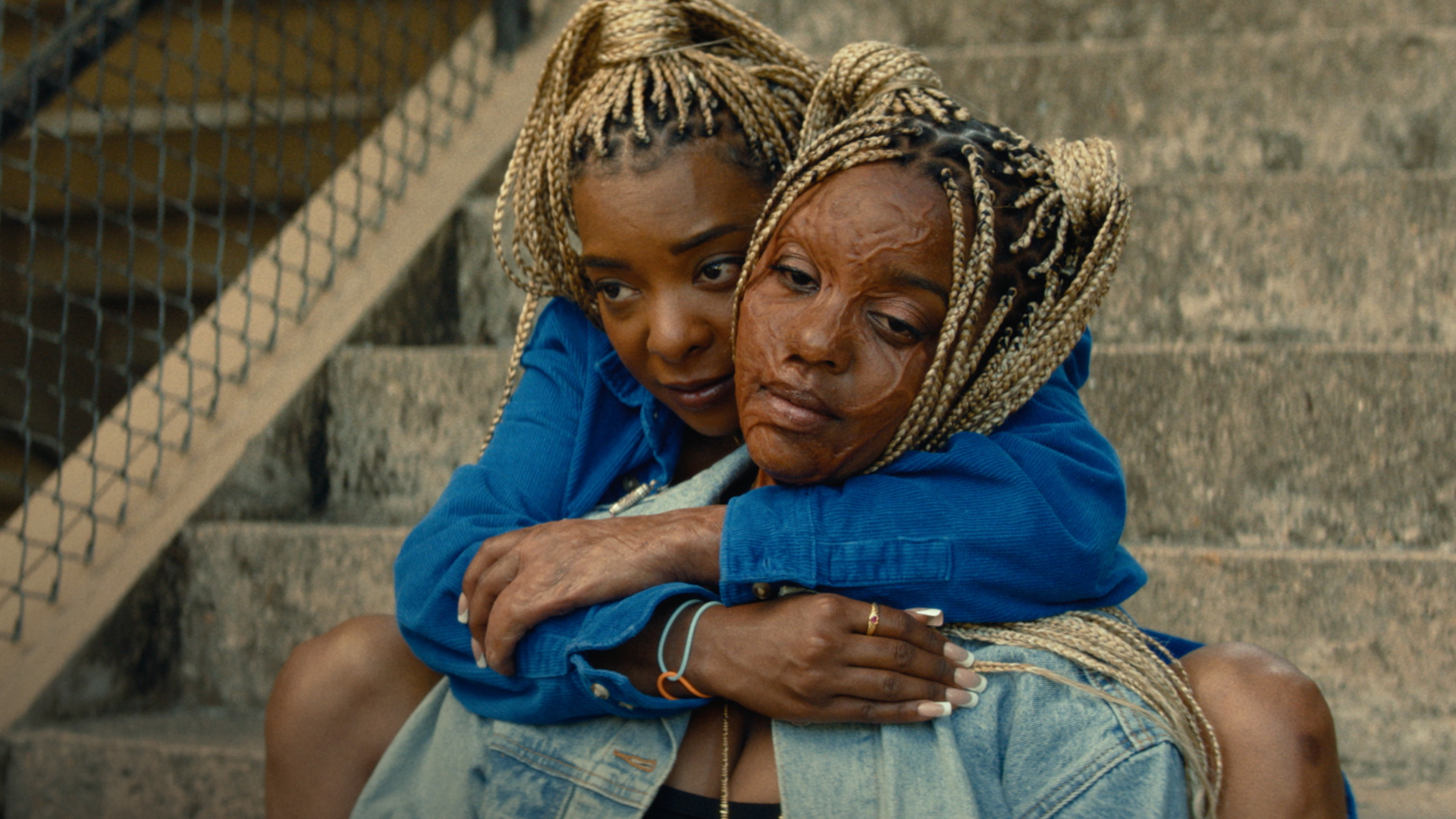
Aleshea Harris’ surreal revenge thriller uses Black feminist aesthetics, beauty politics and righteous rage to confront misogynoir, intimate partner violence and the burdens placed on Black women’s bodies and emotions.
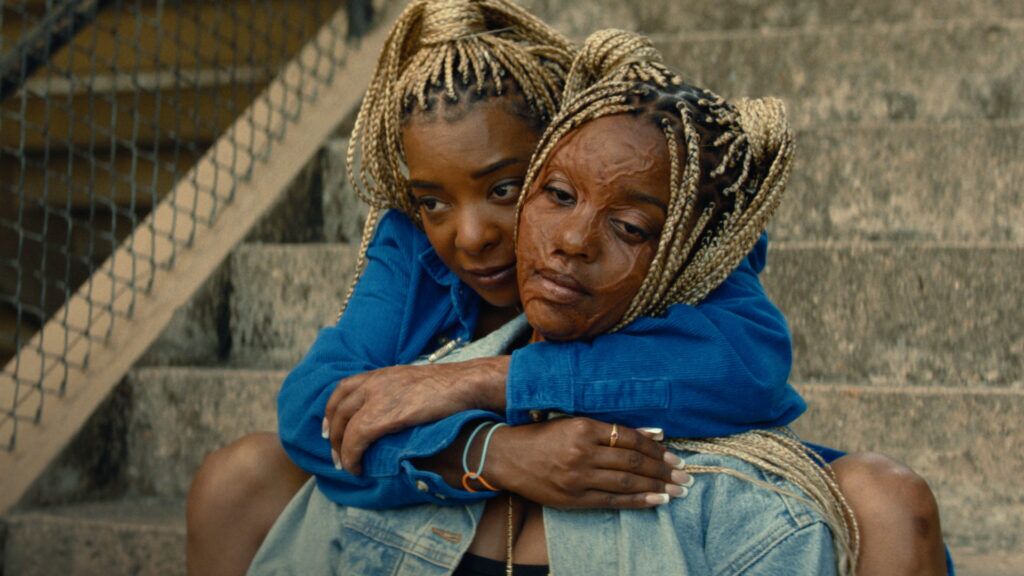
Spoilers to follow.
In one of many surreal scenes in Is God Is—the astonishing new Gothic and absurdist revenge thriller from playwright-turned-filmmaker Aleshea Harris, making her directorial debut—our protagonists (Kara Young and Mallori Johnson as the respective twins Racine, “the Rough One,” and Anaia, “the Quiet One”) play along to expectations that they are hired strippers for a room full of men. However, one twin (Racine) is viewed as acceptable by the men; the other (Anaia) is shooed away from the room because her scar-covered face is too disruptive to their porn-induced fantasies.
Ugliness has a burden … and a subversive quality. The acceptable twin doesn’t wait long before avenging the insult against her sister—something she’s used to doing since childhood, as evidenced from the opening scene of the film. And just like that, Is God Is transcends into a stereotype-busting referendum on what rage-fueled justice might look like for Black women. A vision that is equal parts messy and meaningful.
In our present-day climate shaped by misogynoir Is God Is comes to us right on time, if only through the cinematic imagination, as we seek solutions to violence while also questioning what righteous anger might spawn in efforts to right wrongs and attain something akin to justice. We need only think of the more than 300,000 Black women who lost their federal jobs in 2025, or the same administration headed by a president who feels comfortable referring to a Black woman journalist as a “bitch,” or the high-profile cases of Black femicide in April – including Cerina Fairfax, married to while seeking a divorce from her abusive husband and former Virginia Lt. Governor Justin Fairfax, and Florida’s Vice Mayor Nancy Metayer Bowen, who was also killed by her husband, and even the tragic killing of eight children by their own father in Shreveport, Louisiana.
“Vengeance is mine!” is what God says, and in this film, God is a Black woman.
Revenge of the Black Woman
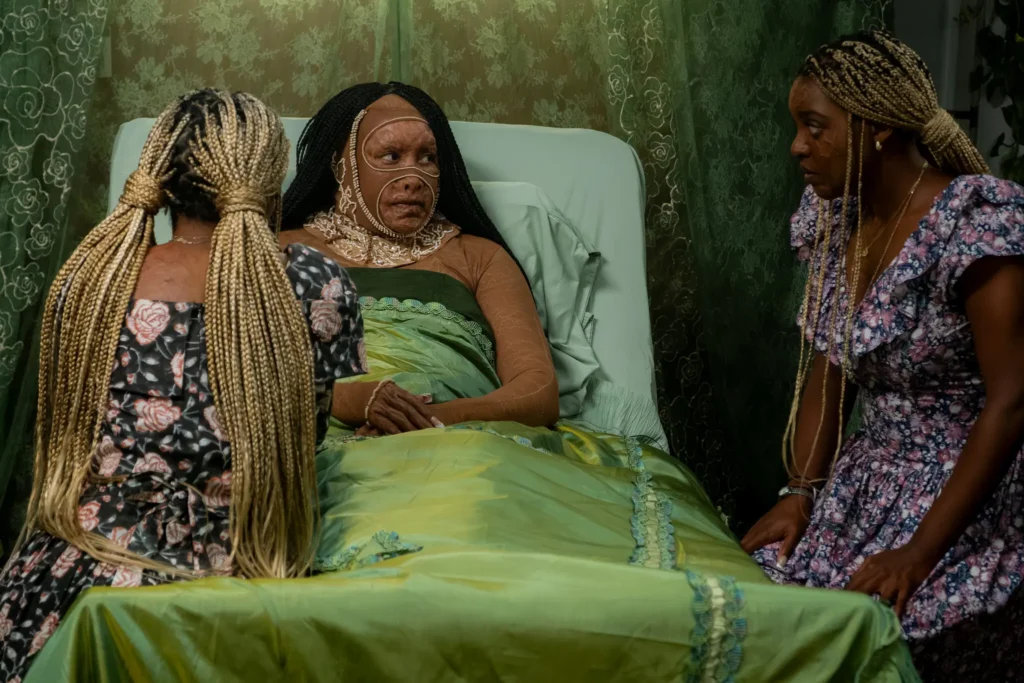
On a cross-country journey in search of their monstrous father (Sterling K. Brown) who had set their mother on fire (played by Vivica Fox, whom they look up to as their titular “God”), the twins now bear the scars of that horrific encounter with domestic violence imprinted on Racine’s left arm and Anaia’s disfigured face. Believing that their mother had died from the incident, the twins – raised in the foster care system – are surprised to learn that she is still alive and, after being summoned by “God” with instructions to make their father “dead, really dead,” agree to the terms of vengeance after witnessing the unbearable (and unseeable) ruins of her singed body.
Is God Is plays with the tropes of the revenge movie genre, inspired by Rihanna’s blood-soaked revenge fantasy in the music video for “Bitch Better Have My Money” and approximating elements of Quentin Tarantino’s Kill Bill, Vol. 1. The different camera shots of its movie villain’s body parts that render him without a face in Is God Is create a cinematic parallel with Tarantino’s movie, which further reminds us that intimate partner violence shapes the lives of both Black and white women while also including the same actor (Vivica Fox) from the Kill Bill narrative.
However, Harris incorporates specific Black feminist aesthetics that disrupt a simple comparison, from the subversive reframing of “God” on her throne (her deathbed where she does not die, her devoted “priestesses” braiding her hair and lighting a joint for her to smoke—very much in the flesh, even if that flesh is disfigured and far from “divine”) to scenes of the twins twerking to trap music and sporting similar braid extensions while driving on the wide expanse of America’s roads, unbothered with no “Green Book” Jim-Crow restrictions. Driving or eventually taking the Greyhound bus after their run-down car gets destroyed, the twins encapsulate a working-class mobility that makes their journey so open and free. Until it isn’t.
What makes this journey so uncanny is how the twins consistently encounter the damage left behind by their father. From the bizarre and hilarious church exorcism of the “devil”—as led by Divine the Healer (played by Erika Alexander in an unforgettably comic scene)—to the same “healer” building a shrine to said devil (the monstrous father) in hopes that he will one day “return,” to the half-brothers trying to erase the twins’ existence, to the “new wife” (played by Janelle Monae) attempting to escape her luxurious yet abusive household while refusing solidarity with the twins and their mother.
For all the online discourse about depictions of “violent Black masculinity,” few have engaged with depictions of Black women—in the church or in bourgeois settings—colluding with or remaining silent about perpetrators of intimate partner violence. Before the twins come face to face with “the devil,” they must first confront and vanquish their own brothers and other Black women.
The Politics of Black Beauty
The twins must also come to terms with themselves, given how they are flip sides of the same coin, mirrors to each other’s soul. Racine is all rage (which literally consumes her in the end), while Anaia has learned to be accommodating and forgiving. So used to rejection because of her scarred face, Anaia is willing to have a relationship with a man who will only be intimate with her from behind (so he doesn’t have to look at her face).
That Anaia can calmly leave the room full of men, despite her obvious hurt, while her twin embodies the rage of that rejection speaks to the collective burden of misogynoir that all Black women carry, even if some attain certain privileges over others (from pretty privilege to class status to heteronormative acceptance). After all, was it not a college-age Moya Bailey at Spelman who chose to organize her fellow students to hold rapper Nelly accountable for his dehumanizing and objectifying music video for “Tip Drill” (a song that includes the dreadful line “it must be yo ass cause it ain’t yo face”)? This occurred years before Bailey coined the term “misogynoir,” which resonated for so many that it has become a regularly used word, holding as it does the rage for the hate leveled against all Black women.
Was it not the collective rage of Black women objecting to Disney’s first animated Black princess spending more screentime as a frog, or coming to the defense of the elegantly poised and gorgeous actor Lupita Nyong’o, now subjected to the racist online screed led by tech billionaire Elon Musk on his X-owned platform because of the possibility she will embody Helen of Troy (“most beautiful woman in the world”) in Christopher Nolan’s forthcoming Odyssey? Have we not raged against any efforts to deny or downplay our “beauty” as Black women, which is to say, our inherent value, our worth, our dignity, our right to our humanity and existence?
Beauty is more than just “skin deep” or “in the eye of the beholder.” Beauty is political, and beauty is power. Think of the testament of Bess Myerson, the first and only Jewish American winner of Miss America in 1945, who before making history with her crown, encountered Holocaust survivors learning of her ethnic identity and insisting that she “win” because “the world needs to know we’re not ugly.”
The world needs to know we’re not ugly.
How many marginalized communities have operated under this assumption? After all, during chattel slavery and Jim Crow segregation, white supremacists were fond of perpetuating the ugliest and most dehumanizing caricatures and stereotypes of Black people to justify their racial oppression. This is why Black artists insist on developing the aesthetics that best humanize us.
Some of the most influential Black women filmmakers have deliberately formulated an aesthetic redefining Black women’s bodies. Think of Julie Dash incorporating the right camera lens to capture Black women’s melanated richness in her 1991 Daughters of the Dust, or Kasi Lemmons casting glamourous actors like Diahann Carroll to recast the stereotype of the Voodoo Queen in her 1998 Eve’s Bayou.
This is the same Carroll who once was excluded from a party celebrating the opening night of the Broadway musical No Strings (1962), for which she made history as the first Black lead actress on Broadway’s musical stage, because the party host felt uncomfortable having to explain to her children how a beautiful and classy Black woman could exist when they had only ever encountered Black women as servants.
Too many have been made comfortable by the devalued, servile Black woman – so much so that even the beautiful Lupita Nyong’o has only been offered these roles in Hollywood movies (still!), often finding solace as a voice actor or in films directed by people of color (Mira Nair’s Queen of Katwe, Jordan Peele’s Us, The Black Panther franchise). If the Helen of Troy controversy reveals anything, it is how Black beauty exists as a threat to the racial status quo.
It is no wonder more recent Black women filmmakers continue in the tradition of crafting Black feminist aesthetics, from Ava Duvernay, who lovingly elevates Black women’s roles in her films and television shows, to pop star Beyoncé whose glamourous depictions of Black women’s beauty in her films Lemonade (2016) and Black is King (2020) made a young girl from South Africa cry, so exceptional had such representations become.
Misogynoir’s Ugly Side
This is why Harris’s bold treatment of the “ugly” and insisting on its centrality in the storyline does much to expand on Black feminist aesthetics and the beauty/ugly divides. Sometimes the “ugly” has to literally be confronted and not avoided. And while dominant white culture prefers the comfort of Black ugliness that reinforces white beauty (while Black beauty somehow disrupts the white supremacist narrative), Harris’s film refuses to erase certain Black women.
Her refusal and embrace of the “ugly” need not reinforce Black stereotype or Black femicide numbers. Rare films like Is God Is also have their opposites in safer rom-com fare like You, Me, and Tuscany (also starring Black leads). And despite the violent realities of Black femicide, there are also genuine love stories like Black astronaut pilot Victor Glover on the Artemis II lunar mission declaring to his wife Dionna before all the world: “I love you from the moon.” Black love can be as expansive as the African continent taking up the most space in the Artemis II photos of the beautiful blue sphere we call home.
Whether the narrative highlights Black-on-Black love or Black-on-Black violence, whether a film can revel in Black women’s beauty or in her “ugly” scars, we must make room for all this varied storytelling. Dominant white and patriarchal cultures insist on shrinking Black women’s humanity the way they shrink Africa on maps; whereas Black feminists know our worlds are wider and deeper.
In her challenge to ableism, queer disability activist Mia Mingus once noted, “Our communities are obsessed with being beautiful and gorgeous and hot. What would it mean if we were ugly? What would it mean if we didn’t run from our own ugliness or each other’s? How do we take the sting out of ‘ugly?’”
Is God Is does just that. Harris takes the sting out of “ugly” in the way she captures the scars of the twins and their mother, who survived the ugliness of misogynoir. The more we learn of the twins on their journey, the more we appreciate their closeness and intimacy, the more we identify with the vulnerabilities of Anaia and the unbridled rage of Racine, both women who are often expected to hide their bodies or diminish their emotions for the comfort of everyone else. In Harris’s film, the “angry Black woman” and the “ugly” Black woman are allowed to take up space.
The irony of the “ugliness” of Anaia, we learn, is how she suffered the most burns from their mother’s assault because she was the one impulsively trying to save her mother after she was doused with fire in a bathtub. Even in her encounter with the devil/patriarchy, Anaia’s sensititivities makes her susceptible to evil’s charms (until her mirror/her twin reminds her of the need for rage). This film captures the power of sisterhood and the harm caused when our rage is not tempered with forgiveness, which is not to say, there is no accountability. Accountability comes with facing the “ugly,” literally embracing our scars, and letting the power and allure of beauty and desperation for love fall by the wayside. The power is in embracing one’s sense of self and the power to become “God” in our own right, as Anaia finds in the end.
There is a biblical story of Moses only seeing the back of “God” because the face of God is too powerful to look upon, similar to Medusa (a Greek mythical figure whose ugliness also bears the scars of misogyny and who is recently reimagined as a Black woman in Ayana Gray’s novel I, Medusa). For those who prefer to only look at Anaia “from behind,” they have revealed her true divine powers. “Is God Is” simply insists on the existence and humanity of those we’d rather not see.