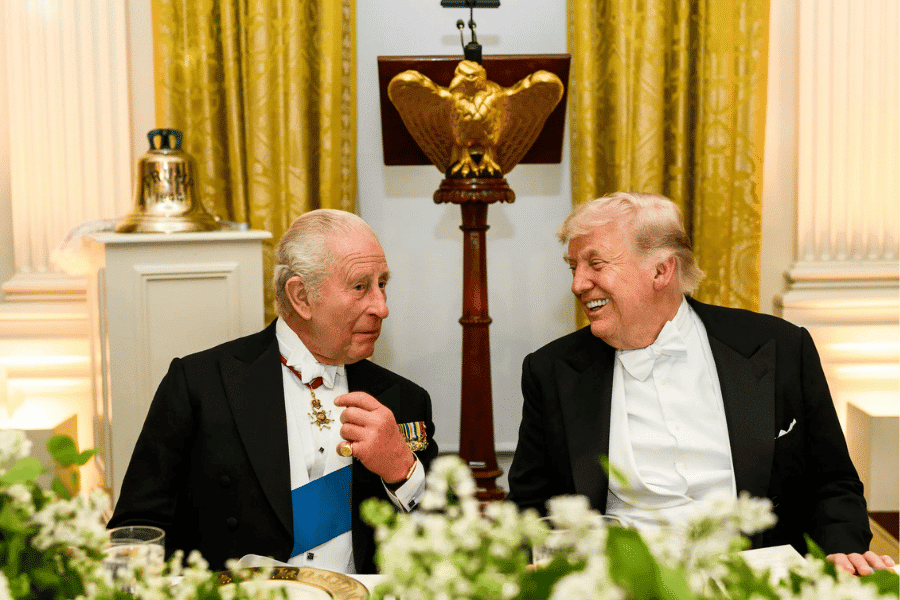
King Charles played a blinder, as British sports fans say. In late April, he addressed a joint session of the U.S. Congress and in the process, dazzled America with a charm and teasing wit that confirmed his top player spot in the international league of soft power.
A smitten Donald Trump, waving goodbye to the monarch at the end of his four-day state visit to the United States, concluded: “We need more people like that in our country.”
Commentators on both sides of the Atlantic dubbed the trip a diplomatic triumph, even as they questioned whether it would have any significant impact on mending the rifts in the fraying ‘special relationship’ between the two countries.
After his American interlude, it was back to the day job for Charles, donning crown and robes to ascend the throne of the House of Lords and read out the British government’s plans for the coming year in the midst of a full-blown political crisis.
Modern hereditary monarchs don’t do politics, or at least that’s the rule. But, as Charles showed in Washington, they have the leeway to highlight shared and universal values without contradicting the stance of the government at home.
Thus Charles used his Washington visit to gently remind the U.S. president and Congress of the checks and balances that exist to constrain executive power. He stressed the shared legacy of the Magna Carta, an eight centuries old charter that established that even monarchs are not above the law.
The enduring power of symbolic leaders
In an era in which political potentates seek to ape the power of kings, it was a timely warning that such a trend should not be allowed to contaminate what remains of the democratic world.
Politicians come and go (or at least they are supposed to). So is there a role for more enduring international figures to exert a moral influence on the course of world affairs?
Which brings us to the pope. At least the pontiff is elected; who hasn’t watched Conclave? But like Charles, he is there for life. Considering that he leads a congregation of some billion and a half Catholics, his writ runs further than that of the U.S. president’s or the British king.
Since Leo XIV was installed a year ago as the first American pope, his moral stance on a range of issues disrupting the modern world have put him at odds with the administration that rules the country of his birth.
His critiques of immigration restrictions, foreign wars and the rise of ethno-nationalism have irked President Trump and swathes of the MAGA right. Add to that his pronouncements on the potential perils of AI and Leo faces further pushback from those who believe he is going beyond his spiritual brief.
A place for papal pronouncements
Leo is not the first modern pope to exert a political influence on the secular world. During his 27-year reign that ended in 2005, Pope John Paul II was widely credited for hastening the collapse of communism in his native Poland and beyond.
But that was in the days when papal pronouncements reflected the interests of the United States and other anti-authoritarian democracies.
In a world increasingly exposed to divisive authoritarian temptations, figures who stand above politics can use their status and their voices to reinforce the primacy of universal values and the shared interests of all humanity.
In the face of spreading nationalism and nativism, their messages can come across as progressive or insufferably woke, depending on the audience. King Charles did not shrink from raising current threats to the planet and the need to combat climate change before a potentially contrary audience in Congress and the White House.
Similarly, the pope’s progressive pronouncements on immigration and the legitimacy of the Iran war have clashed with the stance of the Trump administration while subtly shifting sentiment among even conservative American Catholics.
Among the small cohort of such progressive international influencers, it would be churlish not to mention the Dalai Lama, the 90-year-old who mused almost a decade ago that a woman might succeed him as leader of the Buddhist faith. His prediction incidentally came at the same time as he described the first Trump administration as defined by a “lack of moral principle”.
There was a time when princes, emperors and religious leaders raised armies in support of their own interests or sectarian causes. In a perilous world, they perhaps have a new task to perform in stressing the unity of humanity in confronting the divisions that threaten it.
Questions to consider:
1. Why can a leader with little power, like King Charles, exert influence on the international stage?
2. What makes a pope powerful when it comes to world politics?
3. Can you think of someone in your life who has significant power without holding an elected office?