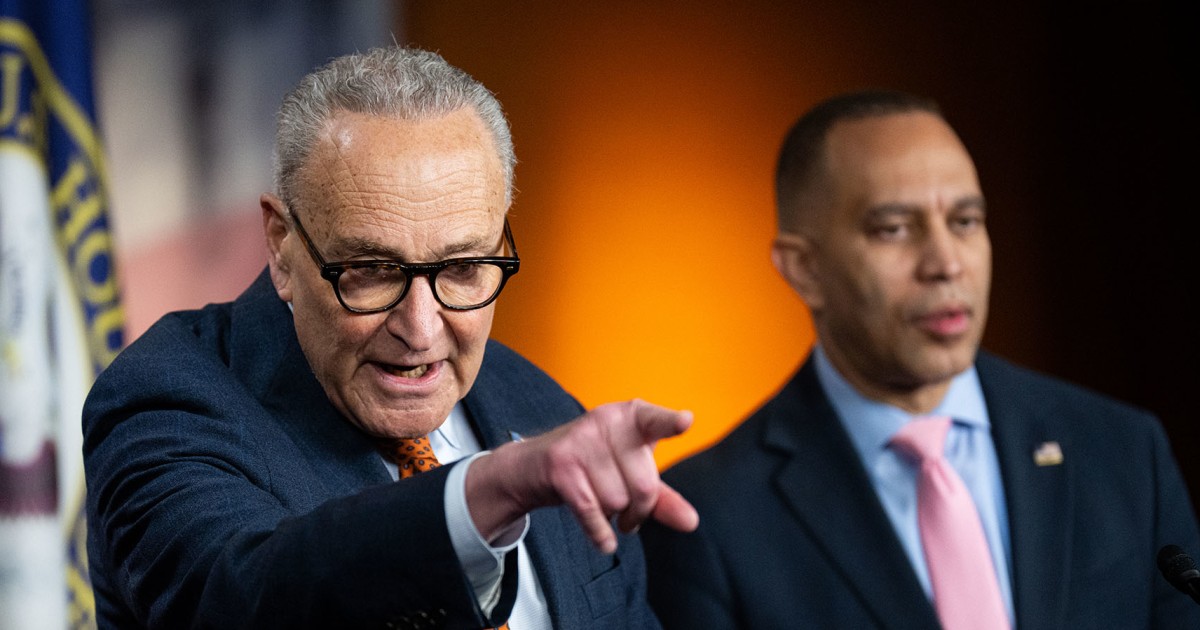
Onstage and on the sidelines of the recent Jewish Democratic Council of America Leadership Summit in Washington, prominent pro-Israel Democrats tiptoed into one of the biggest debates roiling their party.
Subscribe to read this story ad-free
Get unlimited access to ad-free articles and exclusive content.

It’s not clear if the party’s voters are coming along with them.
A dramatic shift in how Democratic voters feel about Israel has shaped party primaries so far in this midterm election. But some Democrats warn that legitimate criticism of Israel from the left has meant turning a blind eye when some criticism veers into antisemitism, repelling Jewish voters.
As Democrats pin their fortunes in the 2026 election to voter backlash against President Donald Trump, they’re making the case that Democrats who feel poorly represented at home can understand the distinction between feelings about a country’s political leadership and feelings about the nation — whether at home or abroad.
“‘I will not stay silent because my country changed her face. I will not give up reminding her, and sing in her ears until she will open her eyes,’” former House Speaker Nancy Pelosi said onstage at the summit, quoting an Israeli poem to argue “differences of opinion” with Israeli leaders shouldn’t weaken support for Israel in the U.S.
“Isn’t that a beautiful poem?” Pelosi said. “Could be about the United States.”
Support for the U.S.-Israel relationship had been a consistent bipartisan issue for decades in Washington. Hamas’ attack on Israel in 2023, which left about 1,200 people dead and another 251 captured, briefly strengthened that feeling. But Israel’s subsequent military campaign in Gaza has driven a significant, deeper-than-ever divide among Democrats and independents, especially among younger voters.
NBC News polling from earlier this year found that 57% of Democrats had a negative view of Israel, up from 35% in 2023. And two-thirds of Democrats said their sympathies were more with Palestinians than with Israelis in the Middle East, up from 18% in 2013.
Earlier this year, Gallup polling found that Americans, for the first time in 20 years of asking the question, said they were more sympathetic to Palestinians than to Israelis. Just like in NBC News’ polling, that shift was powered by massive movement among Democrats and independents, while the majority of Republicans choosing Israel remained relatively constant.
That growing frustration with the war in Gaza and with Trump and Israeli Prime Minister Benjamin Netanyahu’s partnership in the Iran war has given Israel’s critics in the party new momentum — and seen tangible results both in Congress and on the campaign trail.
More than a dozen Democratic lawmakers have described Israel’s conduct in Gaza as a genocide, according to the news site Zeteo, with progressives pushing their candidates to weigh in on the debate on the campaign trail. Debates over Democratic primary spending by pro-Israel groups like AIPAC, the American Israel Public Affairs Committee, have taken center stage in a handful of prominent primaries.
And there are more battles to come, including a rematch of the brutal 2024 primary between Rep. Wesley Bell and former Rep. Cori Bush and a divided Michigan Senate race in which debates over Israel policy have become a primary focus. Last week in Philadelphia, the progressive candidate took an open Democratic primary after a campaign that included significant debate about Israel.
“The mantra of this campaign is: Our fates are intertwined,” Pennsylvania state Rep. Chris Rabb, who won the Democratic primary to replace the retiring Rep. Dwight Evans in a district that’s the bluest in the U.S., said in a recent interview with Rep. Ro Khanna, D-Calif. “So what happens overseas impacts us domestically, and vice versa.”
“We are using our taxpayer dollars for a genocide for which we are complicit — and now in Iran — that’s money that could be invested in our communities here,” Rabb said.
At the conference, pro-Israel Democrats said they’re still heartened by their belief that the party’s congressional leadership is standing behind them. The top two Democrats in Congress, Senate Minority Leader Chuck Schumer and House Minority Leader Hakeem Jeffries, both spoke at the Jewish Democratic Council’s summit, where they emphasized their support for Israel and their commitment to fighting antisemitism.
“Our leadership continues to strongly stand with our views and values, as it relates to Israel. We have not seen the leadership of the party change, waver on this matter,” Halie Soifer, the CEO of the Jewish Democratic Council of America, told reporters on the sidelines of the conference.
“However, we also understand that that does not mean that one needs to rubber-stamp the agenda of Prime Minister Netanyahu,” she continued. “We as American Jews are both pro-Israel, connected to Israel, feel this attachment to Israel, but also disagree with the policies of this current right-wing, extreme government in Israel. So, you know, we are holding both, and many of our Democrats appear to be doing so as well.”
But as Soifer also admitted, there have been policy implications to Democrats’ growing frustration with Israel’s political leadership, ones that her group doesn’t support.
The number of Democratic senators voting to block certain weapons sales to Israel has grown significantly. The most recent round of votes to disapprove of the sale of specific types of bombs and bulldozers won a clear majority of Democratic senators.
“Most of them are sending a message about disapproval of policies of this government. It doesn’t mean that they’ve turned their back on the security relationship with Israel writ large,” Soifer said. “It doesn’t mean they don’t support Israel’s right to exist as a Jewish, democratic state.”
Democratic Sen. Chris Coons of Delaware made a similar point during his roundtable at the conference, but delivered a warning to his colleagues when reporters asked him about those votes.
“It’s important for my colleagues to be careful about what message they’re trying to send. I strongly support Israel’s right to exist, its right to be a Jewish homeland and a democracy, and its value to the American people as a partner and ally,” Coons said, adding: “I think we are at risk of some of my colleagues — in trying to send a message to Netanyahu or in opposition to his policies and stances — to be misunderstood as abandoning that commitment.”
Coons and others raised concerns about other potential risks they believe Democrats might be taking on — particularly by association — as they show their frustration with Israel’s conduct. Multiple attendees and speakers invoked left-leaning streamer Hasan Piker, who has drawn the ire of pro-Israel Democrats in recent months for repeated comments defending Hamas and lambasting Israel, most recently saying during an interview with “Pod Save America,” “I would vote for Hamas over Israel every single time.”
Piker is a prominent voice on the party’s left flank whose large audience has a significant contingent of younger voters, and he’s been embraced by a handful of progressive candidates in recent years. Some have distanced themselves from his most controversial comments, like when then-New York City mayoral candidate Zohran Mamdani condemned Piker’s past comments about 9/11. But others have not, inviting him to appear on the trail with them or appearing on his streams.
The mere mention of Graham Platner, the leading Democrat in the important Maine Senate race, triggered a wave of gasps and shaking heads at the Jewish Democratic conference. Platner has faced criticism from both Democrats and Republicans for having a tattoo that resembled a Nazi symbol, which Platner has said he did not realize the significance of when he got it in his 20s. He has since covered up the tattoo.
When discussing how her group will deploy its resources as part of a seven-figure campaign to mobilize Jewish voters, Soifer teased its upcoming involvement in Michigan’s Senate primary, where the group plans to oppose former public health official Abdul El-Sayed, who recently appeared with Piker and declined calls to disavow the streamer’s past comments.
And when asked about Platner, who condemns the war in Gaza as a genocide, Soifer said that while “we very much want to take back control of the Senate … it could be that at the end of the day, we just stay out of Maine, don’t get involved, even if the party has decided to fully embrace Platner.”
The implications of those associations were clearly on the minds of conference attendees, one of whom asked Minneapolis Mayor Jacob Frey for advice from a political leader in a liberal city about how to communicate the importance of supporting Israel “when becoming anti-Israel, even anti-Zionism, has become a litmus test in so much of the Democratic Party.”
In an interview, Frey told NBC News: “You can be a patriot and be a lover of country and simultaneously believe that those governing it are wrongheaded. That is how I feel about America — that is simultaneously, in many senses, how I feel about Israel.”
“I am concerned when free speech dovetails into antisemitism and hate,” he added. “We need more people that have political courage — it’s easy for me to go against Republicans and disagree with them, and you’ve got a cheering section on the Democratic side. What’s hard, again, is to tell your own side at times what they don’t want to hear, your own extreme.”