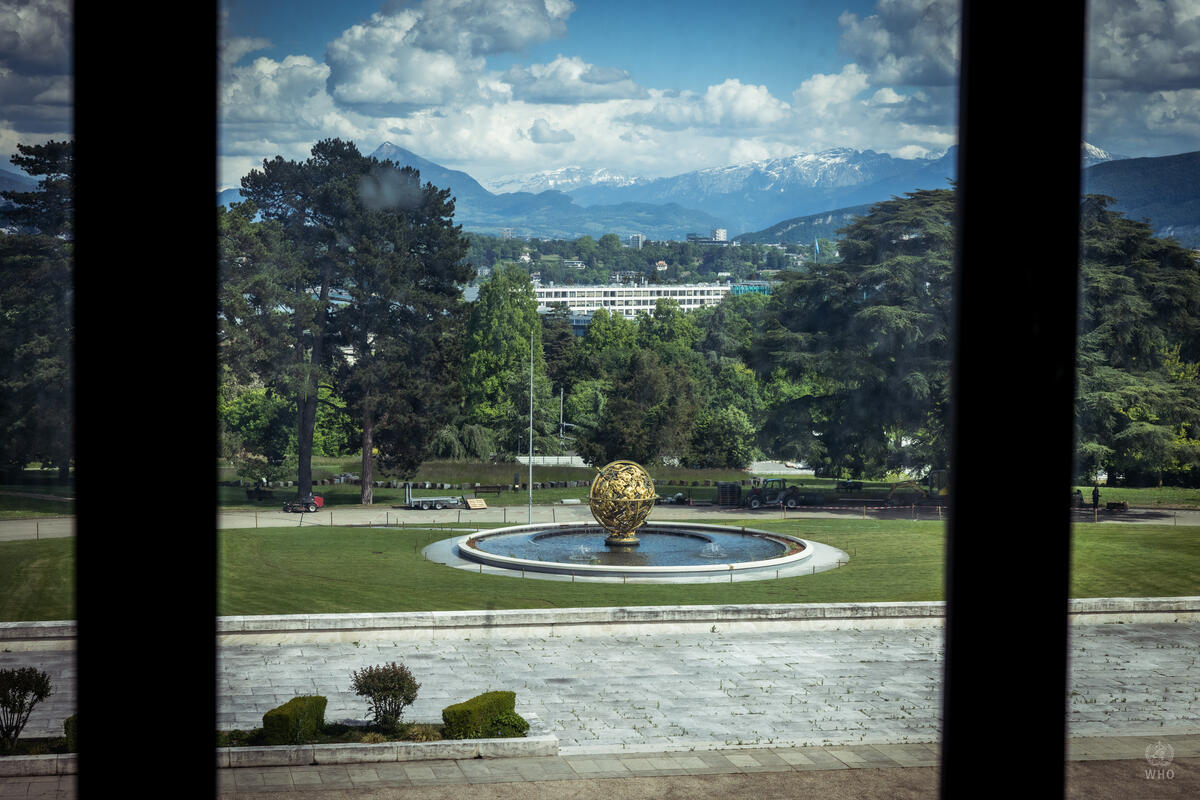
At this year’s World Health Assembly in Geneva, delegates debated some of the world’s most difficult and divisive issues. Discussions touched on conflict, humanitarian crises, geopolitical tensions and the growing pressures facing global health systems.
At times, the debates reflected a world that feels increasingly fragmented.
And yet, amid all these differences, one thing stood out with remarkable clarity: every Member State remained united behind one common goal — the eradication of polio.
Countries that disagree profoundly on many political issues nevertheless continue to stand shoulder to shoulder when it comes to protecting children from lifelong paralysis. Iran and Israel. Russia and Ukraine. Countries from every region, every political system and every level of development all reaffirmed their commitment to achieving and sustaining a polio-free world.
One colleague observing the Assembly discussions described this as a “Lichtblick” — a German word meaning a “ray of hope”.
It is a fitting description.
Because in today’s world, polio eradication represents something much greater than a disease programme alone. It is one of the few remaining examples of a truly universal humanitarian cause — one capable of uniting governments, civil society, health workers and communities around a shared human objective.
That unity matters.
And perhaps there are lessons in it for the broader future of global cooperation.
Throughout the Assembly, delegates also repeatedly returned to another important question: what should the future global health architecture look like in an increasingly complex and fragmented world?
One message emerged particularly clearly from those discussions: global health cannot be driven by governments alone. Member States repeatedly emphasized that civil society, communities and local actors must remain central to both decision-making and implementation.
In many ways, the Global Polio Eradication Initiative (GPEI) already represents one of the strongest examples of this model in practice.
For more than three decades, governments, multilateral organizations, scientists, frontline health workers and civil society partners such as Rotary International have worked side by side toward a shared humanitarian goal. The result has been not only extraordinary progress toward eradication, but also the creation of one of the largest and most effective public-private partnerships in global health history.
At a time when the world is actively reflecting on how to strengthen multilateral cooperation and global health systems, there may be important lessons to learn from the GPEI experience — particularly the recognition that lasting progress depends not only on institutions, but also on communities, trust and shared ownership.
This spirit of cooperation was also reflected in broader Assembly discussions on climate change, air pollution and energy poverty, where Member States and partners emphasized the need for coordinated global action and stronger community-centred health systems. While these challenges differ in nature, they share an important lesson with polio eradication: no country can solve them alone, and lasting progress depends on trust, partnership and collective responsibility.
Together, GPEI partners have reduced wild poliovirus cases globally by more than 99.9%.
In doing so, they have also built something much larger: surveillance systems, laboratories, emergency operations centres, community trust networks and outbreak response capacities that today support broader health security efforts worldwide.
But perhaps most importantly, they have built trust and common ground.
History has shown repeatedly that polio eradication efforts can create space for dialogue even in the most difficult environments.
During the civil conflict in Côte d’Ivoire in the early 2000s, local Rotary members helped bring together government and opposition forces to negotiate temporary ceasefires so vaccination teams could safely respond to a polio outbreak in the north of the country. Those humanitarian discussions later helped open channels for broader peace negotiations.
More recently, synchronized vaccination campaigns have continued across parts of Afghanistan and Pakistan despite periods of heightened political tension. In Gaza, extraordinary humanitarian coordination helped enable vaccination campaigns that successfully interrupted outbreak transmission.
Again and again, the effort to protect children from polio has demonstrated that even where politics divides, humanity can still unite.
Of course, the world faces many urgent challenges. Financing pressures, conflicts, competing priorities and humanitarian crises all place strain on global health systems and international cooperation alike.
But perhaps that is precisely why polio eradication matters so much today.
Because it reminds us that multilateralism can still work.
That collective action remains possible.
And that even in a divided world, there are still causes capable of bringing humanity together around a shared purpose.
The world is now closer than ever to eradicating polio forever.
But the final phase matters precisely because every remaining case is not simply a statistic — it is a child whose life will be permanently affected by paralysis.
That is why this effort continues to matter so deeply.
If we succeed, the achievement will not belong to one country, one organization or one generation alone.
It will belong to all of humanity.