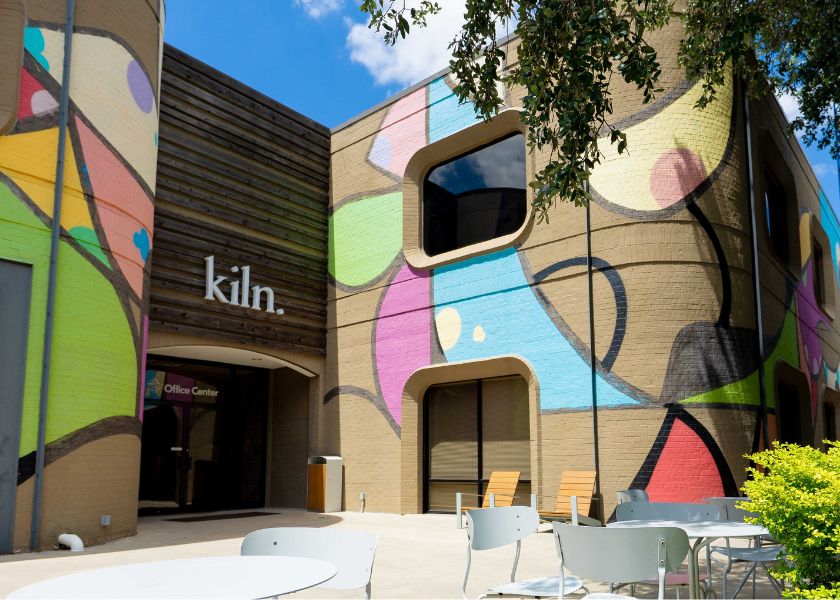
In a time when many companies are still trying to figure out how to get employees to get back into the office, the coworking brand Kiln is offering a solution: make the office somewhere people actually want to be.
Kiln focuses on providing hospitality-driven office space, where amenities and experience play an important role in defining the work environment. It operates in the coworking market. For the uninitiated, coworking refers to shared office spaces where individuals or small firms can rent a combination of private offices, communal work areas, and meeting rooms.


Based in Utah, Kiln operates more than 20 locations. Most of them are in the western United States, but the brand just made its North Texas debut with a new location in Preston Hollow, and it’s got another on the way in Plano.
The Preston Hollow location is situated in The Hill shopping center off North Central Expressway and Walnut Hill Lane, occupying around 23,000 square feet of second-floor space. Kiln’s Plano operation, expected to open late this year, will be a 28,000-square-foot space at The Shops at Legacy North.


Flight-to-quality has been animating the office market for a while now, but that kind of movement tends to lend itself to firms with a sizable footprint. Smaller operations, however, can still get in on the trend with high-end coworking spaces like Kiln’s.

“People need space to work, but they want to work in an environment that lifts them, inspires them, helps them recruit and retain talent, gives them a great place to collaborate,” said Kiln CEO Arian Lewis. “It’s no longer about space, it’s really about experience.”
Lewis described Kiln less as a traditional office provider and more as a “lifestyle brand” centered around community, flexibility, and workplace experience.
“Quality of life for our members comes first, and we think deeply about how to enhance that through every stage of our offerings,” he said.


The coworking market has evolved significantly since the COVID-19 pandemic accelerated remote and hybrid work trends, with even large corporations increasingly turning to flexible office arrangements rather than long-term leases. Memberships with Kiln can run from six months to a year or more.
Lewis said Kiln has seen growing interest from major companies looking to establish satellite offices without taking on large real estate liabilities.
“Kiln’s product is actually designed for teams of up to 30-40 and all the way right down to your individual creator or entrepreneur,” he said.
In some Kiln locations, companies such as Nvidia, Siemens, HP, and Aflac work alongside startups and independent professionals in a shared environment with amenities ranging from wellness rooms and kitchenette features to tiered event theaters and fully-equipped podcast/recording studios.


According to the company, the Preston Hollow location is already seeing strong early demand, with only three of its larger eight-person studio offices still available ahead of opening. The founding member base includes businesses tied to health and wellness, restaurant consulting, landscape architecture, finance, insurance, legal services, and marketing.
“Dallas is actually the number two coworking market in the United States,” Lewis told CandysDirt.com. “A lot of our members are coming from other coworking spaces. Most businesses in Dallas have bumped up against flex office or coworking in some form or fashion.”
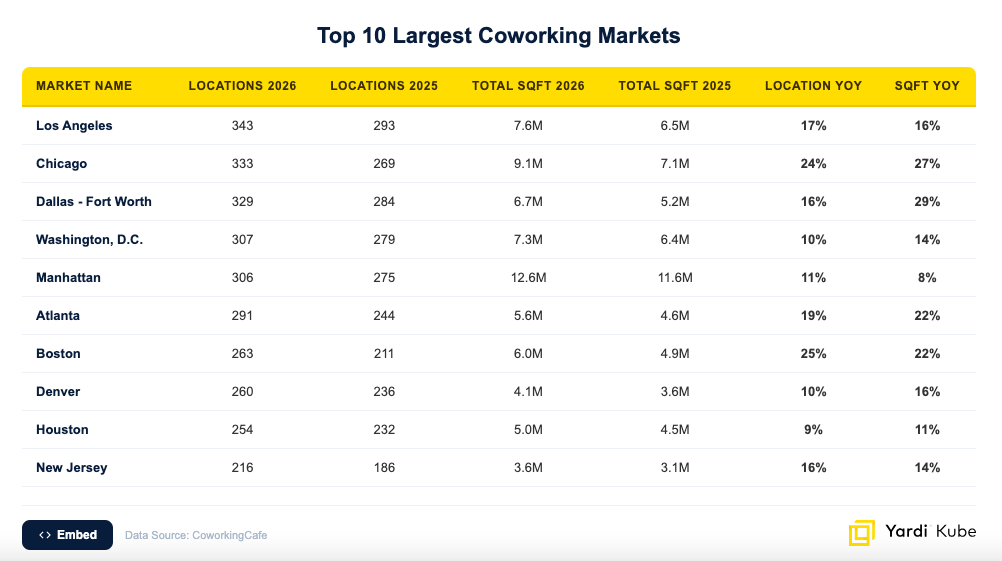
The Metroplex now has roughly 6.7 million square feet of coworking inventory after adding about 1.5 million square feet between early 2025 and early 2026 — a nearly 30% increase, according to a recent Yardi Kube report. Industry analysts say the growth reflects both the region’s strong economy and changing attitudes toward office space, and it’s made Dallas a target market for Kiln.
A looming game changer could impact the office market, though, as if the pandemic wasn’t enough. Instead of office workers being dispersed, it may be that companies need even fewer of them altogether. Advancements in AI are expected to replace a lot of white-collar jobs, meaning smaller (or even no) corporate footprints. Lewis, however, thinks this might strengthen demand for small collaborative environments — especially those willing to pay a premium. He argued that teams working in AI and innovation-heavy industries still rely heavily on in-person networking and knowledge sharing.

“When you think about what a team that’s building with AI really needs is they need top tier talent. They need a high amount of creativity. They need to move quickly, and they need to be learning from others around them,” he said. “And those are our strong suits.”