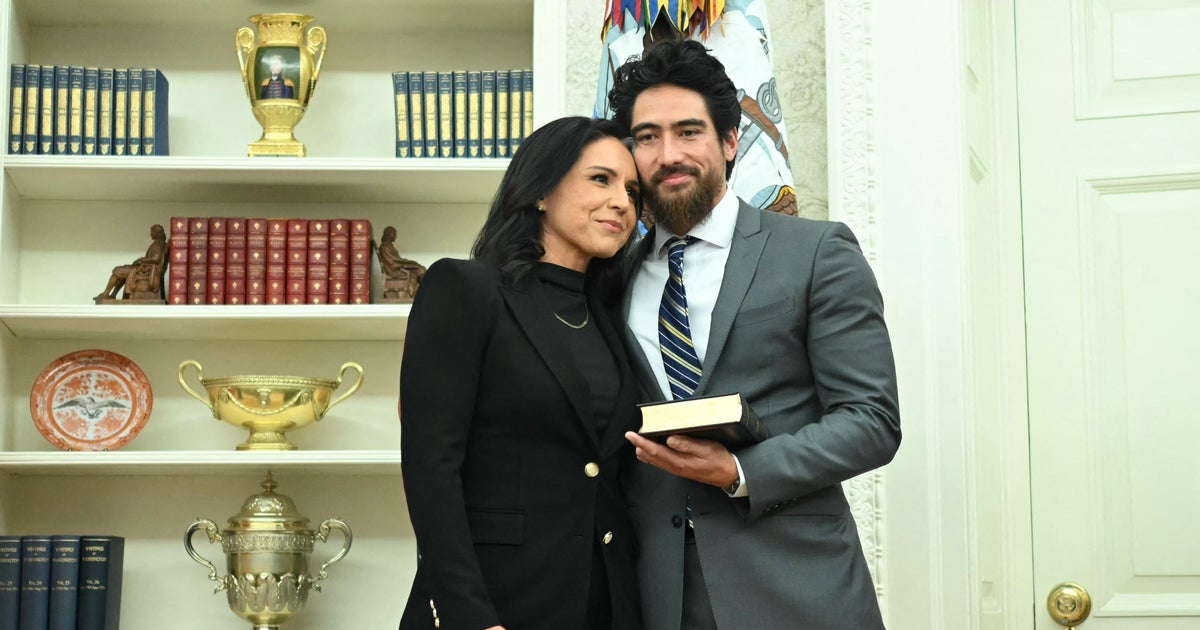
Washington — Tulsi Gabbard said Friday that she is resigning as the director of national intelligence, stepping aside after her husband was diagnosed with a rare form of bone cancer.
In a letter to President Trump, Gabbard said her resignation would be effective June 30.
“My husband, Abraham, has recently been diagnosed with an extremely rare form of bone cancer. He faces major challenges in the coming weeks and months. At this time, I must step away from public service to be by his side and fully support him through this battle,” she said. “I cannot in good conscience ask him to face this fight alone while I continue in this demanding and time-consuming position.”
Gabbard said her husband has been her “rock” during their 11-year marriage, which has included a deployment, political campaigns and her role in the Trump administration.
“His strength and love have sustained me through every challenge,” she said, adding that she is “fully committed to ensuring a smooth and thorough transition over the coming weeks.”
ANDREW CABALLERO-REYNOLDS/AFP via Getty Images 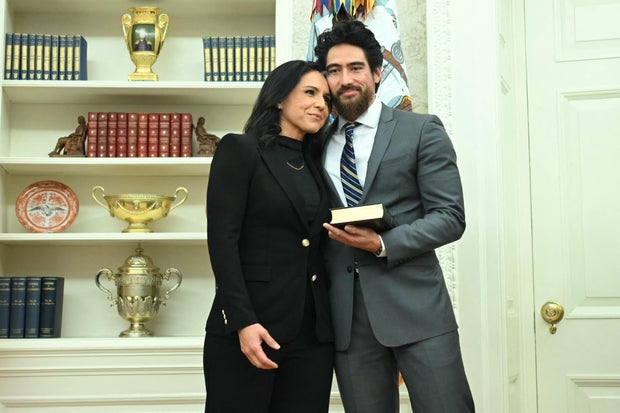
Mr. Trump praised Gabbard in a post on Truth Social, saying she “has done an incredible job.” He said Aaron Lukas, Gabbard’s deputy at the Office of the Director of National Intelligence, will serve as acting director in the interim.
Gabbard’s resignation was first reported by Fox News.
Gabbard is the fourth Cabinet member to leave the administration this year, following the departures of Attorney General Pam Bondi, Homeland Security Secretary Kristi Noem and Labor Secretary Lori Chavez-DeRemer.
Her departure will create an opening in a crucial role overseeing the 18 agencies that comprise the nation’s intelligence community amid the war with Iran.
Gabbard’s tenure
Gabbard, a former Democratic lawmaker who broke with her party to endorse Mr. Trump in 2024, was sworn into her post in February 2025. She had been firmly opposed to military intervention in Iran throughout her political career.
Appearing before Congress earlier this year, Gabbard did not express support for the current war, telling members that it’s up to the president to determine what constitutes an “imminent threat.”
In March, Gabbard’s top aide Joe Kent, who led the National Counterterrorism Center, resigned, saying “Iran posed no imminent threat to our nation.” Gabbard told lawmakers that Kent’s statement concerned her, without elaborating.
“Ultimately, we have provided the president with the intelligence assessments and the president is elected by the American people and makes his own decisions based on the information that’s available to him,” she said.
Before the bombings of Iran’s nuclear facilities in 2025, Mr. Trump said Gabbard was “wrong” when she testified to lawmakers earlier that year that Iran wasn’t building a nuclear weapon. Following Mr. Trump’s dismissal of the assessment, Gabbard accused the media of “taking my testimony out of context.”
Gabbard also raised alarms in January when she appeared at elections headquarters in Fulton County, Georgia, while the FBI executed a search warrant and took ballots and other records related to the 2020 election. Democrats questioned why the intelligence chief was involved in domestic law enforcement operations.
As DNI, Gabbard said last summer she would slash her office’s staff by around 40%, cutting its headcount to around 1,300. She estimated the cuts would save around $700 million annually. Gabbard said at the time that the ODNI had become “bloated and inefficient, and the intelligence community is rife with abuse of power.”
In a statement about her departure, GOP Rep. Rick Crawford of Arkansas, the chairman of the House Intelligence Committee, said Gabbard made “significant progress” on Mr. Trump’s priorities, including “implementing needed reforms to address the weaponization and politicization” of the intelligence community and “taking actionable steps to increase transparency.”
Sen. Mark Warner of Virginia, the top Democrat on the Senate Intelligence Committee, said in a statement that Gabbard’s replacement “must be committed to restoring trust in the office, protecting the integrity of our intelligence, and ensuring our nation’s intelligence professionals can speak truth to power, without fear or interference.”
Senate Minority Leader Chuck Schumer said the president “must not treat this vacancy as another opportunity to reward loyalty over competence.”
“Senate Democrats will fight any nominee who puts Trump’s politics ahead of America’s security,” the New York Democrat said.