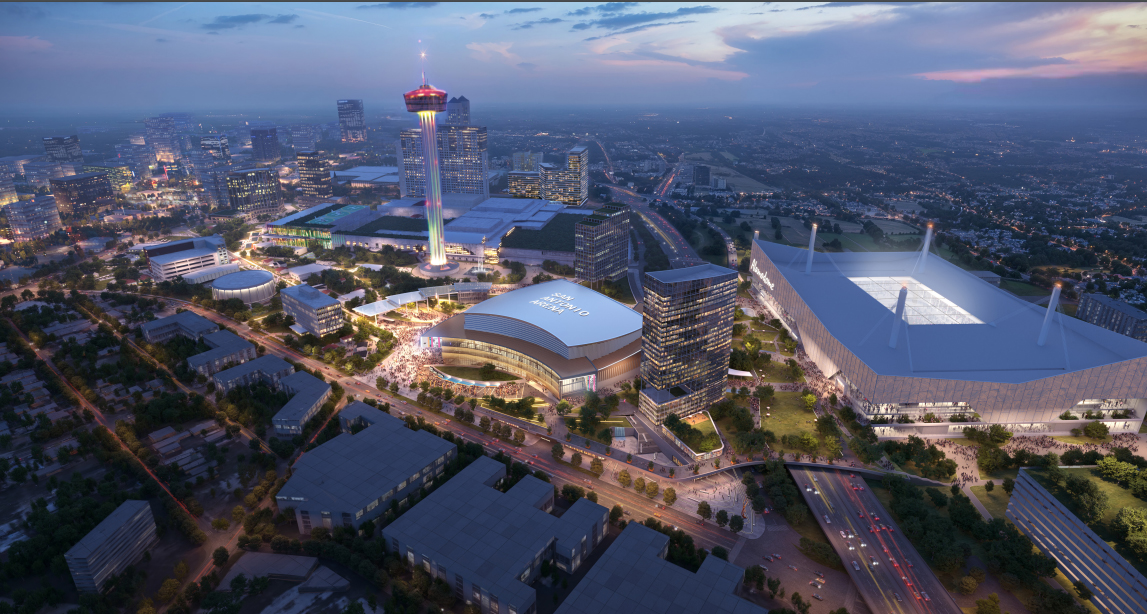

A rendering gives a first look at what a downtown sports and entertainment district could look like. It could involve a new arena for the Spurs, a renovated Alamodome, an expanded Convention Center, another Convention Center hotel and the John H. Wood Jr. Federal Courthouse refashioned as an event venue as well as mixed-use development around the facilities.
A City Council bloc wants San Antonians to vote on funding for key parts of a sports and entertainment district downtown in the city’s next bond election, potentially giving them another opportunity to weigh in on Project Marvel.

Councilman Edward Mungia has proposed putting district-specific projects in the bond package to a vote next year, and Mayor Gina Ortiz Jones and council members Ric Galvan, Jalen McKee-Rodriguez and Teri Castillo say they support the idea.
Article continues below this ad
City staff are looking into what form that could take on the ballot, a spokesperson said, but spinning off individual propositions for a specific area would be a shift from how the city has recently structured its bond programs.
Residents vote on bond propositions for broad categories of projects such as streets, bridges and sidewalks, drainage and flood control and parks and recreation across San Antonio neighborhoods.
The district will include a Spurs arena, renovated Alamodome, expanded Convention Center and second Convention Center hotel. If voters were to reject Project Marvel-specific bond packages, such as street upgrades or parking crucial to making it a reality, officials would have to look elsewhere for the funding. And if property values across the city continue to decline, that money would be hard to come by.
“Whether people are for or against this, it’s a radical re-envisioning of downtown, especially in that very specific area,” Mungia said at a City Council meeting on May 13.
Article continues below this ad
But some council members, including Marina Alderete Gavito, Marc Whyte and Misty Spears, said such a carve-out would be inappropriate. Residents across the city could use streets or ramps funded by the bond to go to a Spurs game or visit other venues in Project Marvel, just as they’d visit parks or use sidewalks in various parts of town.
“Usage is going to be from all over the city,” Alderete Gavito said at the meeting.
In an interview, Mungia said discussions about splitting off Project Marvel-related items in the bond program started last fall when voters were asked to support spending up to $311 million in Bexar County hotel and rental car tax dollars to help build a $1.3 billion Spurs arena at the former Institute of Texan Cultures se at Hemisfair.
About 52% of voters approved public spending on the arena.
Article continues below this ad
Some $500 million for the arena is coming from Spurs Sports & Entertainment, which would also cover cost overruns.
The city agreed to kick in up to $489 million through a combination of its share of state hotel taxes, property tax revenue from new development and ground leases for that development around the arena, the centerpiece of Project Marvel. San Antonio’s contribution was contingent on the county’s measure passing.
Those financing sources are tied to tax and lease revenue generated from Hemisfair properties and development around the arena. But the bond is different, Mungia said.
Council members vie to divvy up limited bond dollars for projects in their districts. The more funds that go to Project Marvel improvements, the less bond money there is for projects in other parts of the city.
Article continues below this ad
“Yes, it’s unprecedented to separate the bond, but in my mind it’s also unprecedented that we have such a large project in one geographic area,” Mungia said.
The November county election results offer “even more reason” to have separate propositions, Mungia added.
The Spurs organization spent nearly $8 million to persuade voters to approve the county money for the arena. In the weeks before the election, the University of Texas at San Antonio’s Center for Public Opinion Research, Political Science and Geography poll found that 40% of likely voters supported the proposal and 46% were against it.
In other words, the jury may still be out on public support for the sports and entertainment district.
Article continues below this ad
“It merits its own vote,” Mungia said of Project Marvel.
Councilwoman Sukh Kaur, whose district includes downtown, said in an interview that she wants more details from city staff about what upgrades the city wants for Project Marvel versus what improvements residents in nearby neighborhoods are already clamoring for, such as new traffic lights.
Kaur also questioned which projects would be considered part of the district. For example, would helping build apartment complexes with lower rents downtown fall under the general affordable housing category in the bond or under the district-specific proposition for housing?
“You could tease out issues like this in every single one of these propositions,” Kaur said.
Article continues below this ad
District price tag
Details about the bond program — and infrastructure costs for Project Marvel — are still fuzzy.
It’s unclear what size the bond will be, but it will likely be far less than the record $1.2 billion package voters approved in 2022, the most recent bond election. That’s because of declining property tax collections — general-obligation bond debt approved by voters is repaid with a portion of the city’s property tax revenue.
Council members are weighing whether to increase the city’s property tax rate to pay a larger bond. If they decide to leave the tax rates alone, city staff said in January that a future bond could pay for $625 million worth of projects.
Article continues below this ad
City staff haven’t finalized a price tag for infrastructure projects for the downtown district. They estimated last summer that the first phase of improvements could cost up to $250 million, but have since said they’re revising that figure and plan to give council members an update later this year.
The city also is hiring a consultant to study parking, public transit, ride-hailing services and other “accessibility and mobility” aspects downtown. Those recommendations could shape what upgrades are necessary for Project Marvel.
The earliest the bond could go to voters is May 2027, which many council members favor over November of that year, because creeping inflation is making construction increasingly expensive. The later the bond election, the more costly the projects could be.
But many details have yet to be hashed out, including who will serve on the committees that discuss and rank potential bond projects. City Council would have to call a May election by mid-February.
Article continues below this ad
City staff are recommending five categories for the next election: streets, bridges and sidewalks; drainage and flood control; parks and recreation; facilities; and affordable housing. Each category would be an individual proposition on the ballot.
It’s unclear how Project Marvel-specific items could appear on the ballot. The city spokesperson said city staff are still figuring that out.
The more initiatives there are on a ballot, the more complicated it gets for voters, said Bryan Gervais, director of the UTSA Center for Public Opinion Research, Political Science and Geography.
Project Marvel-specific ballot initiatives could confuse residents who recall voting on the county funding for the arena last year and are wondering why they’re being asked for more money, Gervais said. The bond is the city’s program and isn’t paying for the arena, but voters may not know the distinction.
Article continues below this ad
“I suspect it’s going to be really hard and clear to communicate what’s going on,” Gervais said.
Adding a sixth category for district projects is unlikely. At the May 13 meeting, Mungia asked about creating such a category, which could encompass sidewalks, flood control measures or other work specifically for Project Marvel.
City staff said bond attorneys told them the city can’t put one proposition encompassing an array of projects across the five categories on the ballot. There would have to be individual propositions divvying up district-specific items depending on type, such as one proposition for parks and recreation projects broadly and another proposition for parks and recreation work tied specifically to Project Marvel.
Article continues below this ad
“We should all be mindful that we may be setting a precedent for geographical-based propositions,” Walsh said.
One idea floated at the May 13 meeting, also by Mungia, was to look to a different city mechanism to pay for Project Market-related work.
He said city staff could evaluate whether funds from a project finance zone that City Council created in 2025 could be used to pay for Project Marvel infrastructure. The zone allows San Antonio to collect the state’s portion of tax revenue from certain hotels.
Article continues below this ad
“You eliminate a political battle,” Mungia said.
City staff have proposed using revenue from within the zone to build the arena, expand the Convention Center and overhaul the Alamodome.