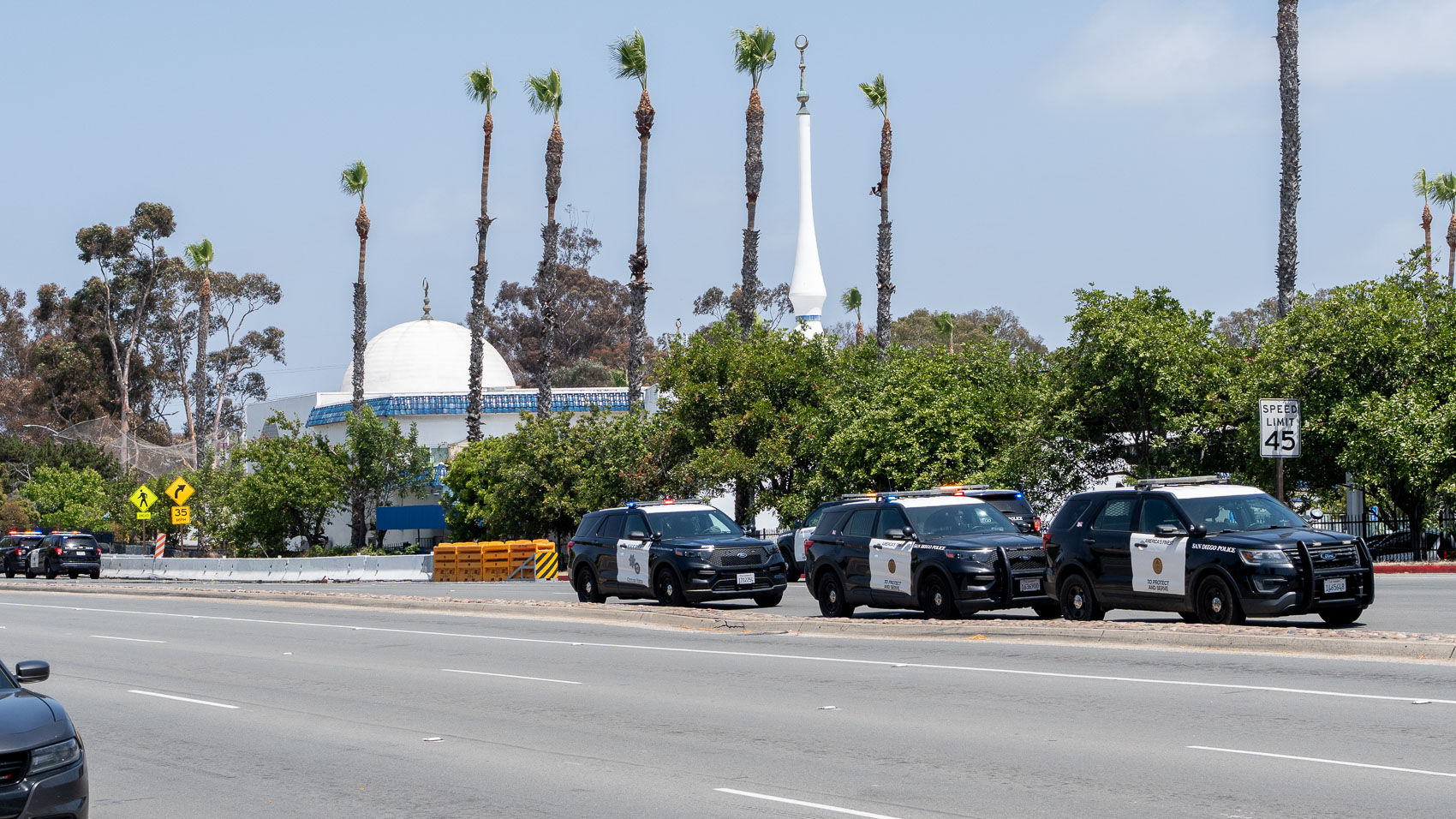

One of the suspected teen shooters in Monday’s hate-inspired rampage at the Islamic Center of San Diego had gone to high school dressed like mass shooters, and once came to class dressed as the TV show serial killer Dexter Morgan, according to court documents obtained by Times of San Diego.
The documents, in which a detective concludes that the teen “would be a danger not only to himself but to others,” reveal the extent to which then-17-year-old Caleb Vazquez’s parents, classmates, school administrators and the Chula Vista Police knew about his radicalization and idolization of mass shooters and of Adolf Hitler.
Ultimately, police determined there was cause to seek a gun-violence restraining order — which allows courts to remove a person’s firearms if they pose a threat to themselves or others, following a petition from a third party — to prevent Vazquez from buying or possessing weapons.
“[His] behavior is very concerning. He has become increasingly obsessed with mass shooters, school shootings, neo-Nazi affiliations, and Hitler. He has expressed suicidal ideations and thoughts of self-harm,” reads the January 2025 petition for the gun violence restraining order.
That order was temporarily granted, and the father stated he would place the 12 guns in storage. In February 2025, Chula Vista Police requested to continue the hearing on the gun violence restraining order until March 11.
On March 11, 2025, San Diego Superior Court Judge Enrique Camarena rescinded the restraining order and dismissed the case.
The court documents do not spell out why the order was rescinded. They do not say whether the guns were ever confiscated or why the order was not permanently granted, despite the detective’s declaration.
Chula Vista police detectives were called in January 2025 after two of Vazquez’s friends went to High Tech High Chula Vista’s vice principal to report that Vazquez had told them not to go to school the next day, implying that he was planning violence, according to the restraining order.
The night of the report, detectives went to Vazquez’s Chula Vista home to conduct a welfare check. Marco Vazquez, Caleb’s father, was “uncooperative,” and there was a “lack of cooperation” with police, the gun violence restraining order says. The family also prohibited detectives from interviewing Caleb Vazquez alone, and his parents refused to let detectives view what Caleb Vazquez’s friends had said were “concerning” social media posts, according to the order.
The teen’s father then informed police that he had 12 registered firearms in the home and assured detectives that he would secure them, the documents show.
“The father’s lack of cooperation hindered officers’ ability to fully assess and evaluate the reported concerns and ensure the safety of all parties involved,” reads a court declaration from Chula Vista Detective Nicholas How, dated four days after the vice principal’s call to police.
While detectives could not interview the teen alone, they did speak to him with his parents present. Records show the teen said he was “having ongoing issues with a ‘trans student’” and other students were bullying him for “being the shy, quiet kid, for the way he dresses, and for having conservative views about the world,” reads How’s declaration.
The parents, How wrote, were supportive of their son and believed the allegations that he was planning school violence were false.
The following day, detectives visited High Tech High in Chula Vista and spoke to the vice principal, who had contacted them.
The vice principal informed them that Vazquez had “displayed troubling behaviors over the past year,” and had made comments about school shootings and other violence.
The school administrator said Vazquez had been seen punching a tree after his girlfriend broke up with him.
In the days and weeks that followed, Vazquez had come to school dressed as the fictional serial killer Dexter Morgan from the HBO program “Dexter.”
“[Vazquez] emulating such a character suggests a troubling fascination with themes of violence, control and morality centered around killing,” the detective wrote.
Vazquez, according to the restraining order, spoke of a “day of retribution” and “expressed fascination” with mass shooters who conducted fatal attacks in Isla Vista, California; El Paso; Norway and elsewhere.
“This act could be interpreted as an alarming indicator of deeper psychological concerns or a potential fixation on violent or dangerous ideologies,” How wrote in his declaration.
The vice principal also told detectives that Vazquez was seen pointing a banana at other students and pretending it was a gun, and showing up to school with a shaved head so he could look similar to those in concentration camps. The vice principal also denied that there was any transgender student with the name that Vazquez had told police during their interview.
Following his interview with police, Vazquez told school resource officers and members of the San Diego County Psychiatric Emergency Response Team that he was upset about his breakup and was also becoming “increasingly infatuated” with mass shootings and World War II. Vazquez said he idolized Adolf Hitler and was gathering information about him and mass shooters on the “dark web.”
Following the interviews with school resource officers and the county’s Psychiatric Emergency Response Team, Vazquez was placed on a 72-hour mental health hold for evaluation.
“Based on the totality of it all, with the depression starting from last year with the breakup from his girlfriend and obsession of mass shooters, along with his father owning twelve firearms inside the residence, it was determined [Vazquez] would be a danger not only to himself but to others as well,” How wrote.
How recommended a gun violence restraining order — a specific type of court order that bars someone from owning guns or ammunition — was needed to prevent Vazquez from purchasing firearms on his then-upcoming 18th birthday.
According to a court minute order, also obtained by the Times of San Diego, on March 11, 2025, Judge Enrique Camarena, less than two months after police visited Vazquez, officially rescinded the temporary gun violence restraining order and dismissed it “without prejudice.”