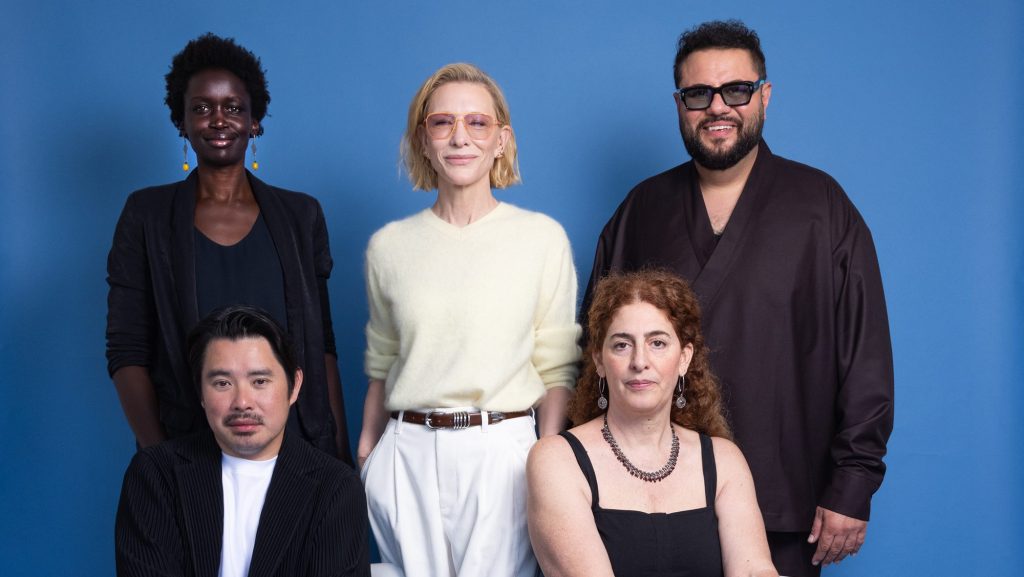
“I don’t think it’s political, I think the issues get politicized,” said Cate Blanchett at the Deadline Studio in Cannes, regarding how stories about displacement can contribute to political discussions at film festivals and beyond.
The actor, producer and global Goodwill Ambassador for UNHCR was at the Cannes Film Festival to announce the second cohort of her Displacement Film Fund (DFF). This year’s selected filmmakers are Palestinian-American comedian-writer-director Mo Amer, Palestinian director Annemarie Jacir, South Sudanese filmmaker Akuol de Mabior, Vietnamese-American filmmaker Bao Nguyen and renowned Cambodian director Rithy Panh.
In partnership with the International Film Festival Rotterdam’s (IFFR) Hubert Bals Fund (HBF), the DFF aims to champion and fund the work of displaced filmmakers, or filmmakers with a proven track record in creating authentic storytelling about the experiences of displaced people. Each of the nominated filmmakers will receive a production grant of €100,000 ($116k) to make the short films. The completed projects will then world premiere at IFFR’s next edition, running from January 28 to February 28, 2027.
“This fund is really about bringing the human face and the incredible stories of resilience, humor and invention that these extraordinary filmmakers bring to life,” Blanchett explained alongside Amer, Jacir, Mabior and Nguyen. “I think these things get politicized and this program is about breaking that narrative down.”
Politics and Palestine have been hot topics at this year’s fest, with discussions about blacklisting actors in Hollywood for expressing pro-Palestine views being most notably addressed by jury member Paul Laverty and The Beloved star Javier Bardem during press conferences.
When asked whether she thinks that there is a correlation between expressing certain political views and being blacklisted in the industry, the Black Bag actress replied, “I think the press has a really important role to play in this. It’s important to create forums where nuance can breathe and I think politics is all about solutions and outcomes and that’s often fear based. Whereas storytelling and filmmaking is about connecting with people and bringing that nuance to life, so as I said, it’s not political.”
Later on in the conversation, Palestine 36 director Jacir chimed in to shed light on the “unnamed blacklist” that affects non-celebrities in the film industry: “There’s a blacklist, sort of an unnamed blacklist, that when you hear voices that are not acceptable but are part of the mainstream, and because we’re not celebrities, that’s very real and that’s been going on for a long time.”
Jacir added: “So, to be at something like this, the Displacement Film Fund, we connect to other artists who are also coming from communities that have not been heard from or have been vilified. For us as Palestinians, just to tell our story, is to insist on the right to our memory, our story and to talk about who we are without control. Without somebody else deciding what that should be.”
To see the full conversation, click on the video above.
The Deadline Studio at Cannes is sponsored by SCAD.