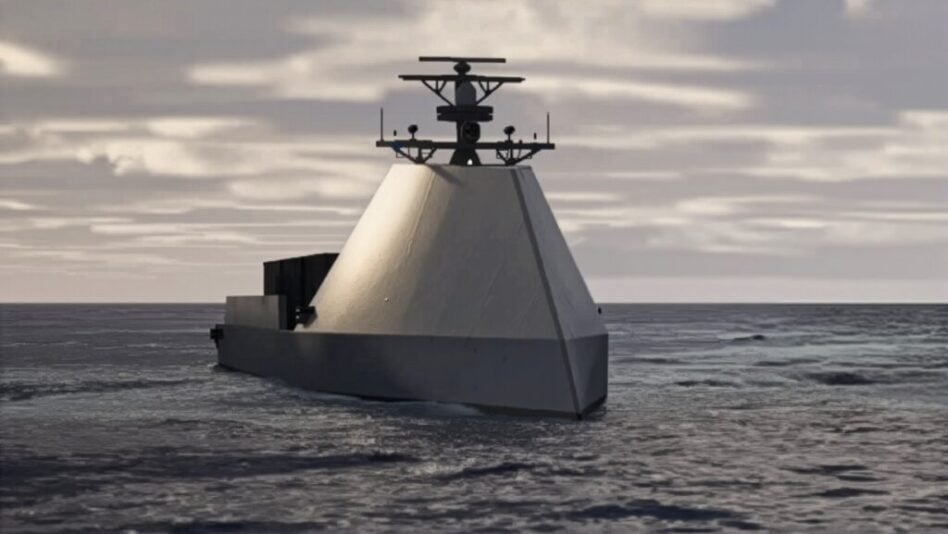

Seven designs have been tapped by the Navy to develop medium unmanned surface vessel prototypes as part of the sea service’s foray into robotic systems, USNI News has learned.
Out of about two dozen options submitted for the MUSV marketplace, the unspecified shipbuilders will develop vessels that will be tested against Navy requirements for the robotic craft, service spokesperson Capt. Ron Flanders said in a Friday statement to USNI News.
“The Navy selected seven entrants in the Medium Unmanned Surface Vessel (MUSV) marketplace to advance to the next phase – prototype evaluation,” Flanders said. “Selected industry partners must successfully complete at-sea demonstrations to prove the maturity of their systems… After successful at-sea demonstrations prior to October 2026, the Navy plans to work with industry to have vessels available for Navy leasing or procurement in fiscal year 2027.”
The basic requirements include the vessel having the ability to travel 2,500 nautical miles at 25 knots in sea state 4 carrying a payload of up to 25 metric tons, according to naval solicitation documents published in late March. The payload needs to accommodate at least two 40-foot shipping containers and operate autonomously with the shipbuilder able to field an operational vessel by Fiscal Year 2027.
Shipbuilders able to meet the requirements during the prototype phase will receive $15 million and be eligible for follow-on production, according to the solicitation.
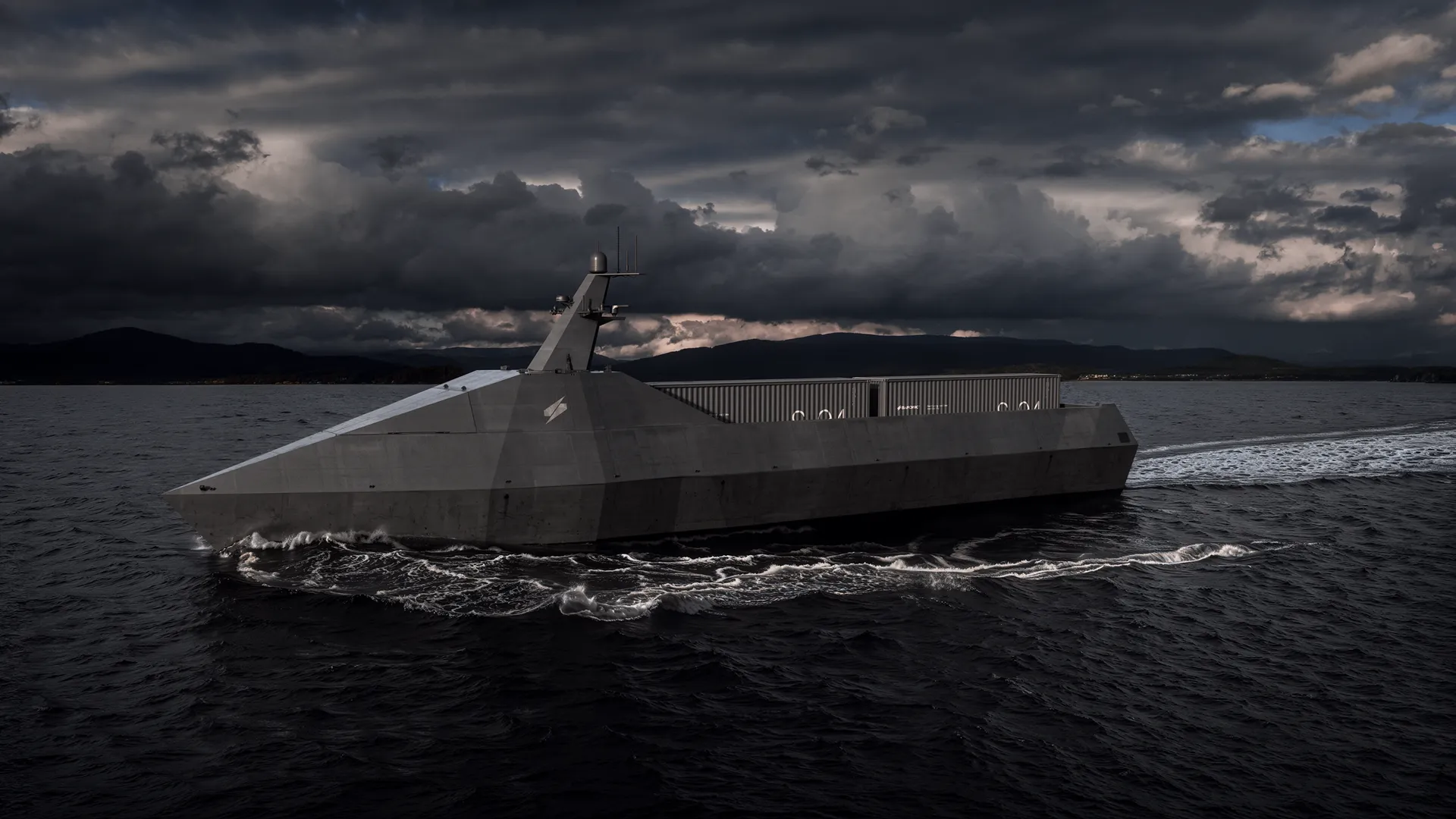
The service did not identify the companies when asked by USNI News. Companies ranging from Saronic, HII and Blue Water Autonomy have offered up models for MUSV work and made deals with shipyards to produce the hulls.
Companies building MUSVs not only develop hull, mechanical and engineering systems for a vessel that can operate for weeks at a time without human intervention – they also have to develop the sophisticated autonomy systems that guide the ships and accommodate the variety of systems being developed as part of the Navy’s overarching containerized capabilities drive.
In April, Chief of Naval Operations Adm. Daryl Caudle released the outline of a containerized capability campaign that would be key to the MUSV effort.
“The containerized approach generates combat power at speed and scale by placing containerized payloads on any viable platform; frigates, [Littoral Combat Ships], auxiliaries, unmanned systems, and commercial vessels,” reads the memo. “The end state is a fleet that can rapidly reconfigure, integrate and employ combat capability without redesign, delay or dependency on specific ship classes.”
For example, the Navy and Army have developed systems that fit inside the profile of a 40-foot shipping container like the MK 70 Typhon missiles launcher capable of fielding Tomahawk Land Attack Missiles that have been tested on unmanned platforms and from an LCS.
Robotic Market Place
In its recently released long-range shipbuilding plan, the Navy outlined intensions to buy 36 MUSV in Fiscal Year 2026 as part of the $5 billion in the 2026 Reconciliation Act using “other transaction authority,” which allows the service to sidestep regular public contract reporting requirements.
The plan, released earlier this month, reiterated the Portfolio Acquisition Executive for Robotics and Autonomous Systems’ stance on placing the research and development onus on the shipbuilders.
“To incentivize industry’s internal investment, payments will only be made for demonstrated operational success, with opportunities for non-competitive, follow-on production agreements,” reads the plan. “The government will not fund bespoke prototype design or fabrication.”
The Navy, under the new Portfolio Acquisition Executive for Robotics and Autonomous Systems, upended the previous Modular Attack Surface Craft program in favor of the marketplace approach that puts the research and development risk on the shipbuilders.
“Our goal is to create a regular and recurring marketplace, not just for the MUSV, but for other classes of vessels as well over time, designed to match the growing demand for unmanned systems across a range of missions,” PAE RAS Rebecca Gassler told reporters in March, USNI News reported. “Because industry has leaned forward and has built boats or has built the technology already … We no longer needed to go through the prototyping phase. So this will allow us to test the capability on water and go straight into production. And that will save us approximately on, you know, on the order of a year, and we will get capability to the fleets faster.”
Speaking to Congress this week, Jason Potter, performing the duties of the Assistant Secretary of the Navy for research, development and acquisition (RDA), said the MUSV marketplace construct would be used for more robotic and autonomous systems competitions in the future.
“That’s the model we’re going to use over and over again to solve more and more of these problems: undersea cables, offensive missions, contested logistics,” Potter said. “We think [with] unmanned there’s a huge opportunity here. We have a whole other industrial base we’re able to tap into to get after it, and we have a model to do it.”