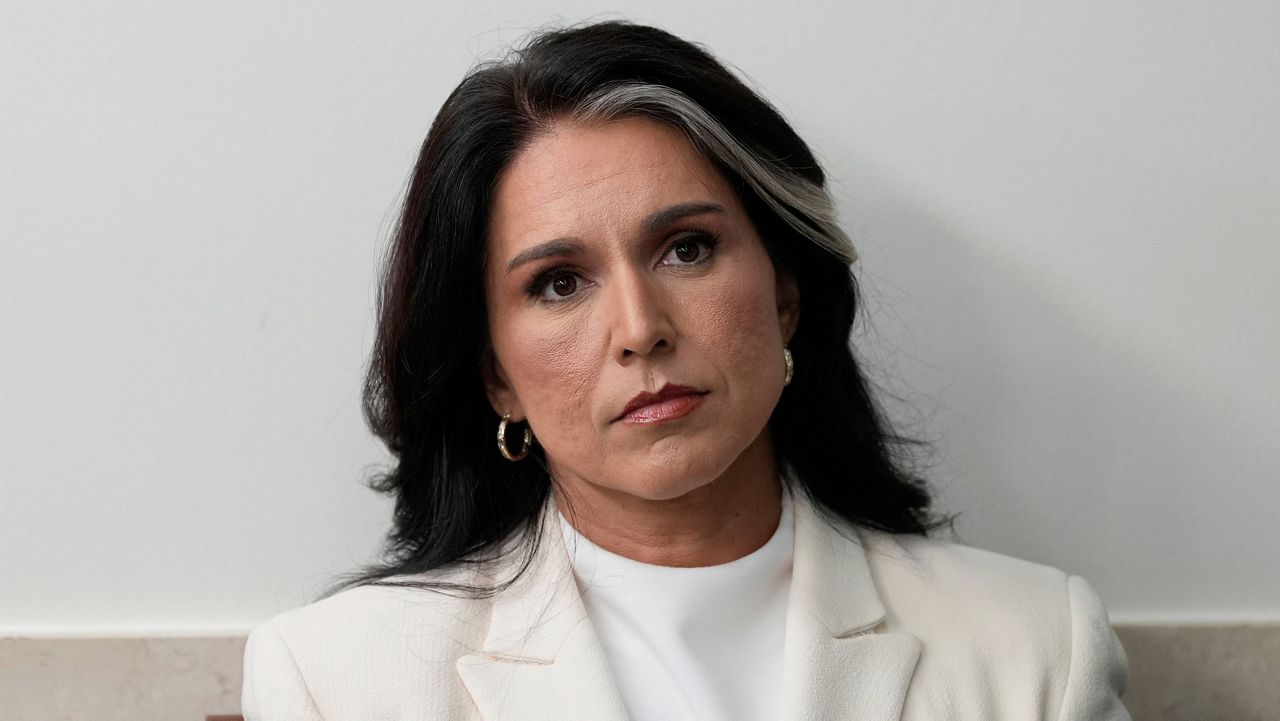
President Donald Trump selected Tulsi Gabbard as his top intelligence official thanks to her non-interventionist, “America First” ideology that had pushed her away from the Democratic Party and into the MAGA fold.
But as Trump’s director of national intelligence, Gabbard’s isolationist tendencies quickly put her at odds with his military actions in Iran and Venezuela. Months before announcing her resignation Friday, citing her husband’s diagnosis of a rare form of bone cancer, Gabbard was routinely sidelined from some of the administration’s biggest foreign policy decisions of Trump’s second term.
When Trump’s national security team gathered at Mar-a-Lago on New Year’s Day to watch the US operation in Venezuela unfold, Gabbard was thousands of miles away posting pictures on social media from a beach in her home state of Hawaii.
Ahead of Trump’s decision to strike Iran’s nuclear sites last summer, Gabbard posted a video warning that the world is “closer to the brink of nuclear annihilation than ever before,” which angered Trump and the White House and put her on the sidelines.
And in February, when Trump launched joint strikes on Iran with Israel, Gabbard was in Washington with Vice President JD Vance and other cabinet members. Trump was in Mar-a-Lago with top national security officials, including CIA Director John Ratcliffe, Defense Secretary Pete Hegseth and Chairman of the Joint Chiefs Dan Caine.
Before the strikes, Trump and Gabbard had a conversation about his potential military action in Iran, and he asked if the rumors about her resigning over it were true — whether she would leave if he decided to go forward, a source familiar with the matter told CNN. She said that the rumors were not true and she would not resign if he took military action, the source said.
While Gabbard was sidelined when it came to international deliberations, she shared Trump’s suspicions of the so-called “deep state.” Rooting out those perceived as being against Trump’s interests in the intelligence community became a main focus of her time as DNI.
“It’s scorched earth for anyone who they feel crossed Trump,” a source familiar with the matter told CNN.

Gabbard quickly became isolated inside even her own office, the source said, surrounding herself with a small circle of advisers and — in a move many viewed as a symptom of paranoia — objecting to CIA officers serving as a part of her security detail because she did not trust that agency.
Another source pushed back on this notion and said Gabbard only removed one member of her detail for incompetence and lack of professionalism.
“She is extremely grateful for her protective team and trusts them with her life,” a spokesperson for the Office of the Director of National Intelligence told CNN.
Gabbard and CIA director Ratcliffe have had a fraught relationship, according to multiple sources. Gabbard felt Ratcliffe at times was going around her directly to the president, despite the agencies traditionally working hand in hand. This prompted Gabbard to begin talking to the president directly about various issues, something one source speculated saved her job.
Gabbard met with Trump in the Oval Office on Friday to present him with her resignation letter. A source close to Gabbard told CNN on Friday that despite her turbulent tenure at DNI, a key reason she stayed in the job as long as she did was simply that the president still likes her personally.
Another source close to Gabbard said she had been wrestling with the decision to resign since her husband was diagnosed roughly three weeks ago.
Trump praised Gabbard on social media Friday after she announced her departure, saying she’d done an “incredible job” — a message that did not reference his previous clashes with his intelligence chief on Iran and Venezuela.
But while she found some common ground with Trump, Gabbard seemed to be largely on the outside looking in during her tenure.
“She’s just not in sync with this administration,” Beth Sanner, a former deputy director of national intelligence, said Friday on CNN’s “The Lead.”
“This is why her initials DNI became ‘do not invite,’” Sanner added. “In this administration, Tulsi was put in a position where I think that she just was such a bad fit that it became absolutely nothing. And she then turned to other endeavors.”
Gabbard’s 18-month tenure in the job, which ends next month, is defined as much by her lack of involvement in Trump’s military actions as it is for her willingness to pursue some of Trump’s biggest grievances.
She declassified documents from the intelligence community’s assessment on 2016 Russian election interference in order to claim President Barack Obama was behind a “treasonous conspiracy” against Trump. She took voting machines in Puerto Rico to try to prove baseless claims of election rigging. And in January, pictures of Gabbard on the scene in Fulton County, Georgia, as FBI agents seized ballots from the 2020 election raised serious questions over why Trump would want his top spy chief present — given that the DNI is barred from domestic law enforcement operations.
Gabbard’s decision to take on a prominent role in election-related investigations was described by some Trump officials as a sign of just how much she had been sidelined on the more pressing issues like Iran and Venezuela.
One source familiar with the matter said the two were unrelated — noting that Trump called Gabbard directly and asked her to oversee the election-related investigations because he knew she was already looking into 2020 on his behalf.

Gabbard was always an unconventional choice as director of national intelligence, a role created after 9/11 to facilitate information sharing and coordination across the 18 agencies that make up the US intelligence community. A Hawaii congresswoman who ran for president as a Democrat in 2020, Gabbard had previously expressed sympathy toward whistleblowers who leaked classified information and criticized Trump’s military actions against Iran during his first term.
But after a falling out with Democrats during the Biden administration — including Gabbard’s opposition to US aid to Ukraine to fight Russia — Gabbard became a Republican and endorsed Trump in 2024.
It didn’t take long, however, for Gabbard’s anti-war views to run afoul of Trump. In March 2025, she testified to Congress that Iran was not actively pursuing a nuclear weapon — a direct contradiction of claims from US and Israeli officials that Iran was rapidly working to obtain a bomb.
“She’s wrong,” Trump said of Gabbard in June 2025, days before he launched missile strikes against Iran’s nuclear sites.
CNN reported at the time that Trump considered Gabbard “off message,” driven by her video warning about the dangers of nuclear proliferation and blaming “political elite and warmongers” for stoking “fear and tensions between nuclear powers.”
After the joint US-Israeli strikes on Iran this February, Gabbard was again put in the awkward position of being pressed on the basis behind the strikes during congressional testimony.
“It is not the intelligence community’s responsibility to determine what is and is not an imminent threat,” Gabbard said in her testimony before the House and Senate Intelligence Committees in March.

If Gabbard did not see eye-to-eye with Trump on military intervention, she was able turn the page quickly last year to a topic he was fully behind.
Last July, Gabbard declassified and released a series of documents she claimed were proof of the Obama administration “manufacturing” evidence against Trump in its 2017 intelligence assessment that Russian President Vladimir Putin had interfered in the 2016 election and tried to help Trump.
Many of Gabbard’s claims that the intelligence was manufactured were dubious, however. A Republican-led Senate report in 2020 agreed with the intelligence community’s conclusions on Russia’s election interference and Putin’s role directing the effort.
Last August, Gabbard revoked the security clearances of at least 37 current and former national security officials, a list that included people involved in the Russia assessment and members of President Joe Biden’s National Security Council.
In January, Gabbard took the extraordinary step of going to the scene after FBI agents executed a search warrant for the Fulton County elections office, near Atlanta.
Gabbard’s presence turned heads, given her purview generally involved coordinating US intelligence agencies and their efforts overseas, not domestic matters or law enforcement.
While there, Gabbard put Trump on the phone with some of the FBI agents who searched the elections office, CNN reported at the time.
She told top Democrats on the House and Senate Intelligence committees in a letter that her presence during the search “was requested by the President.”
Several former senior intelligence officials and election law experts told CNN that Gabbard had no legal authority over the FBI search and that her presence in Fulton County risked eroding a crucial line between foreign and domestic intelligence activities instituted after Watergate.
After the Trump administration offered conflicting explanations for Gabbard’s presence, White House press secretary Karoline Leavitt said Trump had “tapped” Gabbard “to oversee the sanctity and the security of our American elections” and that she was “working directly alongside the FBI director.”