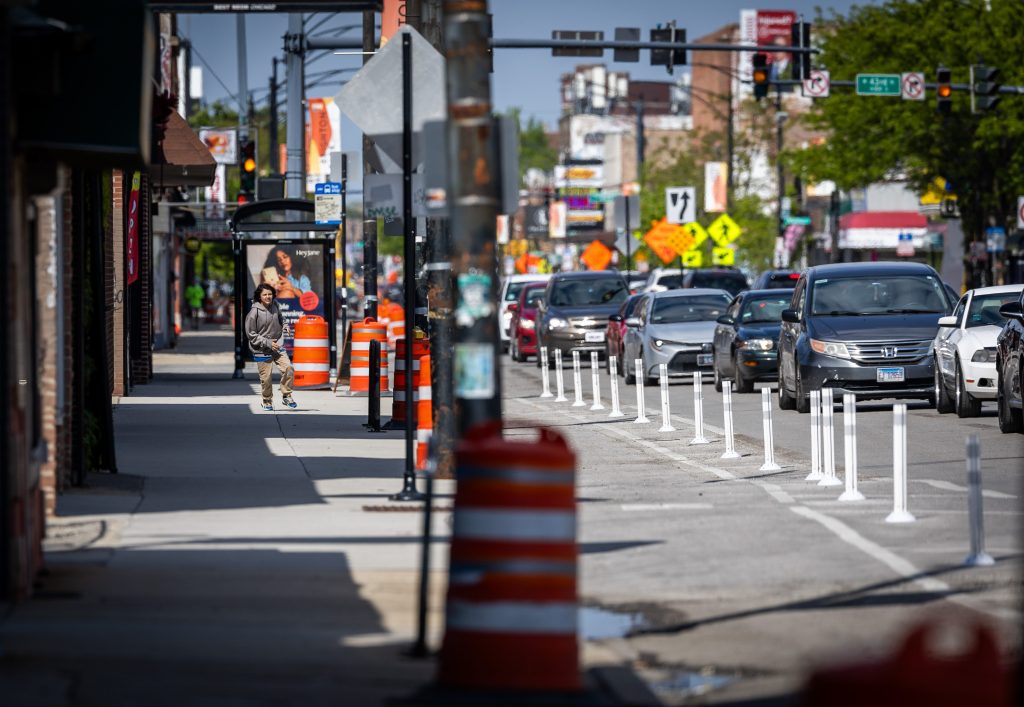
Cars whiz past, a few bikes too, as concrete bumpers and painted lines slowly grow at the edge of the busy street.
But as reliably as time passes, the two groups show up to the sidewalk, stand there a few feet apart and yell.
The protesters and counter-protesters who have demonstrated every week since early December share a belief that an effort to overhaul a bustling 2-mile stretch of Archer Avenue in Brighton Park with pedestrian-friendly features will have massive consequences.
And the small, relentless Southwest Side fight is over more than just that construction project. It’s the latest front in a citywide political divide over the future of transportation and safety.
To the pro-bike lane faction, the concrete bump outs and bus-boarding islands added to the busy street mean safety for cyclists, kids heading to school and even drivers.
“People don’t bike on Archer because it was so dangerous,” said Alfredo Valladares Jr., who founded the group Gage Park Cyclists. “Everybody needs to have a fair opportunity to be safe.”

Their opponents say the changes mark a force-fed death knell for businesses losing parking spots and a wasteful impediment to people with places to be who need to drive.
“It’s the first phase of gentrification,” said Claudia Zuno, a lead opponent of the road redesign who announced in February that she is running to unseat 12th Ward Ald. Julia Ramirez, a supporter of the project. “It’s a lack of transparency. It’s a lack of communication.”
It’s a clash playing out with similar intensity along Grand Avenue in the West Town neighborhood, where a growing street remake has rankled businesses and rallied pedestrian safety advocates to its defense.
Both projects are part of the citywide Chicago Department of Transportation’s Complete Streets program, which requires each street reconstruction to include safety upgrades for pedestrians, cyclists and transit riders — not just cars.
Backers argue the mounting changes are data-driven and proving their worth in plummeting traffic injuries. There has been an approximately 35% drop in traffic fatalities since 2019, even as the number of cyclists surges, CDOT assistant commissioner David Smith said.
“Our city is safer than it’s ever been,” Smith said. “Nobody’s arguing with the results.”
And while the road changes undoubtedly inspire genuine support and resistance across neighborhoods, some argue that the pushback against them is in part an effort to score cheap political points.
On Archer Avenue, a weekly protest with debated origins
The project remained half-finished in early January when the two groups gathered to demonstrate, around a dozen to each side. A megaphone amplified a recorded message from atop a blue Toyota SUV blocking the road.
“How many lanes do you want?” the voice repeated. A passing white 18-wheeler honked in apparent support. A biker swerved to avoid the parked car. A man stood atop a rough concrete barrier, videotaping himself and reading from a phone as he shouted into a microphone while no one appeared to listen.

Steps away, but separated by police, the counter-protesters stood in front of Ramirez’s ward office. House music staples blared from a speaker sitting in a cart attached to a bike.
Maria Martinez, a regular at the ritual protests, said she became involved after driving down the street, seeing the construction and feeling like the bike lanes were a bad fit for the neighborhood of working families. She felt compelled to show up after being muted during a virtual meeting, she added.
“We weren’t able to speak. They just spoke about numbers and statistics and a bunch of mumbo jumbo,” she said. “You can’t put your two, three kids on a bike, especially in winter. Like, when it’s snowing, who rides their bike in the snow?”
The dissent against the project germinated on Facebook as construction started and traffic slowed, Martinez said. The Department of Water Management is completing a major, monthslong sewer main replacement on the same Archer strip aimed at mitigating flooding that has contributed to traffic.
The construction began in November, just as Ramirez, a progressive first-term City Council member, went on maternity leave. She had her baby on a Friday. The protests started that Monday.
The project’s origins predate both her and Mayor Brandon Johnson, who has championed Complete Streets, Ramirez said. As it approached, her office canvassed small businesses and hosted two public meetings, she said, adding that she wished she had done even more outreach.

The changes are needed, she argued. She has been hit by a car biking the road herself, and a man was killed crossing the street in a hit-and-run outside her office last year, she said.
“You can’t even stand on the corner for a few minutes without feeling unsafe,” she said. “There is a bucket of money that’s willing to be poured into Brighton Park, and I want to support my community with those funds and that investment to ultimately just keep people safe.”
Ramirez believes the pushback has been cultivated to cause political divide by the Urban Center, a pro-school choice political organization. The group, a key backer of former mayoral candidate Paul Vallas in 2023, sent out mass texts claiming the street redesign has caused traffic and made it harder for emergency vehicles to get through.
“[Ramirez and Johnson] have forced their concrete bike lanes on our community who doesn’t want them,” read one text.
Urban Center’s political committee spent over $116,000 to back Eva Villalobos, a key protest regular, in her unsuccessful 2024 Chicago Board of Education run, and listed Zuno as a contact in initial news releases urging the media to attend the first protests.
Juan Rangel, the group’s CEO, said he spoke to Zuno, a longtime family friend, about running for alderman about a year ago and added that the Urban Center is only responding to community frustration with the project.
The leading anti-bike lane protest coordinators told the Tribune they’re neighborhood residents who came together organically. Zuno said she got involved after Ramirez knocked on her door to tell her about the project, which includes similar road changes on Kedzie Avenue. After that, she saw the growing frustration on Facebook claiming there was no heads-up and the project was unwanted.

Zuno encountered more complaints about the project when she canvassed businesses, among them struggling restaurants, car dealerships and BNSF Railway, which operates a nearby train yard attracting heavy truck traffic on Kedzie, she said.
She said the protest is “not from any particular organization” and that “Ramirez’s decisions pushed [her] to run.” Zuno argued the bike lane’s proponents are from outside the neighborhood and said her petition calling for the barriers to be removed has gotten 3,000 signatures.
“I’m not a politician,” Zuno said. “If she would have done her job, I wouldn’t be pursuing politics.”
“Remove obstructive bike lanes and concrete barriers,” is the first priority listed on her campaign’s website.
Alderman says cars can’t always win ‘zero-sum game’
Last month, Ald. Daniel La Spata, the City Council’s most vocal cyclist and pedestrian safety advocate, was giddy as he walked along Grand Avenue.
He conjured the incoming changes. Wider sidewalks, a tree canopy, a boarding island so buses won’t need to pull over, an improved crosswalk by the elementary school.
“The reason that I kind of chafe at the description of this as a bike lane project is that it’s so much more than that,” La Spata, 1st, said.
The road redesign — partially implemented and gradually growing east — won’t just improve safety, he argued.
“I think if you design a space that invites people to walk on it, invites people to bike to it, we will see more commercial activity here,” he said.
But Roger Romanelli, executive director of the Fulton Market Association, predicted the changes will close shops and restaurants and slow drivers, buses and ambulances.

Romanelli played a key role in opposing Mayor Rahm Emanuel’s eventually abandoned plans for a bus rapid transit system on Ashland Avenue and has also advocated for other transit investments like express buses and train stations. He has made his own so-far unsuccessful pitch for Grand Avenue, largely based around slightly narrowing sidewalks without added trees and using smaller bike lane barriers.
“There’s some people on the street, some of the longer residents, that don’t even want to talk about bike lanes,” he said at an April news conference outside City Hall. “We’re not saying that. We’re saying, ‘Let’s use the best urban planning practices to find a compromise.’”
He contradicted claims that the changes have improved safety and said crash data he received via a records request show more crashes with injuries have occurred along the project’s finished segments.
He also argued La Spata hasn’t seriously considered his concerns and instead told Romanelli he “had [his] chance three years ago” when two public meetings were held on the project. La Spata said he recently met with Romanelli for half an hour, but did not support his proposals.
Romanelli has found a sympathetic backer in Doug Van Tress, who said he moved his antiques business, The Golden Triangle, to the street expecting a renaissance. He got two years of slow-moving construction instead.
“I’m not a crazy hater. I’m a bike rider also,” Van Tress said, adding praise for bike lanes in Europe. “I love the sidewalks. I even like the trees, if you have room for them, but you got to compromise.”

For his part, La Spata said more parking could be made available for consumers by putting meters on side street corners near the road. The change is hard, he said, and the public way “is a zero-sum game,” albeit one where bus riders, bikers and walkers have historically lost out.
“There’s only so much space from lot line to lot line, and how we use that has impacts for everybody,” he said. “But for the longest time in Chicago, we only considered one user of the public way, and that was the car. And we are changing that to arguably the benefit of everyone.”
Bike lanes make streets safer, city says
Since the finished Grand Avenue stretch was completed, the street has seen no severe crashes and more people are walking and biking, according to Smith.
It’s a case he makes for the entire Complete Streets program: “The results are there.” The changes can be “a little scary” to some, but Chicagoans expect more options to move safely for themselves and their loved ones, he added.
Pushback “naturally goes away” once projects are finished and people experience them, said CDOT managing deputy commissioner Vig Krishnamurthy.
Along Archer, some of the criticism appears to be tied to “misconceptions” about the design, winter delays and traffic sparked by construction, not the changes themselves, Krishnamurthy said.
The Archer project also adds left-turn lanes. Krishnamurthy said the change addresses the corridor’s most common crashes and frees up drivers from waiting for others to turn.

The emergency vehicle claim is “not a real outcome,” Krishnamurthy said, citing federal studies showing such designs are neutral or positive for response times and careful work by planners to make sure cars have space to pull over. Parking losses, he argued, are not “10,000 to two,” but a matter of shifting from one finite number to another.
A CDOT study of six recent bike lane projects published this month found the areas where they were put saw neutral or positive changes in sales tax revenue, property values, employment and storefront vacancy. It also found a majority of responding residents, especially in North and Northwest Side neighborhoods, support bike lanes even when it means less parking. Public requests for traffic studies have doubled in recent years, Krishnamurthy said.
“I see what has been happening around the city as an incredible success,” Smith said. “It’s been incredibly responsive to what people want to see around the city, and I just don’t want that to get lost in the conversation.”
Ald. Pat Dowell has a different grade for recent CDOT work in the Near South Side neighborhood of her ward.
“I would give them a big, fat F,” she said.
The problem is not the product, but the process, she argued. A bike lane project on Indiana Avenue was largely accepted after community meetings, but complaints flooded her office when lanes went in at 18th Street and Wabash Avenue without engagement, she said.
She asked CDOT to remove the changes. The department took out a concrete median, and she hopes other still-pending removals will advance under the department’s new leadership, she said.
“In my ward I don’t want them to do any kind of bike lane improvements without having a conversation with our community,” she said.

On Archer in late April, the department restored 17 parking spots, removed a small stretch of concrete barriers and moved a pedestrian island, all “small targeted adjustments,” according to Smith.
At yet another protest Monday at the corner of Archer and Kedzie, Zuno was joined only by Martinez and Villalobos.
The tweak to restore parking is a move in the right direction that adds to costs, but not enough, Zuno argued. She wants to undo the changes.
“We definitely want our two lanes back,” she said before striking a softer tone. “I want to see community input. Let’s really sit down and talk to the community.”
Across the street, longtime Brighton Park resident Gilbert Campos stood near his purple three-speed. He recalled the times he would ride on the road and wonder, “Is today the day that I get hit.” It happened twice in the last year, he said.
Cars might be slowed a few minutes, he conceded. His own daughter makes that complaint. But he tells her, “I’m out here on these streets too.”
“Give it a little chance,” he said. “I just don’t see what the big problem is with trying to get safer streets.”