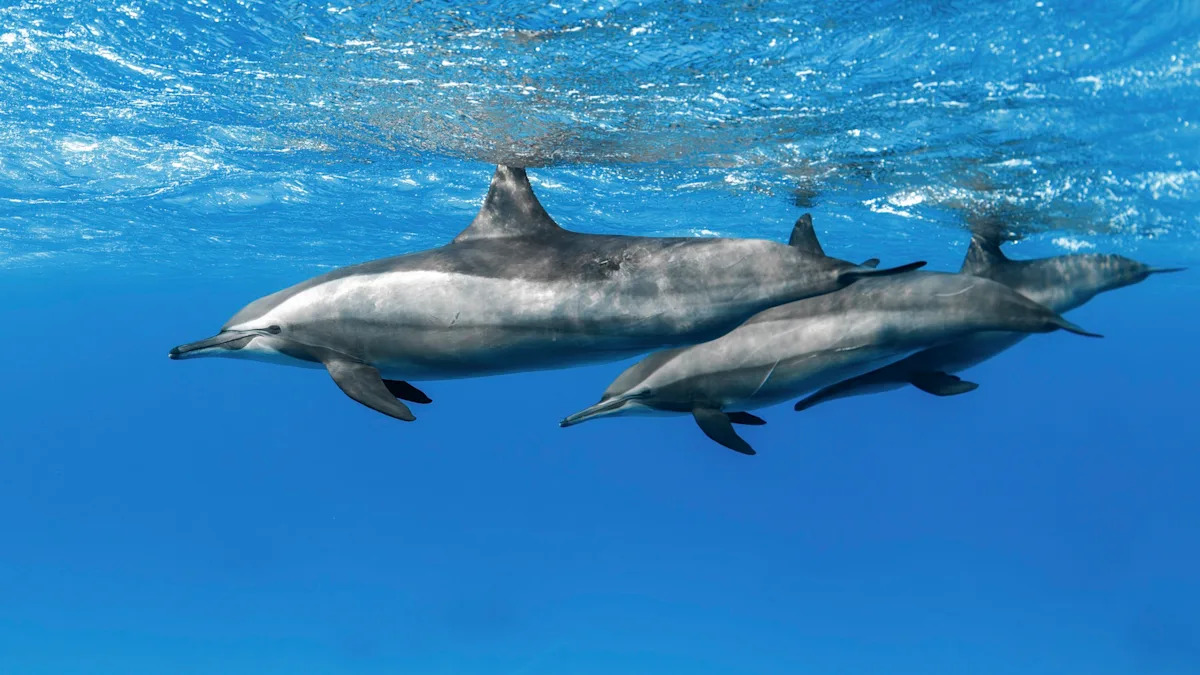
Scientists have identified a promising new way to monitor dolphin populations, and it starts with a simple seawater sample.
According to Good News Network, a study published in Frontiers in Marine Science found that mitochondrial DNA suspended in ocean water can do more than confirm whether dolphins are nearby. It can also provide insight into their genetic diversity, an important indicator of population health. The finding could give conservationists a less invasive and more efficient way to study marine mammals in the wild.
Environmental DNA, or eDNA, is already widely used to detect species by collecting traces of genetic material that organisms leave behind in the water. But until now, the method has mostly been useful for answering a basic question: whether a species is present in a given area. It has been much more difficult to use eDNA to measure the deeper forms of biodiversity that are critical for long-term conservation, including genetic diversity and effective population size.
To explore whether that might be possible, the researchers followed 15 dolphin schools near Santa Catalina Island off the coast of Southern California in 2021. From small boats, they collected two-liter surface water samples each time they encountered one of the region’s four most common dolphin species — long- and short-beaked common dolphins, bottlenose dolphins, and Risso’s dolphins, GNN reported.
After comparing the seawater DNA to public genetic databases, the team identified 836 mitochondrial sequence variants across 126 water samples. A substantial portion of those sequences came from cetaceans, and nearly one-third matched the species identified visually in each dolphin school.
Among the species studied, long-beaked common dolphins showed the highest genetic diversity in the area, followed by short-beaked common dolphins, while bottlenose and Risso’s dolphins appeared less diverse near Santa Catalina.
Genetic diversity can help reveal a population’s resilience. In general, higher genetic diversity gives a species a better chance of adapting to disease, pollution, environmental shifts, and other pressures. For conservation teams, a practical way to estimate that from seawater could make it easier to identify vulnerable populations sooner and take action more quickly.
Healthy dolphin populations can reflect healthier marine ecosystems overall, supporting coastal biodiversity and the communities that rely on thriving oceans for tourism, recreation, and local economies. Because eDNA sampling is relatively low-impact and cost-effective, it could also help researchers monitor wildlife more often and across broader areas than visual surveys alone.
The approach may eventually help scientists track how species use habitat over the course of the year, including rare marine animals that are easy to miss during traditional surveys. It could also offer a clearer view of how human-driven pressures, such as pollution and underwater noise, are influencing where marine mammals live and how they’re doing.
“Here we show that repeated eDNA sampling can be used to estimate the genetic diversity of dolphins that occur in large schools and have very large populations,” corresponding author Dr. Frederick Archer from the NOAA/NMFS Southwest Fisheries Science Center said, according to GNN.
“It would be good to start eDNA monitoring programs as soon as possible that were not possible before,” he added. “This can give us a lot of information on habitat use and will also allow us to potentially observe how environmental changes and anthropogenic effects such as pollution or underwater sound affect species distributions.”
Get TCD’s free newsletters for easy tips, smart advice, and a chance to earn $5,000 toward home upgrades. To see more stories like this one, change your Google preferences here.