I have been to all seven continents. I have sat in middle seats on overnight flights to Singapore. I have navigated layovers in poorly laid out airports where nothing made sense—the signage, the currency, and the concept of time itself all incomprehensible. I have travelled solo and with my son. And through all of it, through every delayed departure, and turbulent crossing, and long-haul flight where the person ahead of me immediately reclined their seat, I have had one non-negotiable: my headphones situation has to be airtight.
Over the years, I have landed on a three-pair system that costs anywhere from just over £1,450 to £20, and I will defend it with the same energy I use to defend my right to the window seat. The system only works because each pair does something the others cannot: one goes over your ears and makes the world disappear, one tucks in so you can actually sleep, and one plugs straight into your phone (or seat-back) for when you need something simple.
Here is what I carry, why I carry it, and why you might want to rethink whatever half-baked single-pair strategy you have been running with.

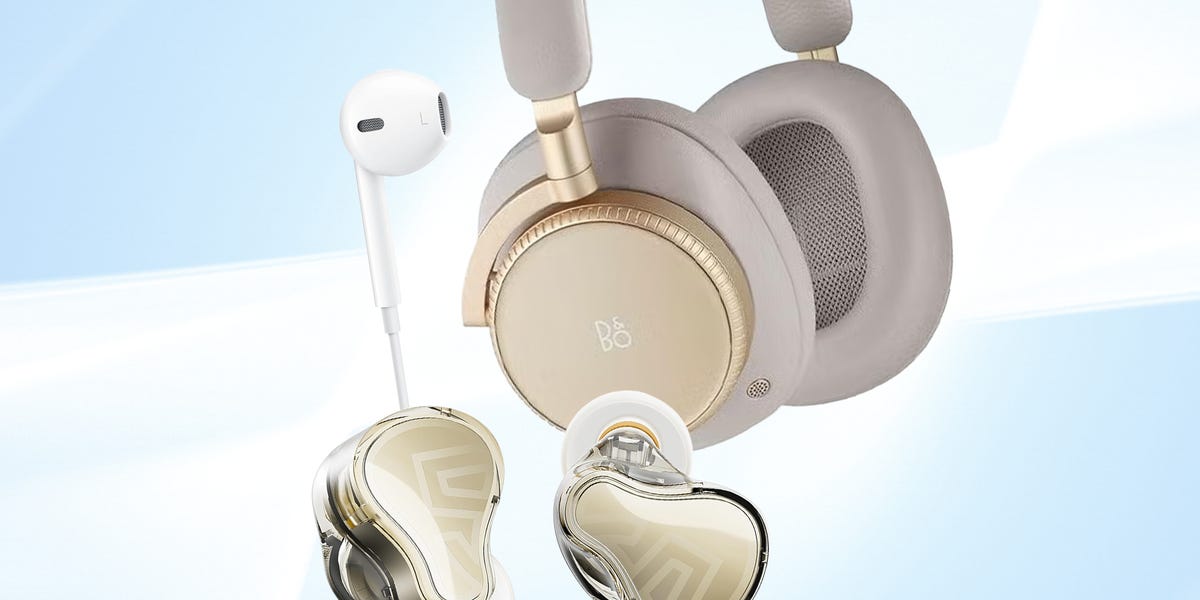
Any frequent traveler should have a really good pair of over-ear noise-canceling headphones. Not optional. Not a nice-to-have. These are a requirement, like a passport or a charger. That means they’re worth an investment. The Bang & Olufsen Beoplay H100 falls firmly into that category. They cost just about £1,450 (depending on where you shop), which is a lot for headphones, and I regret absolutely nothing.
These are over-ear, noise-canceling headphones with custom titanium drivers tucked behind very beautiful aluminum grills, and ten studio-grade microphones working overtime to make the world go away. And they really do. I’ve put these on in a packed airport or while a baby was crying on the airplane, and the chaos disappeared.
They’re built for Dolby Atmos, with spatial audio that makes everything feel bigger and more immersive, rather than stuck in your head. There’s also a haptic dial that lets you move smoothly between full noise cancellation and transparency mode. It sounds minor, but it means you can actually hear a flight attendant without doing that awkward half-removal of one ear cup and hoping you caught the important part.
They also come with a leather pouch, a detail that makes you feel like you have your life together, even when you are eating snacks off your child’s tray table. And maybe most importantly, they plug into airplane entertainment systems.
Buying them is like buying a Rolex. Technically, a Casio does the same job for less, but that’s not really the point. The point is having the best of the best, and having it for a lifetime.

The thing about over-ear headphones, even magnificent ones, is that sleeping in them is miserable. You roll over, and suddenly you are being slowly crushed by your own audio equipment. This is where the Soundpeats H3 earbuds come in, and at just over $100, they have become one of my smarter travel discoveries in recent years.
I am not an AirPods person because my ears are small and AirPods have never once stayed in them. The H3s fit securely, and the sound quality is genuinely impressive for something that disappears into your ears, with three drivers working together to produce full, detailed audio that holds up whether you are listening to music or a podcast at 35,000 feet.
The noise cancellation is serious enough to handle airplane cabin noise, and there is a transparency mode you can adjust through the app for those moments when you need to be at least partially present. Battery life runs seven hours on a single charge, with 37 hours total when you factor in the charging case, and 10 minutes of charging gives you two hours of playback. These are the headphones I fall asleep with somewhere over the Atlantic and wake up with still in my ears, a ringing endorsement if I have ever given one.
Bonus: They double as workout headphones in a hotel gym.

There is real wisdom in traveling with something you can hand over without a second thought. The Apple EarPods are wired, and under £20. They cost about as much as an airport sandwich and require none of the investment of the other two pairs on this list.
I use them when I want to watch something on my iPhone but do not want to deal with Bluetooth. They are also what I reach for when my other headphones inevitably die at the worst possible moment, usually mid-flight, mid-movie, or mid-attempt to create a small pocket of peace. There’s no pairing, no charging, no drama. You plug them in, and they always work.
And when I am travelling with my son, they become essential. He uses them when he suddenly needs a pair, and I am not handing over anything that costs four figures.
They are a backup, a hand-me-over, and a surprisingly decent everyday option all at once. Every solid travel system needs at least one thing you could leave in a taxi and feel completely fine about the next morning.
The Bottom Line
People always want to know what the one perfect travel headphone is, and the honest answer is that there isn’t one, because travel isn’t one thing. Sometimes you are trying to disappear into a long flight, and you need your most powerful tool. Sometimes you are trying to sleep in an awkward position in economy, and you need something that will not press into the side of your head. And sometimes your kid needs a pair right now, and you need to hand something over without doing a risk assessment first.
You can, of course, asses your own needs and only get one of the three, but the £1,450 pair, the £100 pair, and the £20 pair each solve a different problem. Together they have gotten me through every continent on this planet without a single audio emergency. That, to me, is a system worth packing.