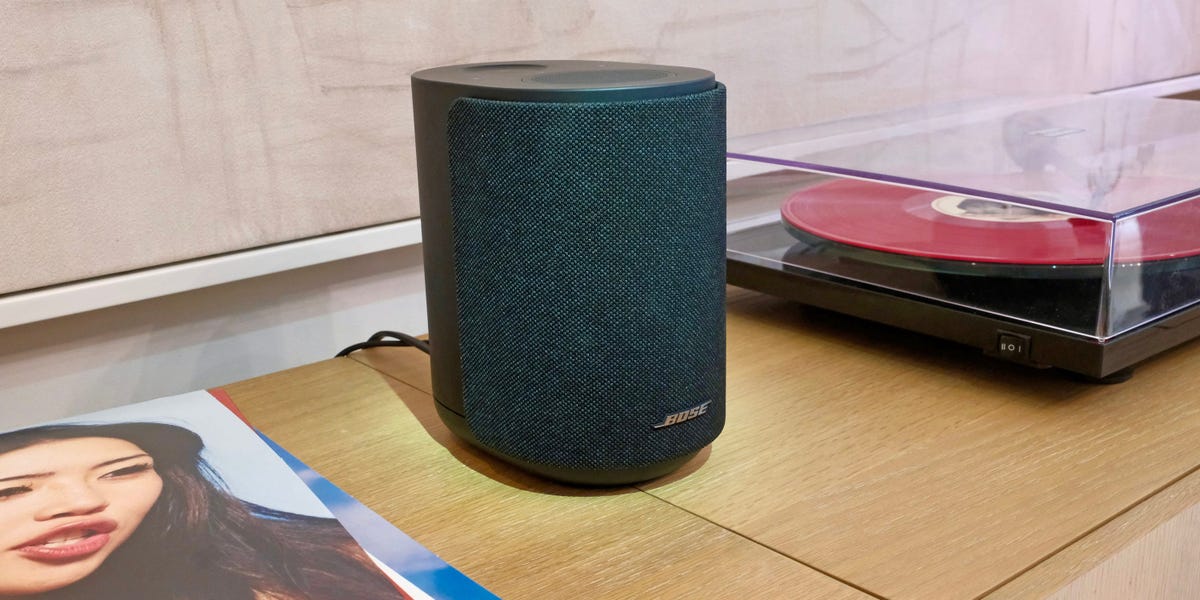
With the release of its new Lifestyle Audio Collection, Bose is recommitting to wireless home audio in a big way. And the Bose Lifestyle Ultra Speaker is a versatile piece of the puzzle. This powerful smart speaker can be used for listening to music, solo or in a stereo pair. It can also be used as a rear speaker in a home theater setup with Bose’s new Lifestyle Ultra Soundbar. Even if you start with just one, you can always add more speakers later on, letting you build a multi-room setup over time.
For over a decade, I’ve covered Bose, Sonos, and other wireless speaker companies, so I know exactly what sets the best smart speakers apart. At $299, it’s clear that Bose is positioning the Lifestyle Ultra as a competitor to the Sonos Era 100, which typically sells for $220. The Era 100 is a similar device, but the Lifestyle Ultra offers a few benefits — and drawbacks — that make it unique.
Whether judged on its own or against the competition, the Bose Lifestyle Ultra Speaker is a compelling smart speaker. Its upfiring audio driver lifts sound throughout the room, offering a vibrant, wide soundstage, and it’s one of the first third-party speakers to support Amazon’s souped-up Alexa+ digital assistant. After spending some quality time with the Lifestyle Ultra, here’s how it performs and who it’s best for.
Bose Lifestyle Ultra Speaker
Bose’s Lifestyle Ultra is an impressive wireless smart speaker with Alexa+ and a built-in up-firing audio driver to create spatial sound.
What the Lifestyle Ultra Speaker can do, and can’t do
Tyler Hayes/Business Insider
From the “Lifestyle” name to the knit fabric on the front, the Ultra Speaker is clearly designed to settle into most homes’ decor without a lot of disruption. It comes in white or black at the entry price of $299. For $50 more ($349), you can get the Driftwood Sand color, which includes a solid white oak base.
The top of the speaker features touch controls that can be swiped or pressed. But it’s the punctured grille at the top, which hides the speaker’s upfiring driver, that draws most of the attention. This driver beams sound upward, so it bounces off your ceiling, creating a sense of added height. There’s also a forward-facing woofer and tweeter, along with Bose’s QuietBass ported design visible on the back.
Interestingly, despite having an upfiring driver, the Ultra Speaker doesn’t support Dolby Atmos music. Dolby Atmos is a popular audio format designed to take advantage of upfiring speakers. When a song is mastered in Dolby Atmos, sound mixers can deliberately place certain instruments and vocals overhead. But instead of Atmos, Bose uses its own TrueSpatial audio processing to give the songs you play a bigger, more immersive sound. It’s an interesting choice that has its pros and cons.
The speaker’s wireless connectivity is abundant, featuring Bluetooth 5.3 for general streaming and WiFi for Apple AirPlay and Spotify Connect. And for those who prefer wired playback, there’s a 3.5mm jack on the back for plugging in a media player or record player — no USB-C adapter required. If you’re into voice commands, the Ultra Speaker supports Alexa and the newer Alexa+ for hands-free operation of music or your entire smart home.
The Bose app is solid, but I ran into issues with stereo pairing
Tyler Hayes/Business Insider
For all the similarities between Bose’s new Lifestyle Collection and Sonos, one clear philosophical difference lies in the mobile app. Sonos integrates different streaming services into its own app, while Bose doesn’t.
Bose’s chosen method for streaming music to its Ultra Speaker is to rely on casting directly from individual music services. For Apple Music, that means using AirPlay. For Spotify, that means using Spotify Connect. For others, that may mean Google Cast. As a universal fallback when you don’t have a WiFi connection, you can use Bluetooth to stream audio from any app, but casting will offer the best sound quality.
While the Bose mobile app looks simple and isn’t overly complicated to use, I did encounter several bugs. Most notably, stereo pairing two Ultra Speakers hasn’t worked. The app says they’re connected, but either only one side plays or there’s a five-second delay between the left and right sides. However, when I used two separate Ultra Speakers and just grouped them using Apple’s AirPlay menu, both played in sync.
I reached out to Bose about my issues, but so far, none of the proposed solutions have worked. To be clear, my time with the speaker has included pre-release testing, so I expect updates of some kind, but the software and connectivity have definitely been wonky.
It’s also worth noting that the app can be used to pair two Ultra Speakers to Bose’s new Lifestyle Ultra Soundbar. This allows the speakers to act as rear satellites to create a full surround sound system. I haven’t been able to test this feature yet, but I plan to try it out soon and will update this review with impressions once I do.
Sound quality is excellent with room-filling audio
Tyler Hayes/Business Insider
Simply put, the Bose Lifestyle Ultra Speaker sounds great. Its three drivers and ported design deliver a wide soundstage with breathy bass in low frequencies and room-filling volume at its upper levels.
To get a sense for how the Ultra Speaker stacks up to rivals, I listened to it head-to-head with the Sonos Era 100. But despite their visual similarities, comparing these Bose and Sonos speakers is a little like comparing apples and oranges. They’re designed differently and produce distinct sound profiles, and each has its pros and cons.
The ported design of the Ultra Speaker delivers deeper, breathier bass compared to the tighter, punchier Era 100. Additionally, because of its top-upfiring driver (which the Era 100 lacks), the Ultra Speaker offers a bit more separation and a wider soundstage.
Going back and forth between the two speakers during the same songs was a challenge because of the difference in power and dynamics. Setting the Era 100 to 50% was much louder than the Ultra Speaker at the same volume.
That’s one reason it’s hard to pick a favorite. So far, the Era 100 is a more established product with what a lot of people will probably think of as a more straightforward bookshelf speaker sound profile. But the Ultra Speaker is fun and, with certain songs, highly impressive with its low-frequency resonance.
Tyler Hayes/Business Insider
The Ultra Speaker also makes use of Bose’s proprietary TrueSpatial technology, but I found this feature to be a little uneven. TrueSpatial tech expands the soundstage of all music sources in order to take advantage of the Ultra Speaker’s upfiring driver. So, Bose’s processing makes all the decisions about how to separate the audio and send it to that upfiring driver. In practice, this mostly just gave the speaker a larger sound, which isn’t a bad thing.
Room placement and size also play a big role in how well the speaker’s TrueSpatial effect works. The best use of the speaker will be in a room with a low, average-sized ceiling so the sound can properly bounce off it. When I used the Ultra Speaker in a room with a 30-foot high ceiling, I didn’t get the same height effect as when I used it in a bedroom.
While TrueSpatial has its benefits, it’s disappointing that the Lifestyle Ultra doesn’t support Dolby Atmos music processing. Atmos processing would only apply when listening to music mastered in Dolby Atmos through services like Apple, but it would provide a more authentic experience. When a track is mixed natively in Dolby Atmos, it’s the artists and music engineers who decide what parts of a song get sent to the upfiring driver. Most speakers with upfiring drivers (like the more expensive Sonos Era 300) support Atmos, so it’s a bit odd that Bose hasn’t included it here.
Tyler Hayes/Business Insider
It’s also important to remember that the speaker’s audio performance will be affected by the quality of the source it’s fed. Since an Ultra Speaker gets its music from whatever app you’re currently casting, that app also determines the quality.
For example, some Pandora tiers default to 64kbps, which is low-quality. Spotify uses 96 to 160kbps, unless you’re a Premium subscriber and choose a higher bitrate or lossless streaming. Services like Apple Music also offer lossless streaming, which delivers the best audio quality. Streaming lower-quality music will affect how songs from different services sound.
I also connected my record player and listened to a few songs through the Lifestyle Ultra. It’s definitely a viable use for the speaker, and with its versatile streaming and smart features, it could save people a lot of space on their media console by consolidating multiple devices into a single speaker.
Bose is the first third-party brand to support Alexa+
Tyler Hayes/Business Insider
The Bose Lifestyle Ultra is one of the first third-party smart speakers to support Alexa+, which is Amazon’s new AI-enhanced version of Alexa. Alexa+ is also available on the latest Echo speakers, but Bose is the only brand outside Amazon to offer it so far.
This upgraded digital assistant uses generative AI to support more natural conversations and respond to more sophisticated requests. As a result, users can carry on longer, more detailed interactions and combine several tasks in a single exchange, without repeatedly using the “Alexa” wake word. Alexa+ is free for Prime members, but it costs $20 a month if you don’t have Prime.
After linking my Amazon account with the Lifestyle Ultra, Alexa+ worked great, just as it has on any Echo speaker I’ve tested. I haven’t used it in every circumstance or gone heavy on it, but in my initial tests, Alexa+ responded very fast and seemed to understand nearly everything I said.
One interesting perk with Alexa support is that you can connect Apple Music, Spotify, and other streaming music services to your Alexa account and have them play via voice command. I have my Apple Music account connected and was able to ask it to play a recently made playlist.
Should you buy the Bose Lifestyle Ultra Speaker?
Tyler Hayes/Business Insider
At its core, the Bose Lifestyle Ultra is a very good wireless home speaker. The company has seemingly taken lessons from the wider smart speaker market and crafted a compelling product that delivers room-filling music and helpful Alexa+ smarts. Ultimately, consumers should be the winners here as they can stream the music and audio they want, without being overencumbered by lock-in platforms.
But while the Ultra Speaker is a good starting point for a Bose whole-home audio system, it has its quirks at launch. I spent my time with the speaker pre-release, so I expect the connection issues I ran into to be ironed out, but they did put a slight damper on my experience so far.
Still, the speaker excels where it matters most, offering great sound quality and plenty of connection options. I’m also excited to test a pair with the new Lifestyle Ultra Soundbar to see how well they work together. I’ll be updating this review with thoughts on the Ultra Speaker’s home theater performance in the coming weeks, so stay tuned for more impressions.