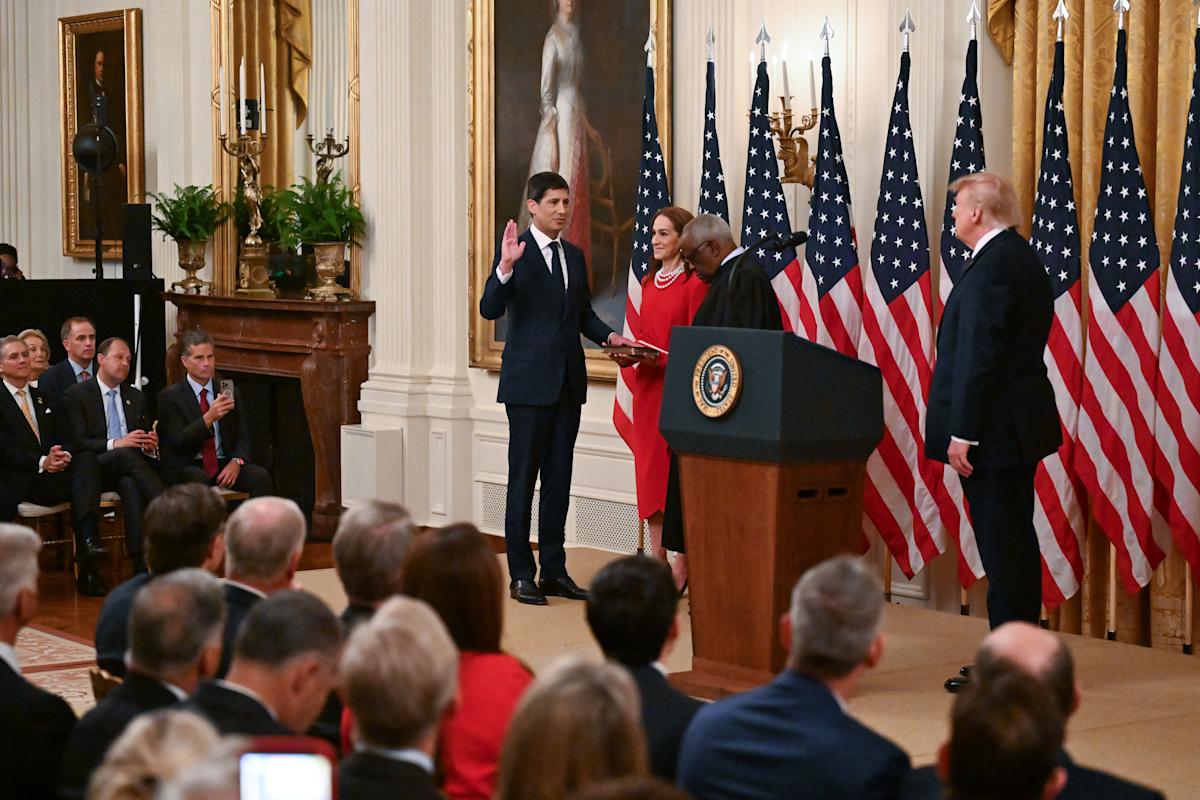
Kevin Warsh is officially the chairman of the Federal Reserve.
Supreme Court Justice Clarence Thomas swore in Warsh on Friday during a ceremony in the East Room. Not since Alan Greenspan in 1987 has a Fed Chair been sworn in at the White House.
Warsh mentioned Greenspan as he addressed the roomful of dignitaries, including several members of President Trump’s cabinet, House Speaker Mike Johnson, and even former Vice President Dan Quayle.
Greenspan, he said, “was the first to tell me and show me what this role demands.”
‘I intend to fill the role of chairman with energy and purpose,” Warsh said, adding that he will lead a “reform-oriented Fed Reserve,” foreshadowing foundational changes that may be ahead.
The US Senate confirmed Warsh as chairman on May 13 in a 54-45 vote, with one Democrat — John Fetterman of Pennsylvania — joining all Republicans to place Trump’s nominee atop the central bank after more than a year of unprecedented pressure from the White House for lower interest rates.
But economic conditions have shifted sharply since Trump nominated Warsh in January. The war in Iran has created an oil price shock that is rippling through the global economy and pushing inflation back up. The job market, meanwhile, shows signs of stabilizing — all of which undermines the case for rate cuts the president badly wants.
Trump addressed that looming issue in his remarks.
“I want Kevin to be totally independent,” Trump said, then turned directly to his nominee. “Don’t look at me, don’t look at anybody, just do your own thing and do a great job.”
Warsh will serve as chair for four years. He was earlier confirmed for a 14-year term as a governor. Jerome Powell, whose term as chair ended May 15 and was acting as chair pro tempore until Friday, has chosen to remain on the powerful Board of Governors.
Warsh takes over at a time when inflation has remained above the Fed’s 2% target for over five years and is being further pressured by tariffs and the surge in oil prices. Inflation data is providing fresh evidence of the task facing Warsh: Wholesale prices soared 6% in April, pushed up largely by higher energy prices.
That data follows consumer price data showing that inflation appears to be broadening as higher input costs from oil are being passed through to consumers.
“The April CPI release underlines the challenge facing Warsh … and the distance the inflation data needs to travel back in favor of disinflation before the FOMC could consider reducing rates further,” said Krishna Guha, head of economics and central banking strategy for Evercore ISI. “It also gives a little more ammo to the hawkish minority who think the next move is as likely to be up as down.”
Traders now see a 57% chance of at least one rate hike by December, according to CME FedWatch.
Kevin Warsh, nominee for chair of the Federal Reserve, testifies during his Senate Banking, Housing, and Urban Affairs Committee confirmation hearing on April 21, 2026. (Tom Williams/CQ-Roll Call, Inc via Getty Images)
Inflation looms large
Last year, before his nomination to lead the Fed, Warsh argued that advances in artificial intelligence would boost productivity, pushing down inflation and allowing the Fed to cut interest rates. He viewed tariffs as one-time drivers of price increases.
That was all before the Iran war.
During his confirmation hearing, Warsh said the US economy is still dealing with ripples from a pandemic-driven spike in inflation and that the Fed needs a different framework for assessing it.
The Fed’s preferred inflation gauge — the Personal Consumption Expenditures index — offers only a rough take, Warsh said, even when volatile food and energy prices are excluded. He favors “trimmed averages” of inflation that remove outlier data. Based on those measures, Warsh said at the time that the underlying trend was “somewhat improving” and looked “quite favorable.”
“Warsh seems less concerned about inflation persistence than many current Fed officials,” said Christian Floro, market strategist at Principal Asset Management. “His preference for trimmed mean and median inflation measures implies he sees underlying inflation pressures as materially cooler than headline data would suggest.”
That could be a tough argument to sell to the rest of the Fed committee right now.
The Consumer Price Index rose 3.8% in April, up from 3.3% in March. Energy prices accounted for 40% of the increase, while shelter and food also surged. Stripping out energy and food prices, inflation on a “core” basis clocked in at 2.8%, up from 2.6%. Services inflation excluding energy was up 3.3%, while goods prices, which have been pushed higher by tariffs, rose 1.1%.
More and more Fed officials are taking note.
Chicago Fed president Austan Goolsbee highlighted that prices for services — things like haircuts and lawnmowing — have remained sticky, and those prices typically aren’t influenced by higher oil prices or tariffs.
Boston Fed president Susan Collins said recently she thinks the Fed will need to maintain its “current, slightly restrictive monetary policy stance for some time.”
“More than five years of above-target inflation has reduced my patience for ‘looking through’ another supply shock,” Collins said.
Warsh said during his confirmation hearing that he wants “messier” interest rate-setting meetings, where a “good family fight” can lead to better economic decisions.
He’s likely to get it. And if he can’t convince the rest of the committee to cut rates, Warsh could also take heat from Trump.
“There will be no majority for renewed consideration of cuts until the Fed has been able to confirm tariff inflation is falling into the rear view mirror, oil is passing through with only moderate and expected one-time impacts on core inflation, core services (excluding) housing is finally starting to cool in a persistent manner, and AI spillovers are not changing the overall trajectory of disinflation,” said Guha, who also warned that that dynamic will threaten tension with Trump.
“The perception challenge for Warsh may prove just as important as the policy challenge,” Floro said. “Because the administration has been vocal about wanting lower rates, any dovish pivot risks intensifying scrutiny around Fed independence.”
Jennifer Schonberger covers the Federal Reserve, Congress, the White House, the Treasury, the SEC, the economy, cryptocurrencies, and the intersection of Washington policy with finance. Follow her on X @Jenniferisms and on Instagram.