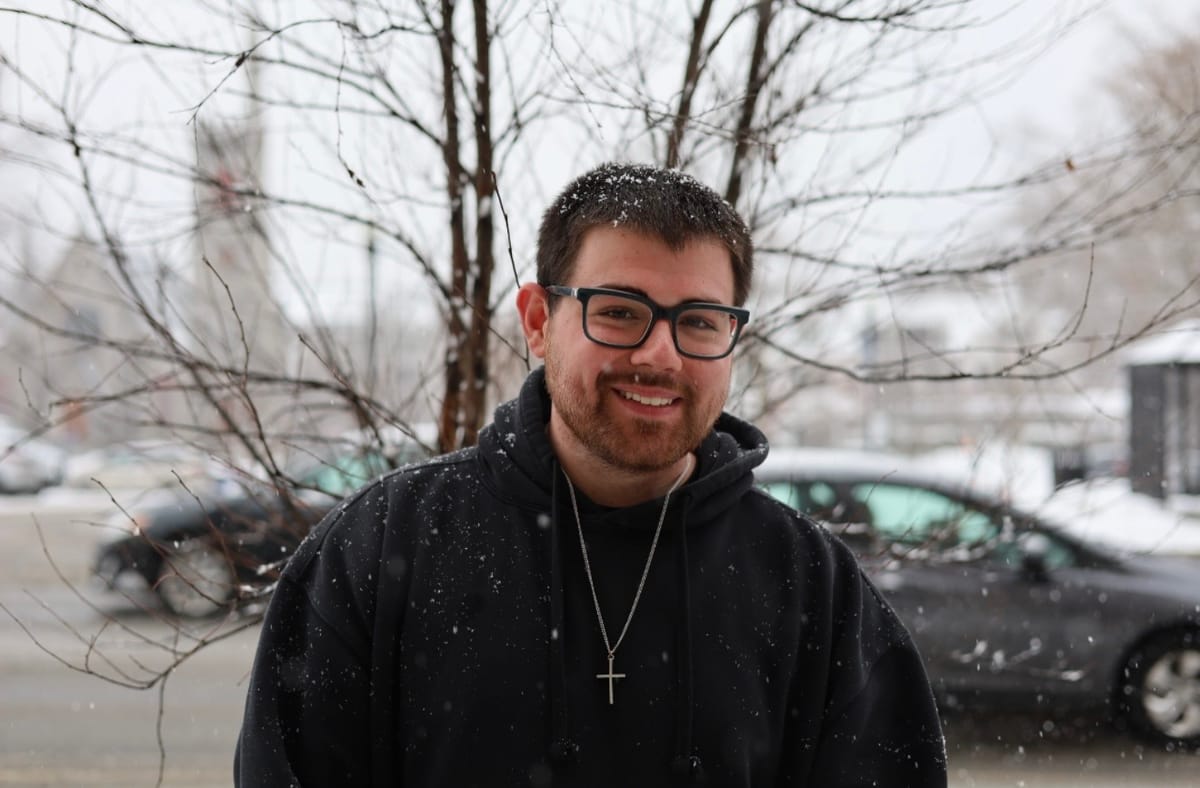
On Feb. 15, 2025, I was sitting in a booth in the back of Valentine Dining Hall (Val), eating dinner with a few friends. As we talked about my campaign and the Association of Amherst Students (AAS) election results, which were coming out the next day, a man in the booth next to us turned his head. He was tall, evident even when sitting, and wore sunglasses — an iconic part of his look. While I wasn’t entirely certain who this person was, he looked familiar and exuded a warm and welcoming aura. He asked if I was Joey Supik, and, after confirming my identity, he said something that has stuck with me ever since: “Congrats and welcome to AAS; you’ll like it here, I hope,” putting a finger up to his mouth to make sure I stayed quiet about it until the results were officially posted. That was my first chat with Shane Dillon ’26.
Getting to the Basics
I had not really known who Dillon was up to this point. Dillon, a known figure on campus, made an immediate impression on the Amherst community when he arrived on campus early in 2022 for the Summer Bridge Program. A three-week, invitation-only program for first-generation and/or low-income students, Summer Bridge was where Dillon met many of the people who would later convince him to run for AAS. “And I remember a moment during the first time I ran for Senate, as a first year, and I was like, ‘I’m not gonna do this.’ And it was all the Summer Bridge kids who sat me down in a room and were like, ‘you’re absolutely doing this. You wanted to do this the whole time.’ And so they really held me accountable.”
Dillon successfully ran for the student senate in his first year, earning the most votes in his class and sparking a rebirth of his student government career. When speaking about freshman year, Dillon barely mentioned his contributions to the senate, with the exception of a conflict between AAS and Student Affairs about the White-Out Rave poster. Dillon started by stating that it led to the first conversation between him and Angie Tissi-Gassoway, vice president for student affairs and dean of students. Dillon immediately backtracked on this, though, as he told me about the first meaningful meeting between the two — a conversation about the Brief Alcohol Screening and Intervention for College Students (BASICS) training, which is mandatory if a student is transported to the emergency room for alcohol-related reasons. Dillon was entirely against BASICS’s structure: “If someone’s getting [transported] because of alcohol, why are we having them go meet with this person to tell them that alcohol is bad? Why are they not going to the counseling center? Why are they not going to the health center?” After several conversations on the topic, Dillon and Tissi-Gassoway came to several compromises to change how that model operates.
This was how the close relationship between Dillon and Tissi-Gassoway began, which would later become crucial in restoring trust between the administration and the student body. Dillon understood that his role in supporting Tissi-Gassoway was “to discern that of the student culture, which the administration could not discern for themselves.” He also recognizes that the administration and student body don’t interact nearly enough to really know how policies will play out. “[Tissi-Gassoway] sets a vision for student affairs, which then gets trickled down through policy, and sometimes how it trickles down isn’t always in the way it was meant to,” Dillon explained. By building these relationships over the past four years, Dillon helped bridge the divide between administrators and students, which was especially important for a campus emerging from the repercussions of Covid. Dillon told me that he hopes that he has left the administration-student relationship in a better place than where he found it, and more importantly, that administrators “understand that we are students, consumers, data — yes — but at the end of the day, there’s an emotional side to the experience here that we don’t talk nearly enough about.”
Who’s Shane?
Dillon served as an AAS senator in his freshman and junior years, vice president in his sophomore year, and now president in his senior year. “I actually told myself when I was leaving high school that I was going to do something different in college, other than student government, and that was the biggest lie I could have told myself,” Dillon explained, laughing. Dillon rarely touched on these student government experiences when reflecting on his time here, but instead emphasized his introspection and deep thought. The first of these more profound conversations transpired in the first question: Who is Shane Dillon?
Dillon described himself as a “nervous, not-so-much-confident individual.” Dillon fit the stereotypical nerd, opting to read books rather than play sports at summer camp. While it was hard for him to come out of his shell, Dillon gradually became more confident over the years, at the very least in his ability to help people. Growing up with a single mom, two “much older” sisters, grandmother (nonnie), and aunts, Dillon’s family was “dominated by girl bosses,” all of whom are “his world” along with the rest of his family. Dillon described the family dynamic as a very “tight-knit” unit that leans on each other for everything. “My nonnie immigrated from Italy in the late 1940s — she was very poor when she came over,” Dillon said. “I grew up in a very, very modest family surrounded by other families in Springfield [Mass.] of the same socio-economic nature … the way I grew up, where I grew up, I got to see how vulnerable people and groups were taken advantage of or needed to find resources, and I wanted to be a person to fix that.”
The Campaign World
Through his internship with Springfield mayor Dominic J. Sarno and his work on a campaign for Richard Neal, his district representative, Dillon was introduced to the world of political organizing during high school. He continued his work on Zaida Govan’s campaign for the Springfield city council, as she messaged Dillon to ask if he could be the sole campaign manager. While Dillon initially thought it was crazy to ask a high schooler to serve as the campaign manager, he eventually came around and agreed to lead the campaign. “Being on the ground, knocking on doors, having the door slammed in your face, but also having meaningful conversations with people who enjoy that someone cares enough to knock on their door … was a really transformative time of my life,” Dillon said. “That was probably when I started to come out of my shell, since you’re doing all these really uncomfortable things, and to do that, you build relationships, you build confidence.” The entire experience also culminated in a winning campaign, capping off an already significant ordeal for Dillon.
After working on that campaign, Dillon took his talents to Massachusetts gubernatorial candidate Maura Healey’s team. In the summer of 2022, Dillon ran Healey’s social media campaign for Hamden County and worked the Democratic State Convention. Dillon’s time volunteering for Healey was also introspectively transformative. “Seeing Healey become the first openly [lesbian] nominee for a governorship (alongside Oregon’s governor Tina Kotek in the same year) and getting up there and being a complete badass — I was like, ‘okay, touché,’” Dillon said. The experience led to Dillon openly expressing his queer identity to his family and writing a letter to Healey about how she helped him feel comfortable doing so. “When I was here for Summer Bridge, I was in the shower in North Residence Hall, taking a cold shower because it’s 90 degrees [outside],” Dillon explained. “I have music playing on my phone, and all of a sudden, I see a Boston area code number pop up on my phone. I got out of the shower, standing in the bathroom wearing my robe. I call the number back, and I hear, ‘Hello, Shane? It’s Maura Healey.’ I thought, ‘No way, this has to be a prank.’” The two talked briefly about Dillon’s letter and have kept in touch ever since.” In 2024, Dillon was sworn in for Healey’s Youth Advisory Council, solidifying their relationship.
The Presidential Family
Moving on from the political campaigning, Dillon praised a few people in his life who had a tremendous impact on him, including his high school guidance counselor, Addison Stoddard. “[Stoddard] serve[d] as both [my] college coach and mentor,” Dillon said. The AAS president confessed that he didn’t even know what Amherst was when he applied; he simply trusted Stoddard when she put the college on his list. “When I got the acceptance email, I was like, ‘oh, cool.’ That’s when I really looked into the school and realized what a great opportunity it was.” For this year’s commencement, Stoddard is being honored as a Phebe and Zepheniah Swift Moore Teaching Award recipient, one of three instructors who made an exceptional impact on a member of that graduating class.
Dillon had several impactful experiences with faculty members here. “Sophomore year, I took a class with [Assistant Professor of English] Frank Leon Roberts in the Black studies and English departments,” Dillon stated. “It was a Baldwin seminar, and that class essentially helped me gain consciousness, if you want to put it that way.” Another person brought up quite a bit was Clarence Francis 1910 Professor in the Social Sciences Leah Schmalzbauer in the American studies, sociology, and anthropology departments. “She was my advisor when I was here for Summer Bridge, and she’s basically my professor mom,” Dillon affectionately noted.
Finally, Dillon talked about some of the peers who made his time at Amherst special. He started with his core senate members who stayed with him in AAS all four years: Hedley Lawrence-Apfelbaum ’26, Jaimie Han ’26, Chloe Yim ’26, Phuong Doan ’26, and Ayres Warren ’26. These five were “incredibly dedicated and passionate in trying to make Amherst a better place,” according to Dillon. After a couple of minutes praising them, Dillon moved on to his roommates: Isaiah Mitchell ’26 and Igaju Agba ’26. “I’m really thankful to be leaving here with lifelong brothers by chance and choice, having only sisters by blood,” Dillon stated. “They have been my rocks, my support systems, partners in shenanigans.”
A Good Time Here
Moving on from the important people in his life, Dillon walked me through the main struggles he faced each year, starting with freshman year. “I think my first year was really defined by coming out of my shell after some romance and heartbreak and losses,” Dillon said. “It was the first time I had been in the position of being in love with another boy, and had to look inward at myself and ask, ‘who are you?’” Dillon also mentioned learning about the community and what he wanted to see at Amherst. “Living in South [Residence Hall] was a pillar in even describing what being a first-year was like here,” Dillon said. “A lot of other people have the same story — the late-night talks, homework in the common room, making tea, sitting with friends, game nights — it’s something I’m really grateful for.” Dillon even connected it to the first college party he went to in Morris Pratt Hall during orientation. “I saw my orientation leader standing on a chair with a speaker over his head,” Dillon told me. “I thought, ‘this is cool, we’re going to have a good time here.’”
In his sophomore year, Dillon continued his pursuit of community while dealing with several losses. In the week that he lost his AAS presidential candidacy, Dillon was also rejected from practically every internship he applied to. Despite that, he was incredibly grateful for that year to be “adopted” by a group of seniors who lived in the same dorm as him: Lipton House. “I learned a lot from them; I spent almost every day in one of those green chairs, thinking … a lot,” Dillon said. One of these seniors, Naviya Kapadia ’25, frequently joined Dillon at the Lipton lawn chairs for much-needed thesis breaks. The interview itself took place in those green chairs outside of Lipton — almost like a window into Dillon’s sophomore state of mind.
Dillon’s junior year was when he began his self-reflection, which eventually saw a revival of his Christian faith. With Mitchell and Agba abroad, and stress at an all-time high with no internship success, Dillon thought a lot about his life and what exactly he was doing. One night, around 2 a.m., Dillon had what he described as both a panic attack and a vision from God, which reignited his faith journey. Another one of the “presidential family,” Arissa McGowan ’26, also encouraged Dillon to pick up his bible and seek guidance through his faith, which he inevitably did. “I was raised Catholic and only really went to church for my nonnie and mom because they brought me, although I never wanted to go,” Dillon admitted. “Being a people pleaser at a somewhat transactional school, learning where I fit in, being poor at a very rich school, and the culmination of loss all led me back to faith. Now I go to church and actually listen to what the priest has to say.”
Dillon had very little to say about senior year, aside from having fun living with his best friends in the Hastings Apartments, and opted to spend more time talking about issues like religion, the anonymous app Fizz, the athlete-non-athlete divide, and intellectual diversity. Besides that, Dillon admitted that he didn’t plan to run for office in the future. “The one big academic thing I learned here is that there’s a public and private world,” Dillon stated. “Being a politician, in the public world, you’re just one leaf on this big grapevine, and you have to sell your soul to so many private people and institutions.” Dillon hopes to be the person behind the scenes, though, helping campaigns succeed and pushing for political change through them.
Last Thoughts
Dillon started telling me about his regrets and offering advice for future Amherst students. The major regret from Dillon’s time at Amherst was not going abroad. “We’re nationally ranked in our abroad experience, and my two roommates had the time of their lives,” Dillon said. “I’ve never been out of the northeast, so I definitely regret not going abroad. The only reason I didn’t is because I ran for [AAS] president, thinking I was going to beat Gent [Malushaga ’25],” Dillon said as he laughed.
Here’s the main piece of advice Dillon offered: It’s not that deep. “Eat a snack and take a nap before you crash out,” Dillon said. “Unless your house is on fire or you are bleeding out, it is genuinely not that serious.” In a different, very humorous tangent, Dillon begged the student body to stay offline. “If there’s anything I’m really worried about, it’s how chronically online we all are, how dependent on the online world and online relationships we are,” Dillon said. “We’re really losing out on that face-to-face human interaction because we exist on our phones 24/7.”
Dillon’s closing remarks focused on his post-graduate plans and his appreciation for Amherst as a whole. “I have done everything from applying to big oil companies to trying to be an au pair nanny for a family in France,” Dillon half-jokingly said. “I’m open to any door, anywhere, wherever it wants to take me. I know that God has my back.” Dillon then addressed the Amherst experience as a whole in a fairly positive light: “There are a lot of critiques I have for Amherst … but I also want this institution and the students to embrace the not-so-good things. You can’t do anything unless you start talking about it, so be more comfortable being uncomfortable. Some of the ideals we preach here aren’t implemented, but the tools to do so are in our power, and I’m grateful for that.”
Dillon then left one last message, again, half-joking: “Hey, Michael Elliott. Let me know when you’re ready to retire. I would definitely come back.”