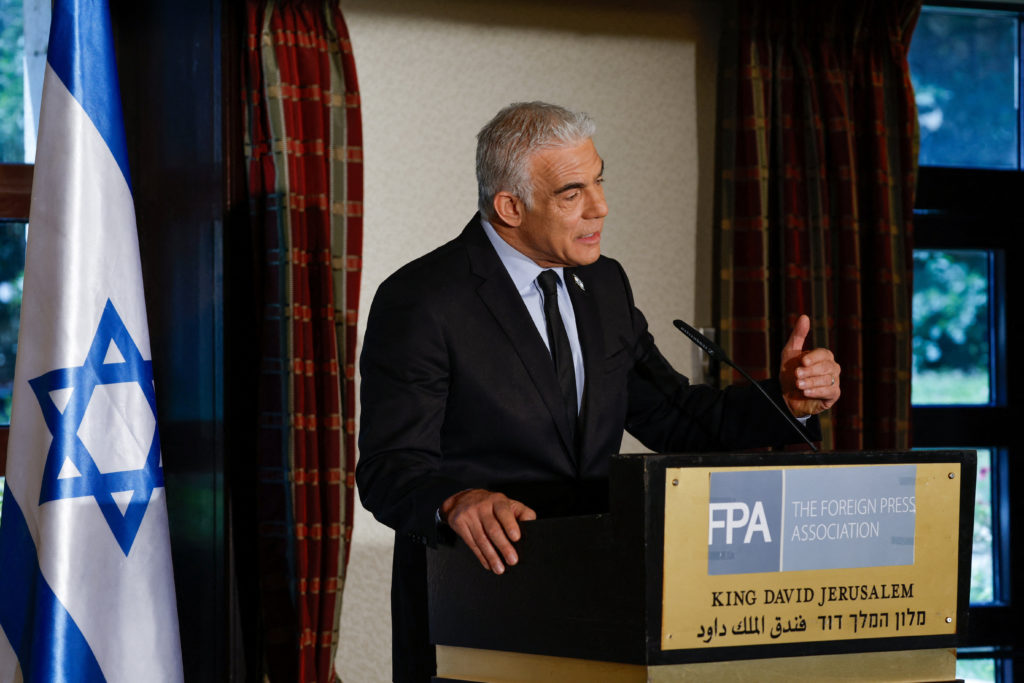
JERUSALEM (AP) — The deal being discussed between the U.S. and Iran fails to achieve any of Israel’s goals for the war, Israel’s opposition leader Yair Lapid said on Monday, as he accused Prime Minister Benjamin Netanyahu of failing to influence a better agreement.
Lapid, who is part of an alliance attempting to unseat Netanyahu in elections this year, said details of the emerging deal are “disturbing.”
“The deal is bad for Israel, bad for the region, bad for the citizens of Iran,” Lapid told reporters in Jerusalem.
Israel and the U.S. launched the war on Feb. 28 vowing to destroy Iran’s ballistic missile program, end its support for proxy militant groups across the region and end Iran’s ability to pursue a nuclear bomb. Both Netanyahu and U.S. President Donald Trump also said they hoped to create conditions to topple Iran’s government.
READ MORE: What we know and don’t know about the emerging deal to end the Iran war
According to regional officials, under the current deal being discussed Iran would give up its stockpile of highly enriched uranium and reopen the strategic Strait of Hormuz in exchange for ending a U.S. blockade of Iranian ports and the lifting of sanctions against Iran. Key details on Iran’s nuclear program would then be negotiated during a 60-day period. It is unclear if the deal will address Iran’s missiles or support for regional militant groups.
Lapid expressed gratitude to Trump for launching the war with Israel, but criticized Netanyahu for allowing Washington to negotiate a potential deal with little coordination with Israel.
READ MORE: Trump says Iran deal should include additional countries joining Abraham Accords
“The Israeli government is at an all-time low in its ability to influence decisions in Washington,” he said, noting that Trump said last week: “Netanyahu will do whatever I want him to do.”
Netanyahu has repeatedly stressed to Trump that Israel maintains “freedom of action” against threats in any arena, according to an official familiar with Israel prime minister’s conversations with Trump, who spoke on the condition of anonymity because they were not authorized to speak to the media.
“Israel is a sovereign state, we are not a vassal state and we are not a protectorate,” Lapid said.
READ MORE: Trump’s emerging plan to end Iran war draws criticism from hard-line Republicans
Lapid, head of the centrist “Yesh Atid” party, briefly served as prime minister in 2022 under a rotation agreement with Naftali Bennett, leader of a small conservative party. Their coalition government ended 12 years of Netanyahu’s rule.
They have once again merged their parties into a single faction headed by Bennett as they attempt to unseat Netanyahu in elections that will be held by the end of October.
Lapid has served as Israel’s opposition leader since Netanyahu returned to power in late 2022, while Bennett took a break from politics. Their alliance is aimed at uniting a fragmented opposition with a shared hostility toward Netanyahu.
Lapid, one of a shrinking number of Israeli politicians who supports the idea of Palestinian independence, said the issue would not be on the next government’s agenda. He said the conditions are not right following the trauma of the Hamas attacks on Oct. 7, 2023, and wars that have followed.
“There will be no two-state solution in the coming years, because Israelis now understand this will become just another failing terrorist state on our borders,” said Lapid, adding that the Palestinian Authority does not have the ability to effectively prevent attacks against Israel.
But Lapid said he would oppose unilateral steps that would make a future Palestinian state impossible and had received assurances from Bennett, a former West Bank settlement leader, that Israel will not move toward annexing the occupied territory.
Lapid also ruled out cooperation with Arab parties to build a coalition to unseat Netanyahu.
Opinion polls indicate that Bennett and Lapid might not be able to form a governing majority coalition without the support of some Arab lawmakers, as they did in their previous government. They broke a longstanding taboo in 2021 when they invited Mansour Abbas, leader of a small Arab faction, into Israel’s governing coalition for the first and only time in Israel’s history.
Lapid said his previous cooperation with Abbas was “the right government for the moment,” but that Israel is in a very different place after nearly three years of wars and that he and Bennett will not build a coalition with Abbas’ party in the next elections.