Palestinians have gone through another electoral exercise that was not, in any democratic sense, an election.
They have not chosen a president since 2005, nor held parliamentary elections since 2006, when the terrorist organization Hamas won at the polls and, the following year, threw Fatah out of Gaza in a violent rupture that has defined Palestinian politics ever since.
Local elections were held in the West Bank and, symbolically, in Deir al-Balah in Gaza. In addition, Fatah’s Eighth Congress in Ramallah elected a new Central Committee and Revolutionary Council.
The municipal votes offered only a limited indication of public sentiment. The Fatah congress revealed something deeper: where power still lies, how it is shifting, and why the post-Abbas transition remains uncertain.
Fatah, PLO, and the embattled PA
Fatah is the dominant Palestinian nationalist movement, historically associated with Yasser Arafat. The PLO is the umbrella organization recognized as the Palestinians’ political representative, with Fatah as its central force. The Palestinian Authority was established under Oslo to administer limited self-rule. In practice, Fatah controls the PA in the West Bank, while Hamas has ruled Gaza since its 2007 coup.
That made the Fatah congress the real contest. Turnout reached 94.64%, with congress members voting in Ramallah, Gaza, Lebanon and Cairo. In practice it was an internal redistribution of power inside Fatah.
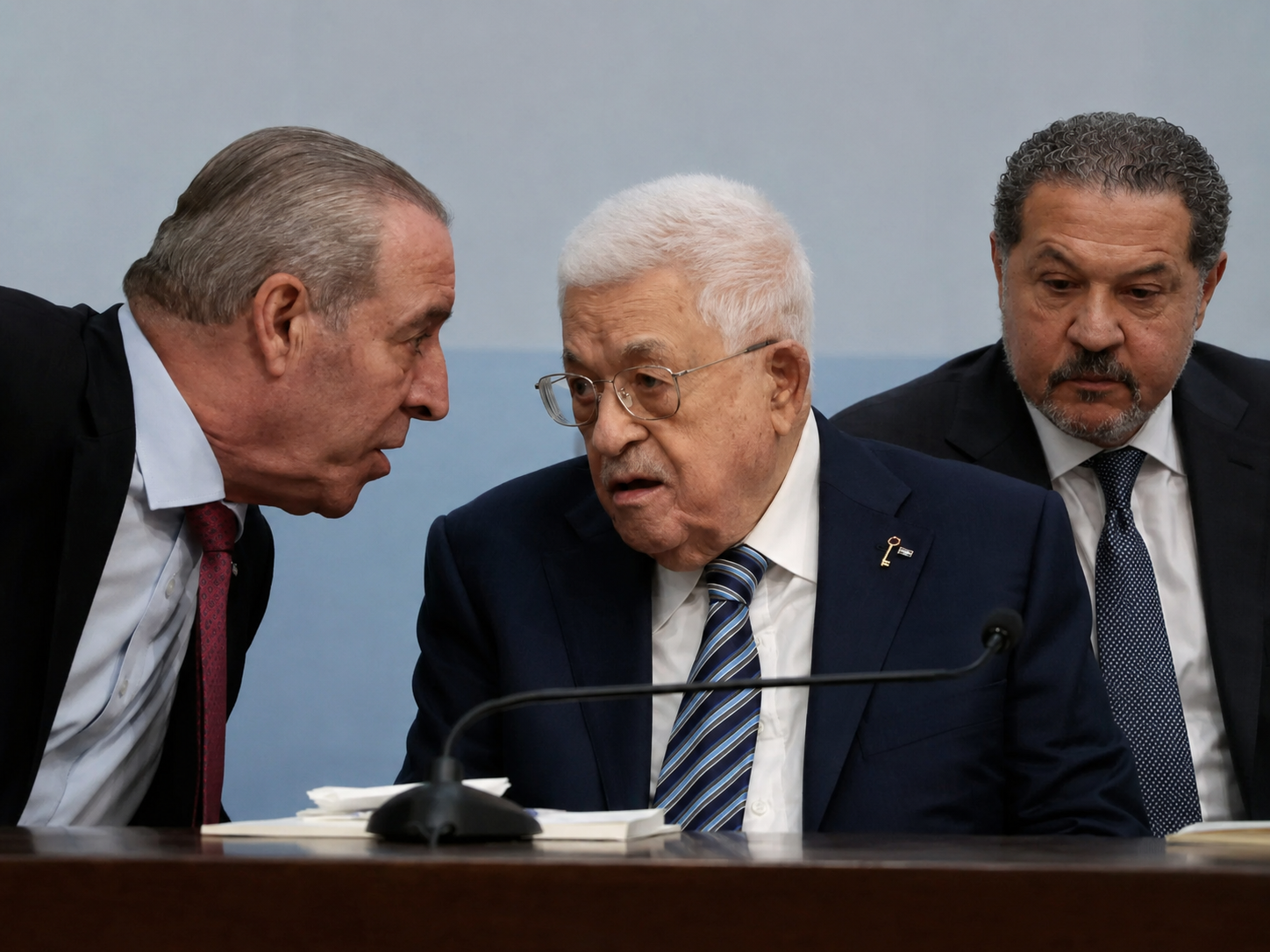
The results revealed three major things. Mahmoud Abbas, at 90, remains formally in control. He was re-elected Fatah chairman and still commands the machinery. But his preferred successor, Hussein al-Sheik, emerged weaker than Abbas had hoped. The figure who captured the political imagination was Marwan Barghouti, the imprisoned Fatah leader convicted in Israel of terrorist attacks.
Killer “Mandela”
Barghouti finished first in the Central Committee vote with 1,877 votes. His victory from prison was the congress’s clearest message: within Fatah, legitimacy does not automatically flow from Abbas’s endorsement. Barghouti still symbolizes another Fatah, more populist, more rooted in the street, and less controlled by Ramallah’s etablissement.
In recent years pro-Palestinian advocates in the West have marketed him as “the Mandela of Palestine.” The comparison is grotesque. Barghouti was convicted in 2004 of five murders and other crimes, including the cold-blooded murder of Greek Orthodox monk Father Germanos, born Georgios Tsibouktzakis.
The myth, however, gives Palestinians a jailed national hero, Western activists a prisoner of conscience, and Fatah an aura of resistance without reform or real elections. Barghouti remains a convicted terrorist whose appeal says something very uncomfortable about Palestinian politics.
The presidential camp’s major figures are Al-Sheik, Faraj and now Yasser Abbas, the president’s son. Al-Sheik is the institutional heir apparent; Faraj is the intelligence chief with strong channels to Israel and the U.S. Both are useful abroad because they are known and easier to coordinate with. Yet if anyone needed a reminder of why Fatah lost credibility, Yasser Abbas provides it.
Wealth Feeding on Misery
Abbas Jr. is a multimillionaire businessman with interests in tobacco, contracting, electromechanical projects, communications, investments, and real estate. His rise symbolizes the nepotism that has hollowed out Fatah’s authority. In the West Bank, where per-capita GDP is roughly $2,500 a year, much of the public lives under strain while Fatah insiders drive expensive SUVs, live in villas, and treat public authority as private inheritance.
Until recently, Yasser Abbas stood outside Fatah’s hierarchy. He now sits on the Central Committee, fueling speculation that Mahmoud Abbas may be positioning him for the post-Abbas order. The Palestinian economy depends heavily on foreign assistance, which the World Bank calls an “indispensable lifeline” and the “dominant source of funding” for it.
Another dispute concerns Israel’s refusal to transfer tax revenues it collects under Oslo, while the PA continues to subsidize terrorists and their families. Ramallah calls it collective punishment. Israel says the payments are an incentive for murder, using the term pay-for-slay. The longer the sentence, the higher the payment — meaning that the system effectively places a premium on the number of Israelis a terrorist murdered.
The issue is whether the PA can present itself as reformed while, in effect, rewarding those who kill Israelis. Abbas announced welfare restructuring, but alternative mechanisms appeared to preserve the system, and the U.S. saw no real reform.
Οne should also not forget the old West Bank machinery: Rajoub, Tirawi, local networks, security figures, clan structures and inherited balances of power. It is strong enough to obstruct Al-Sheik.
Then there’s the absent and excluded form another faction: Mohammed Dahlan’s camp, the exiles, Abbas’s old rivals, and figures who might seek backing from Cairo, Abu Dhabi, or other Arab capitals.
Abbas manages power struggles by narrowing the field, controlling the rules, and keeping challengers outside. The result is a brittle system: disciplined at the top, distrusted below, dependent on foreign money and Israeli security coordination, and lacking a genuine ballot.
Fatah’s problem is that Hamas is weakened, not gone. The terrorist organization remains outside the PLO, but not outside Palestinian politics. In Deir al-Balah, candidates considered affiliated with Hamas won two of 15 seats, while the Fatah-backed list won six. Turnout was only 23%, so the result should not be overstated.
Still, it showed Hamas cannot easily present itself as Gaza’s uncontested political voice after the October 7 massacre and the war it unleashed. It also suggested that some Gazans care more about water, electricity, administration, and survival than Hamas’s ruinous cries.
Al-Sheik’s weakness is that he is more acceptable abroad than at home: “responsible” in diplomatic language, “compromised” in Palestinian street politics. To many Palestinians, he embodies the exhausted, corrupt, and authoritarian Ramallah establishment.
The conclusion is bleak. Fatah projects controlled renewal. The PA wants to return as Gaza’s governing authority, but lacks legitimacy. Hamas is battered but not dead, and has not collapsed politically in the West Bank. Abbas is arranging an Al-Sheik succession, but Barghouti, Faraj, Rajoub, and the security networks remain strong.
For Israel, the congress changes little immediately but complicates things. It needs a West Bank mechanism for order and security coordination, and Al-Sheik and Faraj signal continuity.
Another open front is the issue of Jewish settlements. Israel has accelerated expansion and legalization in the West Bank — Judea and Samaria, as Jerusalem refers to the area by its historical name, for obvious reasons— including E1, which the extreme-right Finance Minister Bezalel Smotrich said “buries” a Palestinian state.
Abbas still controls the game, but the game is shrinking. His chosen heir is weak, his party is divided, his public is unconvinced, his rivals are waiting, and the most popular Fatah figure is a convicted terrorist and murderer serving five life sentences plus forty years in an Israeli prison.